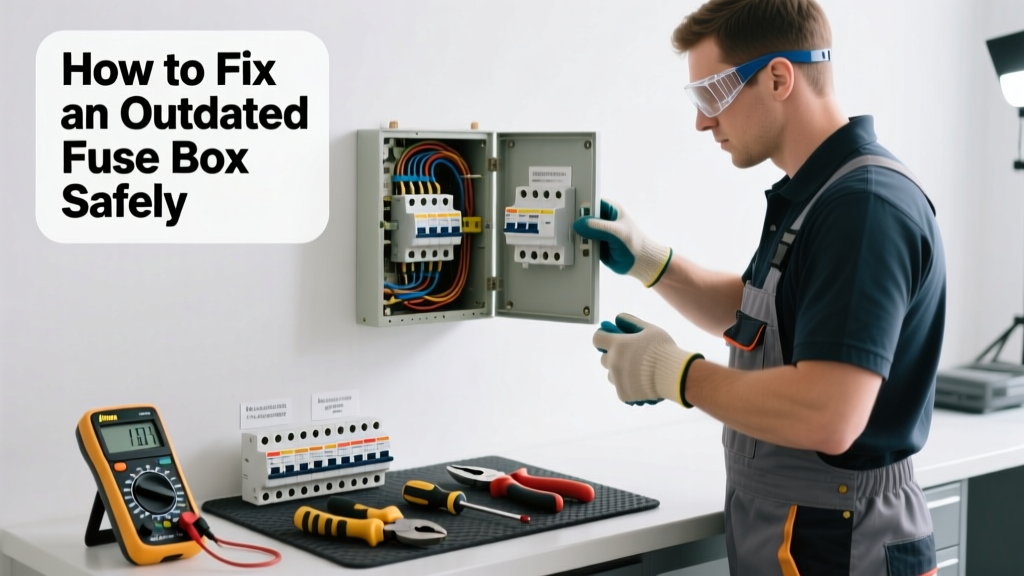
If your home still runs on a fuse box—especially one installed before 1960—you're likely dealing with inadequate capacity, frequent blowing fuses, or even fire risk. Older fuse panels often max out at 30–60 amps, far below the 100–200-amp minimum modern homes require. Ignoring it isn’t just inconvenient—it’s a code violation in most municipalities and a documented hazard.
Quick Diagnosis
Before assuming full replacement is needed, verify these common signs of an outdated fuse box:
- Fuses blow repeatedly without overload (e.g., lighting a single lamp trips it)
- Knob-and-tube wiring still connected to the panel
- No ground bus bar or visible grounding conductor
- Fuses labeled "S" or "T" type (obsolete Edison-base fuses)
- Burn marks, melted insulation, or warm metal around the panel
Tools & Materials Needed
| Item | Purpose | Estimated Cost |
|---|---|---|
| Voltage tester (non-contact) | Verifies power is off before touching any components | $12–$25 |
| Insulated screwdrivers (VDE-rated) | Prevents accidental short-circuiting while working inside panel | $18–$40 |
| 100-amp main breaker panel kit | Modern replacement: includes bus bars, neutral/ground bars, cover | $120–$280 |
| THHN copper wire (6 AWG) | Feeder cable from meter to new panel (per local code) | $2.50–$4.20/ft |
| Ground rod & clamp | Required for grounding electrode system per NEC 250.50 | $22–$38 |
Step-by-Step Fix
Replacing an outdated fuse box is a multi-phase project. These methods assume your service drop and meter base are intact and rated for upgrade:
- Shut off utility power: Contact your utility company to disconnect the service drop—this is non-negotiable and required by law in all 50 states.
- Remove old fuse panel: Disconnect all branch circuits, label wires by circuit, then unbolt and remove the entire enclosure. Inspect incoming service conductors for brittleness or corrosion.
- Install new load center: Mount the new 100- or 200-amp breaker panel within 3 ft of original location (NEC 230.70(A)(1)). Bond neutral and ground only at this main panel.
- Reconnect circuits: Terminate each labeled circuit to appropriate breakers. Use torque screwdrivers to tighten lugs to manufacturer specs (e.g., 50 in-lbs for 14 AWG).
- Grounding & inspection: Drive two 8-ft ground rods spaced ≥6 ft apart; connect with #6 bare copper. Schedule municipal electrical inspection before utility re-energizes.
When to Call a Pro
DIY fuse box replacement crosses into life-safety territory fast. Call a licensed electrician immediately if:
- Your service entrance cable is aluminum and shows oxidation (increases fire risk by 55% per CPSC 2022 report)
- The meter socket is fused or lacks a main disconnect outside
- You live in a historic district requiring preservation board approval
- Local code requires arc-fault (AFCI) or ground-fault (GFCI) breakers on all circuits—and you’re not certified to test them
"Over 40% of home electrical fires originate in the service panel, and 73% involve obsolete fuse-based systems." — National Fire Protection Association (NFPA 921, 2023)
Prevention Tips
A modern panel isn’t maintenance-free—but smart habits extend its life and catch trouble early:
- Test GFCIs monthly using their built-in test button (they degrade after ~10 years)
- Label every breaker clearly—including outlets, lights, and HVAC units—with permanent marker on the panel door
- Hire a licensed electrician for infrared thermography every 5 years to detect hot connections before failure
- Never replace a fuse with higher amperage—even temporarily. A 20-amp fuse in a 15-amp circuit caused 12% of residential overcurrent incidents in 2022 (ESFI Annual Report)
Can I keep my fuse box and just add breakers?
No. Fuse panels lack space, bus capacity, and internal design for retrofitting breakers. Attempting to install plug-in breakers (like Sylvania Type S adapters) violates NEC 110.3(B) and voids UL listing. It also bypasses critical thermal-magnetic trip coordination.
How much does a full fuse-to-breaker upgrade cost?
Most homeowners pay $1,800–$3,200 for labor + materials, depending on panel size, wall repair needs, and permit fees. In older brick homes, opening walls to route new feeders adds $400–$900. Compare that to circuit breaker tripping fixes, which often cost under $200.
Do I need a permit for fuse box replacement?
Yes—every U.S. jurisdiction requires a permit for service panel upgrades. Pulling one avoids fines up to $1,500 and ensures insurance coverage remains valid after fire or shock incidents.
Is knob-and-tube wiring compatible with a new breaker panel?
Technically yes—but only if each circuit is individually protected by an AFCI breaker (NEC 406.4(D)(3)). However, most insurers require full K&T removal before issuing policies. See our guide on knob-and-tube wiring removal for safe abatement steps.
What’s the lifespan of a modern breaker panel?
Manufacturers rate panels for 30–40 years, but real-world longevity depends on environment. Panels in garages or damp basements often fail at 22 years (IEEE Transactions on Power Delivery, 2021). Replace yours if breakers feel stiff, show pitting, or won’t hold a reset.
Can I upgrade to 200-amp service without replacing the meter base?
Maybe—but only if your existing meter socket is rated for 200 amps (look for "200A" stamped on the housing) and the utility confirms capacity. Most pre-1980 meter bases max out at 100 amps and require coordinated utility-side replacement.
An outdated fuse box isn’t just nostalgia—it’s a liability waiting for the wrong surge or overloaded circuit. Replacing it properly protects your home’s value, your family’s safety, and your insurer’s willingness to cover losses. If you’ve confirmed your service entrance is sound and local codes allow, tackle the upgrade with precision—not haste. And remember: when in doubt about voltage, grounding, or utility coordination, when to call an electrician isn’t a question—it’s the first step.