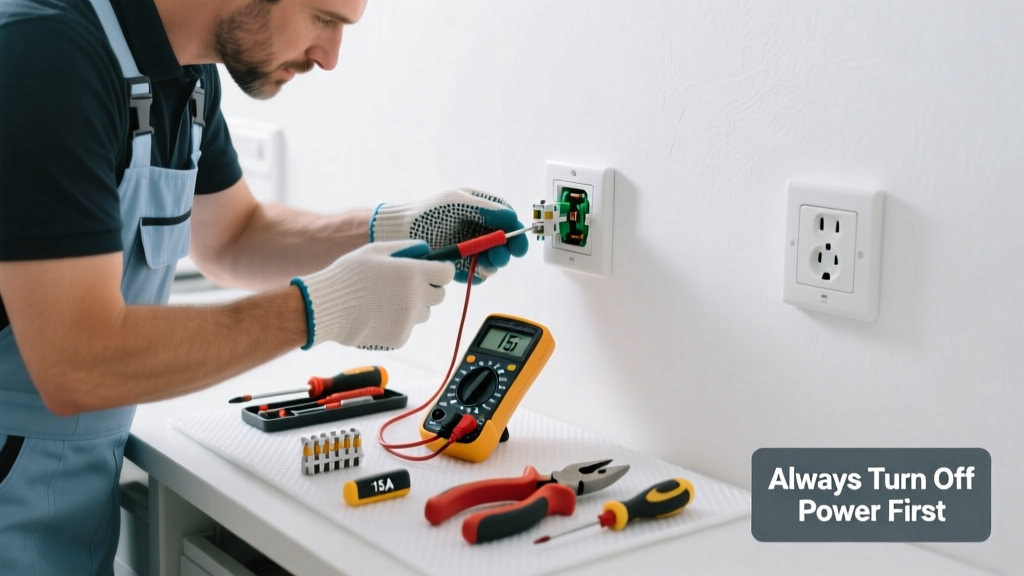
If your toaster won’t heat, your garbage disposal hums but won’t spin, or your microwave powers on but won’t cook—chances are you’re dealing with a blown internal fuse. Unlike circuit breakers, appliance fuses are small, often hidden, and designed to sacrifice themselves before wiring overheats. Most can be replaced in under 20 minutes—if you know where to look and what’s safe to touch.
Quick Diagnosis
Before grabbing tools, rule out simple causes:
- Check if the outlet is live using a working lamp or voltage tester
- Verify the appliance’s power cord isn’t frayed, pinched, or damaged near the plug
- Look for scorch marks, burnt plastic smell, or discolored panels near control boards
- Confirm the appliance hasn’t been overloaded—e.g., running a high-wattage blender on a shared kitchen circuit
Tools & Materials Needed
| Item | Purpose | Estimated Cost |
|---|---|---|
| Digital multimeter | Tests continuity of fuse and verifies no live voltage at terminals | $15–$40 |
| Insulated Phillips & flathead screwdrivers | Safely open appliance housings without slipping or shorting components | $8–$22 |
| Replacement ceramic cartridge fuse (same voltage/amperage) | Exact match required—never substitute with higher-rated fuse | $2–$6 |
| Non-contact voltage tester | Confirms power is fully disconnected before opening casing | $10–$25 |
Step-by-Step Fix
- Unplug the appliance and wait 5 minutes—capacitors in microwaves and dryers can hold lethal charge even after unplugging.
- Locate the fuse: In most countertop appliances, it’s behind the rear access panel; in microwaves, it’s often near the magnetron or on the control board; in older dishwashers, check the junction box behind the toe kick.
- Test the fuse with your multimeter set to continuity: place probes on both metal ends. No beep = blown. A reading of “OL” or infinite resistance confirms failure.
- Remove the old fuse using needle-nose pliers if it’s soldered, or gently twist a cartridge fuse from its holder. Note orientation—some have polarity-sensitive clips.
- Install the replacement, ensuring snug contact and correct amperage rating (e.g., a 10A fuse for a coffee maker—not 15A). Reassemble housing and test with a known-good outlet.
When to Call a Pro
Stop immediately and call a licensed electrician or certified appliance technician if:
- You measure voltage across the fuse terminals while unplugged—indicates internal short or capacitor failure
- The fuse blows again within 30 seconds of powering on, suggesting motor winding failure or control board damage
- You’re working on a built-in oven, induction cooktop, or any hardwired appliance (no plug)—these require lockout/tagout procedures per NEC Article 422
- The appliance is under manufacturer warranty—DIY repair may void coverage, especially for sealed components like compressor relays
Prevention Tips
Fuses blow for a reason—and repeated failures point to underlying issues. Extend appliance life by:
- Using dedicated 20-amp circuits for high-draw devices like microwaves and garbage disposals (per NEC 210.23(A)(1))
- Cleaning lint traps and vent ducts every 3 months—restricted airflow causes compressor and motor overheating
- Avoiding daisy-chaining power strips, especially for space heaters or air fryers drawing over 1,200W
- Replacing aging extension cords—those with cracked insulation increase fault current risk
Can I replace a 10A fuse with a 15A fuse to prevent future blowouts?
No. Doing so removes critical overcurrent protection. According to the National Fire Protection Association’s Electrical Safety Foundation International 2022 report, 42% of home electrical fires involve improper fuse substitution or breaker bypassing.
Is it safe to test a fuse while the appliance is plugged in?
Never. Even with the appliance ‘off,’ line voltage may be present at fuse terminals. The U.S. Consumer Product Safety Commission recorded 1,200+ shock incidents in 2023 linked to live-circuit testing of internal components.
Why does my appliance’s fuse keep blowing after replacement?
Recurring fuse failure signals deeper trouble—often a shorted heating element (in toasters or kettles), grounded motor windings (in blenders), or failing rectifier diode (in microwave high-voltage circuits). These require component-level diagnosis beyond basic fuse replacement.
Do all appliances have user-replaceable fuses?
No. Many modern units—especially smart dishwashers and inverter-driven refrigerators—use non-serviceable thermal cutoffs or embedded electronic fuses. If you don’t see a standard 5×20mm or 6.3×32mm ceramic fuse, consult the service manual or contact the manufacturer.
What’s the difference between a slow-blow and fast-blow fuse in appliances?
Slow-blow fuses tolerate brief inrush currents (like those from compressor startup) without opening. Fast-blow fuses respond instantly to overloads—common in electronics-heavy appliances like microwaves. Using the wrong type leads to nuisance blowing or fire risk. Always match the original’s time-delay rating marked on its body.
Can I use a multimeter to test other parts after replacing the fuse?
Yes—but only after confirming zero voltage at all terminals. Test motor windings for continuity (should read 1–30Ω depending on size), heating elements (typically 10–50Ω), and thermostats (should show continuity when cold).
"If your multimeter reads less than 0.5Ω across a heating element, suspect an internal short—even if the fuse holds." — Appliance Repair Technician Certification Guide, ASE 2023 Edition
Replacing a blown fuse is one of the most straightforward appliance repairs—if you respect the risks and verify compatibility. But remember: electricity doesn’t forgive assumptions. When in doubt, unplug it, label it, and hand it off to someone with the right training and tools. For more on related issues, see our guides on microwave not heating and garbage disposal humming but not spinning.