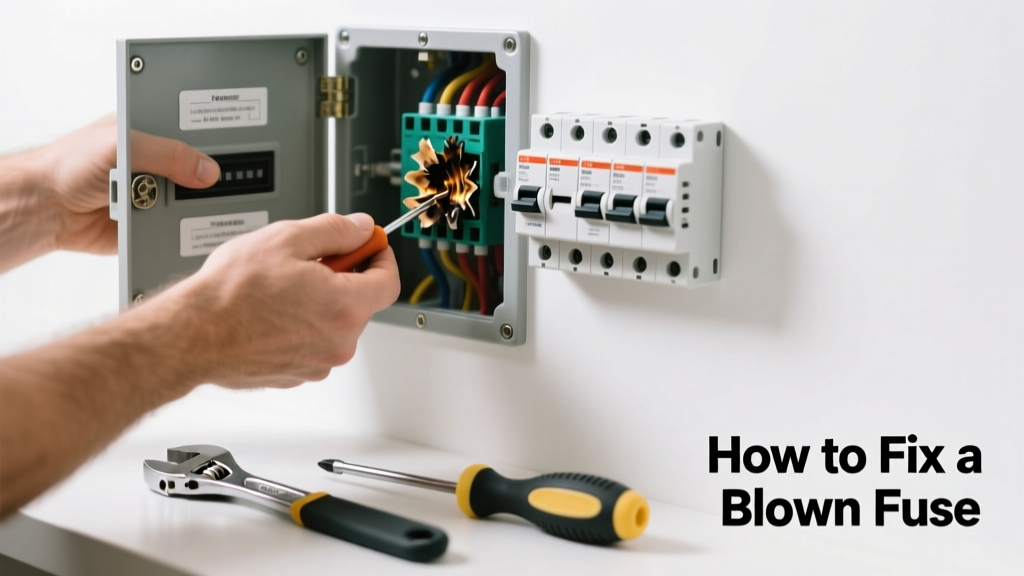
A sudden loss of power in one room—or your entire house—can be alarming, but a blown fuse is often the quiet culprit behind the silence. Unlike circuit breakers, fuses don’t reset; they sacrifice themselves to stop dangerous overloads. Knowing how to diagnose and replace one correctly keeps your home safe and avoids unnecessary electrician calls.
Quick Diagnosis
Before grabbing tools, confirm it’s truly a blown fuse—not a tripped breaker or wiring issue. Look for these telltale signs:
- Darkened, cloudy, or shattered glass on a screw-in or cartridge fuse
- A visible broken or melted metal strip inside the fuse body
- Power loss isolated to outlets, lights, or appliances on one circuit only
- Burning smell near the fuse box (stop immediately—do not proceed)
- Fuse feels warm to the touch (indicates overload or poor connection)
Tools & Materials Needed
| Item | Purpose | Estimated Cost |
|---|---|---|
| Non-contact voltage tester | Verifies power is OFF before handling fuses—critical safety step | $15–$30 |
| Insulated screwdriver (Phillips or flathead) | Removes fuse panel cover and loosens fuse holders | $8–$12 |
| Replacement fuse (same amperage & type) | Must match original rating exactly—never substitute higher amperage | $2–$6 per fuse |
| Work gloves (rubber-insulated) | Protects against accidental contact with live parts | $10–$20 |
| Flashlight (LED, battery-powered) | Provides safe illumination inside dark fuse boxes | $5–$15 |
Step-by-Step Fix
Follow these steps in order—skipping any increases risk of shock or fire:
- Turn off main power: Locate your home’s main disconnect switch (usually at the top of the fuse box) and flip it OFF. Confirm with your non-contact tester that no voltage reads at the fuse terminals.
- Remove the old fuse: Using insulated gloves, unscrew or pull out the suspect fuse. Hold it up to light—look for discoloration, bubbling, or a broken filament. If uncertain, compare it to an identical working fuse nearby.
- Match specifications exactly: Check the amperage (e.g., 15A), voltage rating (e.g., 125V), and type (Edison-base, Type S, cartridge). Using a 20A fuse in a 15A circuit is a leading cause of overheated wiring—according to the National Fire Protection Association’s 2023 Electrical Safety Report, 42% of residential fuse-related fires stem from incorrect replacements.
- Install the new fuse: Screw in firmly (but don’t overtighten) or insert cartridge into its holder until fully seated. Replace the panel cover and restore main power.
- Test gradually: Turn on lights and plug in one low-wattage device at a time. If the fuse blows again immediately, stop—there’s likely a short or ground fault requiring investigation.
When to Call a Pro
Some situations demand licensed expertise—not just caution. Call an electrician if:
- The same fuse blows repeatedly within 24 hours
- You smell burning plastic or see scorch marks on the fuse box or wiring
- Multiple circuits are affected simultaneously
- Your home still uses outdated knob-and-tube wiring (common in pre-1950 homes)
- You’re unsure whether your system uses fuses or breakers—or if it’s a mix of both
"Never replace a fuse with anything other than its exact-rated counterpart—even a penny or foil strip can bypass critical protection and ignite wall cavities." — NFPA 70E Standard for Electrical Safety in the Workplace, 2023 Edition
Prevention Tips
Blown fuses rarely happen without warning. Reduce recurrence by:
- Unplugging space heaters, microwaves, and hair dryers when not in use—they draw high surge loads
- Avoiding daisy-chained power strips on the same circuit
- Labeling each fuse clearly at the panel (e.g., "Kitchen Outlets," "Master Bedroom Lights")
- Scheduling a whole-panel inspection every 10 years—especially if your home is over 40 years old
- Upgrading to modern circuit breakers if your fuse box is corroded, cracked, or lacks proper grounding
Can I replace a 15-amp fuse with a 20-amp fuse?
No—this is extremely dangerous. A 20A fuse allows more current than the circuit’s wiring is rated to handle, creating a fire hazard. Always match the amperage stamped on the old fuse. For context, standard 14-gauge NM-B wiring is rated for 15A maximum; using a higher-rated fuse violates NEC Article 240.4(D).
Why does my fuse keep blowing after I replace it?
Repeated blowing signals an underlying problem: a short circuit (exposed wires touching), ground fault (hot wire contacting grounded metal), or sustained overload (too many devices drawing power). It could also indicate failing insulation, loose connections in outlets or switches, or a defective appliance. Use a multimeter to test continuity and consult our guide on how to test an outlet first.
Are fuse boxes illegal or unsafe today?
Fuse boxes aren’t illegal, but many insurers require upgrades if the panel is over 50 years old or lacks sufficient capacity (e.g., under 60A service). The U.S. Consumer Product Safety Commission notes that homes with fuse panels built before 1965 have a 2.3x higher risk of electrical fire than those with modern breaker panels.
What’s the difference between a Type S fuse and a standard Edison-base fuse?
Type S fuses have an adapter base that prevents insertion of higher-amperage fuses—a critical safety upgrade for older panels. They’re required in many jurisdictions for new installations or retrofits. Standard Edison-base fuses (like those in vintage homes) accept any size, making them prone to dangerous over-fusing.
Can I use a circuit breaker as a replacement for a fuse?
No—you cannot directly swap fuses for breakers without rewiring and panel modification. However, licensed electricians can perform a full fuse box to breaker panel upgrade, which improves safety, adds GFCI/AFCI protection, and supports modern power demands like EV chargers and HVAC systems.
How do I know if my fuse is ceramic or glass?
Glass fuses have transparent or translucent bodies showing the internal wire; ceramic fuses are opaque white or gray cylinders, often used in higher-voltage or industrial applications. Most residential screw-in fuses are glass. Ceramic types typically appear in older service entrances or subpanels—and require special handling due to heat retention.
A blown fuse isn’t just an inconvenience—it’s your home’s first line of defense speaking up. Treat it with respect, not haste. When you follow the right steps, you’ll restore power safely and gain real insight into your home’s electrical health. And if something feels off—trust that instinct. Some fixes are best left to those with a license, liability insurance, and decades of experience troubleshooting what’s hidden behind the walls.