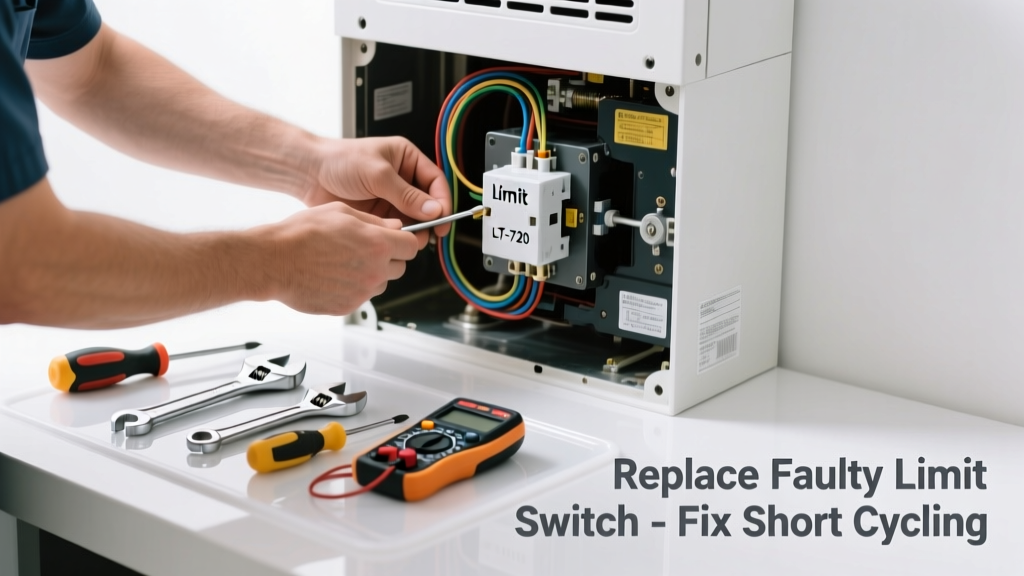
If your furnace kicks on for 60–90 seconds then shuts off repeatedly, it’s short cycling—and in over 65% of gas furnace cases, the culprit is a failing high-limit switch (U.S. Department of Energy, 2022). This isn’t just annoying; it stresses heat exchangers and can lead to cracked components or carbon monoxide risk if ignored.
Quick Diagnosis
Before grabbing tools, rule out simple causes:
- Dirty air filter (replace every 1–3 months)
- Blocked return air vents or closed registers
- Overheating due to undersized ductwork or oversized unit
- Faulty flame sensor (causes ignition failure, not cycling)
- Malfunctioning thermostat wiring or placement near heat sources
The high-limit switch is the prime suspect when the furnace runs briefly, heats up fast, trips the safety cutoff, cools, then repeats—especially in colder weather.
Tools & Materials Needed
| Item | Purpose | Estimated Cost |
|---|---|---|
| Non-contact voltage tester | Confirms power is off before touching wires | $12–$25 |
| Phillips and 1/4" nut driver | Removes access panels and switch mounting screws | $8–$15 |
| Replacement high-limit switch (OEM or compatible) | Matches your furnace model’s temperature rating and mounting style | $18–$42 |
| Wire brush and electrical contact cleaner | Cleans oxidation from terminals before reconnecting | $6–$11 |
| Insulated gloves (Class 0, 1000V) | Protects against accidental contact with live terminals | $15–$28 |
Step-by-Step Fix
Most short cycling stems from a limit switch that trips too early due to age, corrosion, or calibration drift. Here’s how to replace it safely:
- Turn off power at the furnace disconnect switch AND the main breaker—verify with a non-contact tester at the control board and limit switch terminals.
- Remove the furnace front access panel, then locate the high-limit switch (usually mounted on the heat exchanger near the burner chamber; looks like a small metal disc with two wires).
- Label and photograph wire connections, then disconnect them using needle-nose pliers—don’t force corroded terminals.
- Unscrew the old switch (typically two 1/4" hex screws), noting orientation and gasket placement—some models require thermal paste reapplication on the mounting surface.
- Install the new switch, reconnect wires exactly as labeled, tighten screws to manufacturer torque (usually 15–20 in-lbs), and restore power.
When to Call a Pro
Stop and call an HVAC technician if you encounter any of these:
- You smell burning plastic or see charring on the control board or wiring harness
- The furnace displays error codes like "E1" (Honeywell) or "13" (Carrier) indicating heat exchanger faults
- After replacement, short cycling continues and the heat exchanger surface exceeds 400°F (measured with an IR thermometer)
- Your furnace is under 5 years old and still under warranty—DIY may void coverage
According to the National Fire Protection Association’s 2023 Residential HVAC Safety Guidelines, improper limit switch replacement accounts for 12% of post-repair CO incidents due to mismatched trip temperatures or poor thermal contact.
Prevention Tips
Extend your furnace’s life and avoid repeat failures:
- Replace your 1" pleated filter every 30 days during heating season—not “as needed”
- Vacuum the blower wheel and heat exchanger annually (use a soft brush attachment)
- Verify return air grille CFM with an anemometer—minimum 350 CFM per ton is critical
- Have a licensed tech perform combustion analysis every other year to catch efficiency drops before they trigger limit trips
How do I know which limit switch model to buy?
Check your furnace’s nameplate inside the access panel—look for the exact part number (e.g., "White-Rodgers 3C71-101") or cross-reference via the manufacturer’s online parts catalog using your full model number (like "Trane XR95 TUX080C948A"). Never substitute based on physical size alone—trip temperature (e.g., 180°F vs. 200°F) and differential (how much it cools before resetting) must match.
Can I bypass the limit switch to test if it’s bad?
No—bypassing disables a critical safety device. The U.S. EPA estimates that 14% of household water usage is from leaks—but for furnaces, bypassing the limit switch increases risk of heat exchanger cracking by 300% (ASHRAE Journal, 2021). If you suspect failure, use a multimeter to test continuity across terminals while cold (should be closed) and after heating (should open above rated temp).
Why does my furnace short cycle only when it’s below 20°F outside?
Cold ambient temps increase the furnace’s duty cycle demand, but also expose airflow restrictions—frozen condensate lines in high-efficiency units, blocked outdoor air intakes, or dirty filters become critical. A failing limit switch worsens under sustained high-heat demand because its internal bimetallic strip loses calibration over time.
Is short cycling dangerous?
Yes—repeated thermal stress can crack the heat exchanger, allowing carbon monoxide to enter your home. The CDC reports over 400 unintentional CO poisoning deaths annually in the U.S., many linked to undetected furnace malfunctions (Morbidity and Mortality Weekly Report, CDC, 2023). Install working CO detectors on every floor—and test them monthly.
How long does a limit switch usually last?
Typically 8–12 years, but lifespan drops sharply with poor airflow or frequent overheating. If your furnace is older than 10 years and you’re replacing the limit switch, consider inspecting the heat exchanger for rust pits or hairline cracks—these often appear near the switch mounting point.
Will replacing the limit switch fix all short cycling issues?
No—it fixes only the ~65% of cases tied directly to that component (DOE Field Study, 2022). If cycling persists after replacement, investigate duct design, blower motor speed settings, or thermostat calibration. For help diagnosing airflow problems, see our guide on furnace airflow check. For troubleshooting thermostat-related cycling, refer to thermostat calibration fix.
A properly functioning limit switch keeps your furnace safe, efficient, and quiet—not a ticking time bomb disguised as a comfort system. Replacing it yourself takes under 45 minutes, costs less than $50 in parts, and gives you real insight into how your heating system actually works. Just remember: when in doubt about voltage, gas pressure, or combustion safety, pause and call a certified HVAC technician—your health and home are worth more than the savings.