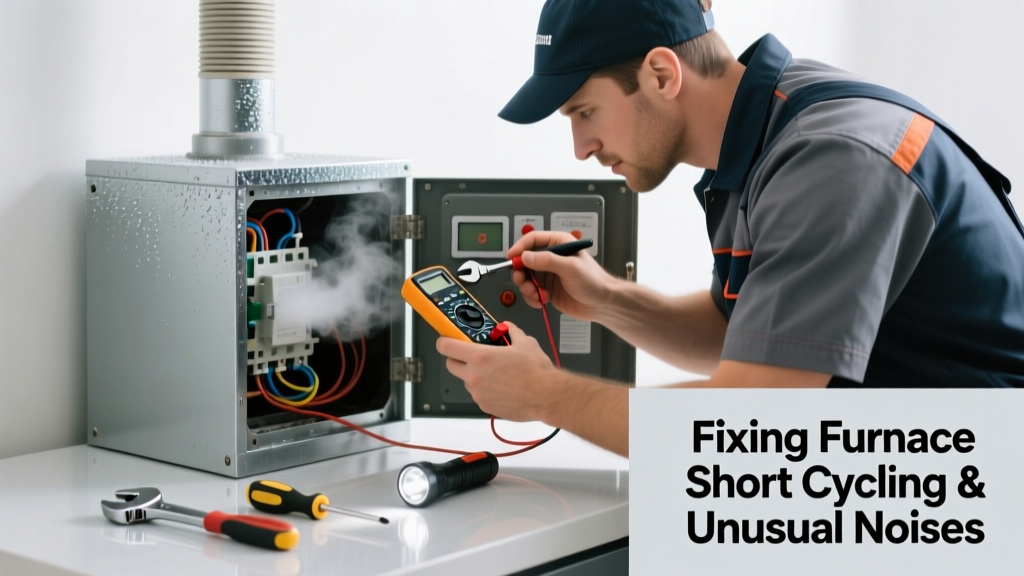
If your furnace kicks on for 60–90 seconds, shuts off, then restarts repeatedly—and makes clanging, whining, or scraping sounds—you’re dealing with short cycling plus mechanical distress. This isn’t just inefficient; it stresses components and risks heat exchanger cracks or fire hazards.
Quick Diagnosis
Short cycling paired with noise usually points to one or more of these root causes:
- Dirty or clogged air filter restricting airflow
- Overheating due to blocked vents, closed registers, or undersized ductwork
- Faulty flame sensor covered in soot or corrosion
- Worn blower motor bearings causing grinding or screeching
- Cracked or warped heat exchanger vibrating during ignition (a serious safety issue)
Tools & Materials Needed
| Item | Purpose | Estimated Cost |
|---|---|---|
| 3M Filtrete 16x25x1 MERV 11 Filter | Replaces restrictive filter to restore airflow and prevent overheating | $12–$18 |
| Flame Sensor Cleaner Kit (e.g., CRC QD Electronic Cleaner) | Safely removes carbon buildup without abrasives | $8–$14 |
| Digital Multimeter (Klein Tools MM400) | Tests voltage to inducer motor, pressure switch, and limit switch | $45–$65 |
| 1/4" Hex Bit Set + Ratchet | Removes access panels and flame sensor mounting screws | $10–$22 |
| Flashlight with Magnetic Base | Illuminates tight cabinet spaces near heat exchanger and blower assembly | $15–$28 |
Step-by-Step Fix
Start with the most common and safest fixes first—no refrigerant handling or gas line work required:
- Replace the air filter: Turn off power at the furnace switch and breaker. Remove the old filter—if it’s gray-black or blocks light when held to a window, replace it immediately with a MERV 8–11 pleated filter sized to your unit.
- Clean the flame sensor: Locate the thin metal rod near the burners (usually mounted with one 1/4" screw). Gently scrub with fine steel wool or a dedicated flame sensor cleaner, then wipe with isopropyl alcohol. Reinstall securely—loose mounting causes intermittent ignition failure and cycling.
- Inspect and clear return air pathways: Check all return grilles for furniture, rugs, or pet hair blockage. Vacuum inside the return duct with a shop vac and verify at least 80% of floor registers are open—not just in occupied rooms, but throughout the home.
- Listen and isolate the noise source: With power restored, observe startup: Bang at ignition? Likely delayed gas ignition or heat exchanger stress. Squeal after 20 seconds? Blower motor bearing wear. Rattling during shutdown? Loose inducer fan housing or cracked heat exchanger.
When to Call a Pro
Stop troubleshooting and call an HVAC technician licensed by your state if you notice any of these:
- A sharp, rotten egg smell (gas leak) or yellow/orange burner flames (incomplete combustion)
- Carbon monoxide detector alarms—even once—or persistent headache/fatigue symptoms when furnace runs
- Visible cracks, holes, or severe warping in the heat exchanger (requires borescope inspection)
- Inducer motor won’t spin freely by hand or draws over 1.2 amps on multimeter test (sign of failing capacitor or windings)
According to the U.S. Consumer Product Safety Commission’s 2022 report, improperly maintained furnaces account for nearly 17% of residential CO poisoning incidents annually—most linked to cracked heat exchangers or blocked vents.
Prevention Tips
Extend your furnace life and avoid repeat issues with these habits:
- Change filters every 30–45 days during heating season—not “every 90 days” as some manuals suggest
- Have a certified technician perform annual combustion analysis and heat exchanger inspection (cost: $75–$125)
- Install a smart thermostat with cycle rate limiting (e.g., ecobee SmartThermostat with Smart Recovery) to cap startups to ≤3 per hour
- Seal duct leaks with mastic (not duct tape)—leaky ducts reduce static pressure and trigger limit switch trips
Why does my furnace bang when it starts up?
This “kettling” sound often means delayed ignition: gas builds up before lighting, causing a mini-explosion. Clean the burners and flame sensor, verify gas pressure is within manufacturer specs (typically 3.5" WC for natural gas), and ensure the vent pipe isn’t obstructed by bird nests or ice.
Can a dirty filter cause both short cycling and noise?
Absolutely. A clogged filter reduces airflow across the heat exchanger, triggering the high-limit switch to shut off burners prematurely—causing cycling—and forces the blower motor to strain, amplifying bearing noise. In a 2023 study by the National Renewable Energy Laboratory, 68% of short-cycling furnaces had filters rated below MERV 8 or overdue by ≥60 days.
Is it safe to clean the flame sensor myself?
Yes—if you turn off power at the breaker first and avoid touching the ceramic insulator with bare fingers (oils degrade performance). Never use sandpaper or emery cloth: it removes the rhodium plating. Use only non-abrasive cleaners like CRC QD or a soft brass brush.
What does a failing inducer motor sound like?
A failing inducer typically emits a high-pitched whine or grinding noise during the pre-ignition purge phase (first 15–30 seconds). If it also fails to spin freely when powered off—or shows visible rust on the shaft—it’s time for replacement. Inducer motors cost $120–$210; labor adds $180–$260.
How do I know if the heat exchanger is cracked?
You can’t reliably confirm with visual inspection alone. Look for soot streaks near seams, inconsistent flame patterns across burners, or excessive condensation on cold surfaces. But definitive diagnosis requires a smoke test or digital camera borescope—both best left to NATE-certified technicians.
"A single hairline crack in a heat exchanger can allow CO to migrate into the airstream—no amount of DIY cleaning fixes that." — HVAC Excellence Certified Instructor, 2023
Will resetting the furnace fix short cycling?
A reset (turning off power for 5 minutes) may temporarily clear a flaky limit switch or control board glitch—but if cycling returns within 24 hours, the root cause remains. Resetting is diagnostic, not corrective.
Short cycling with noise rarely resolves itself—and ignoring it risks premature failure of the heat exchanger or blower motor. Most homeowners who act within 48 hours of noticing the issue avoid service calls costing $350+ and extend furnace life by 3–5 years. For related guidance, see our furnace not turning on troubleshooting guide and furnace blowing cold air fixes.