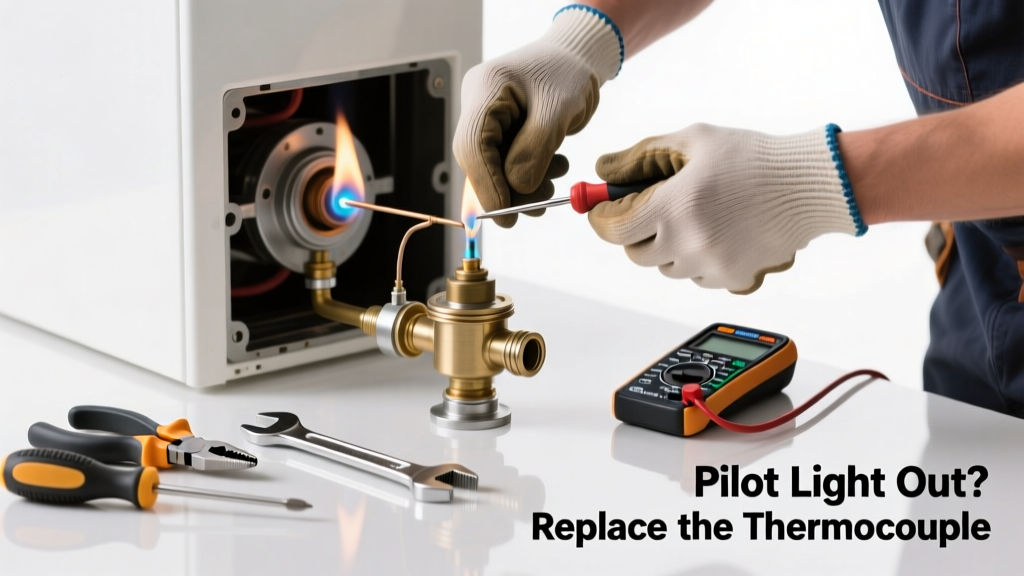
If your furnace pilot light keeps going out—even after you relight it—it’s rarely a gas supply issue. More often, it’s a failing thermocouple, the safety sensor that tells the gas valve to stay open only when flame is present. This small copper rod wears out over time, especially in older furnaces (typically 8–12 years), and replacing it takes under 30 minutes with basic tools.
Quick Diagnosis
Before grabbing tools, confirm the thermocouple is the culprit—not just a dirty pilot or draft issue. Check these signs in order:
- Pilot ignites but extinguishes within 30 seconds of releasing the gas control knob
- Pilot stays lit only while holding the knob down—fails immediately upon release
- Thermocouple tip shows heavy soot, bending, or corrosion (visible near burner assembly)
- No visible flame impingement on thermocouple tip (flame must fully envelope the top 1/2 inch)
Tools & Materials Needed
| Item | Purpose | Estimated Cost |
|---|---|---|
| Replacement thermocouple (18–24" universal or OEM) | Senses heat and signals gas valve to remain open | $12–$28 |
| Adjustable wrench (6" or 8") | Tightens brass compression nut without stripping threads | $9–$22 |
| Emery cloth or fine steel wool (0000 grade) | Cleans oxidation from thermocouple tip and connection points | $3–$6 |
| Flashlight with magnetic base | Illuminates tight furnace access panels and burner chamber | $10–$18 |
| Small wire brush | Removes carbon buildup from pilot orifice and thermocouple mounting bracket | $4–$8 |
Step-by-Step Fix
- Turn off gas and power: Shut off the gas supply valve at the furnace (usually a lever perpendicular to the pipe) and switch off the furnace breaker at the main panel.
- Remove access panel and locate components: Identify the pilot assembly—look for the small copper tube running from the gas valve to the pilot burner. The thermocouple is the thin copper rod beside the pilot tube, mounted with a brass nut.
- Disconnect and remove old thermocouple: Use the adjustable wrench to loosen the brass compression nut where the thermocouple connects to the gas valve. Gently pull the thermocouple straight out—don’t twist or bend it. Note its routing path before removal.
- Install new thermocouple: Insert the new unit along the same path, ensuring the tip sits centered in the pilot flame (not touching burner ports). Hand-tighten the compression nut, then give it a 1/4-turn with the wrench—overtightening cracks the seal.
- Test ignition: Restore gas and power. Press and hold the gas control knob in “Pilot” position for 60 seconds while lighting the pilot with a long lighter. Release slowly—if it stays lit, turn knob to “On.” If it goes out, recheck tip positioning and clean the pilot orifice.
When to Call a Pro
Stop and call an HVAC technician if any of these apply:
- You smell raw gas before or during the process (evacuate and call your utility immediately)
- Your furnace uses a standing pilot but has no manual reset knob—indicating an integrated electronic ignition system
- The gas valve itself clicks but emits no gas (suggests internal valve failure, not thermocouple)
- You’re working on a high-efficiency condensing furnace with sealed combustion—these lack standing pilots entirely and require diagnostic tools
Prevention Tips
Extend thermocouple life and avoid repeat failures with these habits:
- Clean the pilot orifice and thermocouple tip annually using emery cloth and compressed air—carbon buildup insulates the sensor
- Ensure furnace room ventilation meets manufacturer specs; excessive drafts cool the thermocouple tip prematurely
- Replace thermocouples every 7 years even if functional—fatigue causes intermittent failure
- Use only OEM or UL-listed replacements; cheap knockoffs often fail within 6 months
Can I reuse the old thermocouple nut?
No—reusing the compression nut risks gas leaks. Always install the new nut supplied with the thermocouple. Brass nuts deform slightly during tightening and lose sealing integrity after one use. According to the American Gas Association’s Gas Appliance Installation Standards (2022), reused compression fittings are prohibited in residential gas systems.
Why does my pilot light stay lit for 2 minutes then go out?
This delayed failure points to a weak thermocouple output—its millivoltage drops below the 15–25 mV threshold needed to hold the gas valve open as it heats unevenly. A multimeter test confirms: healthy units generate ≥20 mV when heated by pilot flame. If yours reads under 18 mV, replacement is necessary.
Is it safe to bypass the thermocouple to test the gas valve?
"Never bypass or jumper a thermocouple—it disables a critical safety device designed to prevent unignited gas accumulation. A single failure could lead to explosion or CO poisoning." — HVAC Excellence Certified Technician Handbook, 2023Doing so violates NFPA 54 and voids insurance coverage. If the valve doesn’t respond to a known-good thermocouple, the valve itself is defective and requires professional replacement.
How do I know which thermocouple length I need?
Measure from the gas valve connection point to the pilot burner mounting bracket—not total tube length. Most standard furnaces use 18" or 24" units. If your furnace is a Bryant, Carrier, or Lennox model built before 2005, consult the service manual online (e.g., furnace model number lookup)—some require proprietary lengths or thread types like 1/8" NPT vs. 5/16" flare.
Can a dirty air filter cause pilot light issues?
Indirectly—yes. A severely clogged filter restricts airflow across the heat exchanger, causing overheating and high-limit switch shutdowns. While this won’t kill the pilot directly, repeated cycling stresses the thermocouple and can accelerate fatigue. Replace filters every 1–3 months; see our how to change furnace air filter guide for proper sizing.
Do modern furnaces still use pilot lights?
Few do. Since 2009, nearly all new furnaces use hot-surface or spark ignition systems. If your furnace was installed after 2010 and has no manual pilot knob, the issue isn’t a thermocouple—it’s likely a failed igniter, flame sensor, or control board. Refer to our furnace igniter not glowing troubleshooting guide instead.
A working pilot light isn’t just about warmth—it’s your furnace’s first line of defense against gas leaks and incomplete combustion. Replacing a worn thermocouple restores that safety function reliably and affordably. Keep spare parts on hand, document your furnace’s make/model/year, and schedule annual professional tune-ups—even after DIY fixes—to catch wear before it becomes a hazard.