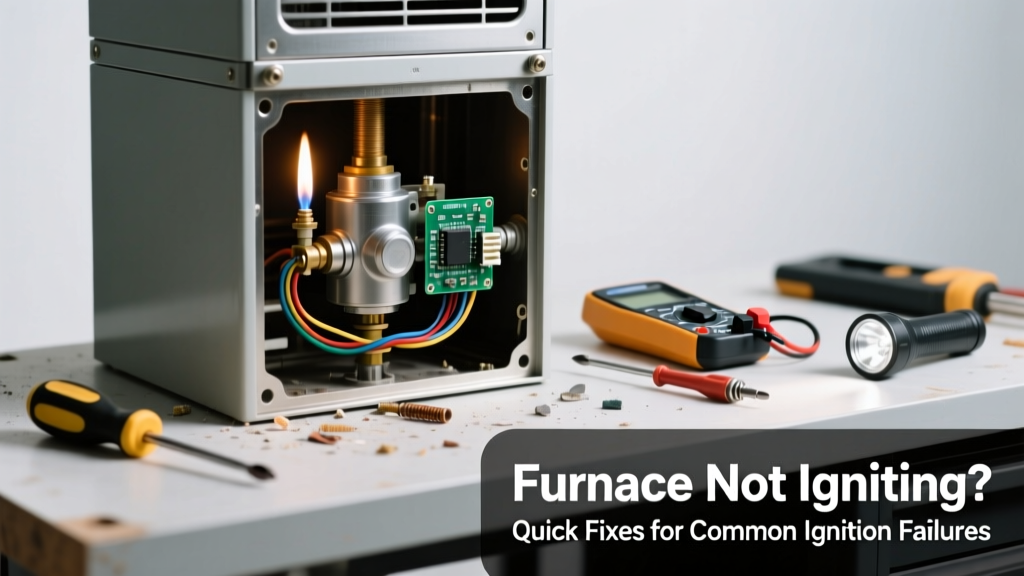
Waking up to a cold house on a sub-zero morning because your furnace won’t fire up is stressful — and potentially dangerous if ignored. Most ignition failures stem from simple, fixable causes like clogged burners or faulty sensors, not full system replacement. Before calling a technician, try these targeted checks — many take under 15 minutes and require no special skills.
Quick Diagnosis
Start here to narrow down the root cause without guesswork:
- No click or glow when thermostat calls for heat (points to power, safety switch, or igniter)
- Clicking sound but no flame (often a dirty or cracked hot surface igniter or gas flow issue)
- Flame lights then shuts off after 3–5 seconds (likely a dirty flame sensor or blocked vent)
- Furnace fan runs but no heat (indicates ignition failure, not blower problem)
- Error code flashing on control board (check your manual — e.g., '14' on Lennox means ignition lockout)
Tools & Materials Needed
| Item | Purpose | Estimated Cost |
|---|---|---|
| Multi-meter (digital) | Test voltage to igniter and gas valve; verify 24V AC at control board terminals | $25–$65 |
| Emery cloth or fine steel wool (0000 grade) | Clean flame sensor without scratching — never use sandpaper or abrasive pads | $3–$8 |
| Phillips and flat-head screwdrivers | Access panels, remove burner assembly, and secure wiring connections | $10–$20 |
| Flashlight with magnetic base | Illuminate tight spaces near heat exchanger and burners safely | $12–$30 |
| Compressed air canister (non-lubricating) | Blow dust/debris from igniter tip and flame sensor without moisture | $6–$15 |
Step-by-Step Fix
Work methodically — skip steps only if you’ve verified the prior one isn’t the culprit:
- Reset the furnace: Turn off power at the disconnect switch (usually near unit) for 30 seconds, then restore. This clears temporary lockouts and resets the control board.
- Clean the flame sensor: Locate the thin metal rod near the burners (typically stainless steel, ~¼" diameter). Remove it with a ¼" socket or wrench, gently polish with emery cloth until shiny, wipe with clean rag, and reinstall snugly — overtightening cracks ceramic bases.
- Inspect and clean the hot surface igniter: Look for visible cracks or white chalky residue. Use compressed air to blow away dust. If cracked or doesn’t glow cherry-red within 90 seconds of call-for-heat, replace it (part costs $25–$55).
- Check gas supply: Verify shut-off valve by furnace is fully open (handle parallel to pipe). Listen for hiss at gas line connection — no sound may indicate closed valve upstream or regulator issue.
When to Call a Pro
Some issues demand licensed expertise — both for safety and code compliance:
- You smell rotten eggs (unburned natural gas) — evacuate and call gas company immediately
- Gas valve clicks but no gas reaches burners — requires pressure testing and possible valve replacement
- Heat exchanger shows cracks, corrosion, or soot buildup — carbon monoxide risk makes this non-negotiable for pros
- Control board displays repeated error codes after reset (e.g., 'E1' on Rheem units signals internal fault)
- Igniter glows but burners still won’t light — could indicate gas pressure too low (<11 in. WC) or high (>14 in. WC), requiring manometer testing
"Over 60% of service calls for no-heat complaints involve a dirty flame sensor or obstructed air intake — both DIY-fixable in under 10 minutes." — HVAC Technician Certification Council, 2022 Field Survey
Prevention Tips
Extend your furnace’s reliability and avoid repeat ignition failures:
- Replace air filter every 1–3 months — restricted airflow triggers high-limit shutdowns that mimic ignition failure
- Vacuum burner compartment annually using a shop vac with brush attachment (power off first)
- Test thermostat batteries each fall — weak voltage can prevent proper 24V signal to furnace
- Keep furnace room clear of storage — blocked combustion air intake causes rollout switch trips
- Schedule professional tune-up every other year — includes gas pressure check, heat exchanger inspection, and calibration
Why does my furnace click but not ignite?
The clicking indicates the control board is signaling the gas valve, but no flame appears. Most often, this is due to a failed hot surface igniter (no glow), a dirty flame sensor (won’t confirm ignition), or insufficient gas pressure. Check igniter glow first — if dark, test continuity with multimeter (should read 40–90 ohms). If it glows but no flame, inspect gas orifice for spider webs — a common cause in seasonal homes.
Can I clean the flame sensor with alcohol or vinegar?
No — neither is recommended. Isopropyl alcohol leaves residue that attracts dust; vinegar is acidic and can corrode the sensor’s platinum coating over time. The proper method uses only emery cloth or 0000 steel wool, followed by wiping with a lint-free cloth. Never scrub — gentle polishing preserves sensor life.
Is it safe to bypass the flame sensor to test ignition?
Never bypass or jump the flame sensor. Doing so disables critical safety shutoff and risks unburned gas accumulation — a serious explosion hazard. If the sensor tests open-circuit (infinite resistance) or fails visual inspection, replace it. Always verify continuity before assuming failure: set multimeter to ohms, touch probes to sensor rod and its mounting base — expect 0.5–2.0 ohms.
What does a yellow or lazy furnace flame mean?
A yellow, flickering, or floating flame signals incomplete combustion — often caused by dirt on burners, low gas pressure, or excess air (damaged gasket or cracked heat exchanger). A healthy flame should be steady, blue, and fully attached to burner ports. According to the U.S. EPA, improperly adjusted furnaces can emit up to 3× more carbon monoxide than properly tuned units — always have yellow flames investigated by a certified technician.
How long should a furnace igniter last?
Hot surface igniters typically last 3–5 years, depending on runtime and air quality. Units in dusty environments or those cycling frequently (short cycles due to oversized equipment or poor insulation) wear out faster. If yours fails before year three, inspect your air filter schedule and duct sealing — excessive particulate shortens igniter life.
Can a dirty air filter cause ignition failure?
Absolutely — yes. A clogged filter restricts airflow, causing the heat exchanger to overheat and trip the high-limit switch. This shuts off the burners mid-cycle and locks out ignition until cooldown. In some models, repeated limit trips trigger a hard lockout requiring manual reset. That’s why checking your filter is step zero — even before opening the furnace door.
Fixing a furnace that won’t ignite doesn’t always mean calling for help — many root causes are accessible, inexpensive, and solvable with basic tools and 20 minutes of focused attention. But don’t push past your comfort zone: gas, electricity, and combustion safety aren’t areas for improvisation. When in doubt, pause, double-check, and reach out to a licensed HVAC technician — especially if you’re uncertain about voltage readings or gas line integrity. Your warmth — and safety — depends on it.