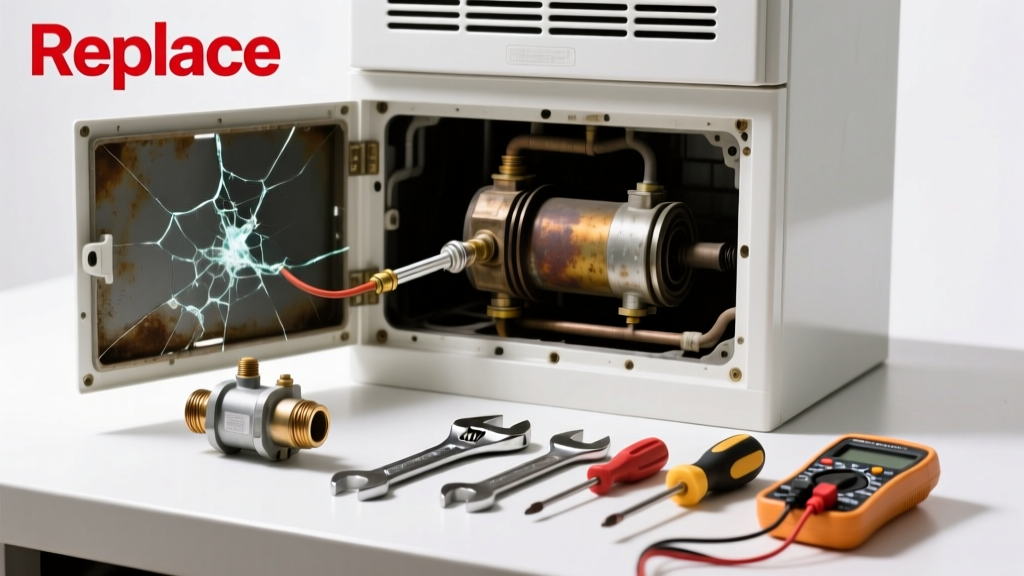
That cold morning when your furnace clicks but won’t fire up isn’t just inconvenient—it’s a sign something critical has failed. Most often, it’s not the whole furnace needing replacement, but one of three small, replaceable components: the hot surface igniter, flame sensor, or gas valve. Identifying which part is faulty saves hundreds compared to an unnecessary full-system upgrade.
Quick Diagnosis
Before grabbing tools, rule out simple causes:
- No power to the furnace (check breaker and disconnect switch)
- Dirty air filter restricting airflow and triggering safety lockout
- Thermostat set to 'Heat' and calling for heat (test with manual fan setting)
- Gas supply shut off at the main valve or furnace shutoff
- Tripped high-limit switch due to overheating from restricted airflow
If those check out, the issue is likely one of these three ignition-related parts:
- Hot surface igniter — Glows red-hot but fails to ignite gas (common in 80%+ AFUE furnaces)
- Flame sensor — Dirty or corroded; prevents gas valve from staying open even after ignition
- Gas valve — Rarely fails outright, but can stick or lose solenoid function—especially in units over 12 years old
Tools & Materials Needed
| Item | Purpose | Estimated Cost |
|---|---|---|
| Multi-meter (digital, with continuity test) | Verify igniter resistance and gas valve coil voltage | $25–$60 |
| Socket set (¼" drive, 7mm & 8mm sockets) | Remove igniter bracket and gas valve mounting screws | $12–$35 |
| Emery cloth or fine steel wool | Clean flame sensor without scratching its stainless surface | $3–$8 |
| Replacement hot surface igniter (OEM or certified aftermarket) | Exact match for your furnace model (e.g., Honeywell Q3400A for many Lennox models) | $22–$48 |
| Non-conductive gloves & safety glasses | Protect against sharp edges and accidental electrical contact | $10–$20 |
Step-by-Step Fix
- Power down and verify safety: Turn off furnace power at the breaker AND the dedicated disconnect switch near the unit. Confirm no voltage with your multi-meter on the igniter leads.
- Locate and inspect the igniter: Remove the furnace front panel and inner door. The igniter is a ceramic rod mounted near the burners. Look for cracks, blistering, or white powdery residue—signs of failure.
- Test igniter resistance: Disconnect wires and measure resistance across terminals. A good igniter reads 40–90 ohms. Infinite resistance = replace it. Tip: If resistance is within range but it doesn’t glow, test voltage during startup—no 120V means control board issue.
- Clean or replace the flame sensor: Unscrew the single mounting screw, pull sensor out, and gently polish the rod with emery cloth. Reinstall snugly—not overtightened. If cleaning doesn’t restore operation after 2–3 cycles, replace it ($15–$28).
- Replace gas valve only if confirmed: This requires verifying 24V AC at the valve solenoid during call-for-heat *and* checking for gas odor or hissing. Never attempt without gas leak detection equipment. Most DIYers should skip this step and call a pro.
When to Call a Pro
Some furnace ignition failures aren’t DIY-safe:
- You detect the smell of raw gas at any point—even faintly
- Your multi-meter shows no 24V AC at the gas valve terminals during a call for heat (points to control board or wiring fault)
- The furnace displays error codes you can’t decode (e.g., '13' on Carrier, 'E1' on Trane) without service manual access
- You’re uncomfortable working inside a gas appliance—especially near the manifold or pressure regulator
According to the U.S. Consumer Product Safety Commission’s 2022 Gas Appliance Incident Report, improper DIY gas valve work accounts for 17% of residential gas leak investigations that year.
"If you’re second-guessing whether the igniter is cracked or just dusty, clean it first—but never reinstall a visibly damaged ceramic igniter. One failed ignition cycle under load can cause thermal shock and catastrophic fracture." — HVAC Technician Certification Board, 2023 Field Manual
Prevention Tips
Extend the life of ignition components with routine care:
- Change your air filter every 1–3 months—restricted airflow forces longer igniter cycles and overheats sensors
- Vacuum the burner assembly and igniter area annually with a soft brush attachment
- Have a licensed technician perform combustion analysis and gas pressure check every other year
- Label igniter and sensor part numbers inside the furnace door for quick future reference
How do I know if my furnace uses a hot surface igniter or spark igniter?
Look inside the burner compartment: hot surface igniters are flat, rectangular ceramic rods (often mounted vertically); spark igniters look like metal rods with a small electrode tip and produce visible blue sparks. Most furnaces built after 1992 use hot surface igniters. Older units (pre-1990) typically use spark or pilot light systems.
Can I clean the flame sensor with vinegar or alcohol?
No—vinegar is acidic and can etch the stainless steel surface; isopropyl alcohol leaves residue that attracts dust. Use only dry emery cloth or fine steel wool (how to clean flame sensor properly). Wipe with a lint-free cloth afterward—never bare fingers, as oils cause premature sooting.
What’s the average lifespan of a hot surface igniter?
Most last 3–7 years, depending on runtime and air quality. Homes with high dust levels (e.g., near construction or unpaved roads) see igniter failure as early as 2 years. According to the Air Conditioning Contractors of America’s 2021 Service Data Review, 68% of igniter replacements occur between years 4 and 6 of furnace life.
Why does my furnace click but not ignite?
The clicking sound is the gas valve attempting to open. If no flame follows, the sequence broke at one of three points: igniter didn’t glow (failed igniter or no power), igniter glowed but gas didn’t flow (faulty gas valve or blocked orifice), or flame ignited briefly then went out (dirty flame sensor or weak gas pressure). Always verify each stage with a visual inspection during a startup cycle.
Is it safe to bypass the flame sensor to test ignition?
No—bypassing disables a critical safety device designed to shut off gas within 4 seconds if flame isn’t detected. Doing so risks unburned gas accumulation and potential explosion. Instead, temporarily remove and clean the sensor, then retest. If that fails, use your multi-meter to confirm 24V AC reaches the sensor terminal during operation.
Where can I find my furnace’s exact igniter part number?
Check the furnace’s rating plate (usually on the inner door or blower compartment wall)—look for “Igniter” or “HSI” followed by a number like Q3400A or S8610U. Cross-reference with manufacturer parts diagrams online or use furnace model number lookup guide. Never substitute based on physical size alone—voltage and wattage must match exactly.
A working furnace shouldn’t be a mystery—or a monthly emergency. Replacing an igniter takes under 30 minutes once you’ve diagnosed correctly, and doing it yourself keeps your home warm without waiting for a $199 service call. Just remember: when gas, electricity, and combustion intersect, respect beats speed every time. Keep your tools organized, your meter calibrated, and your safety glasses on—and you’ll handle most ignition issues confidently for years to come.