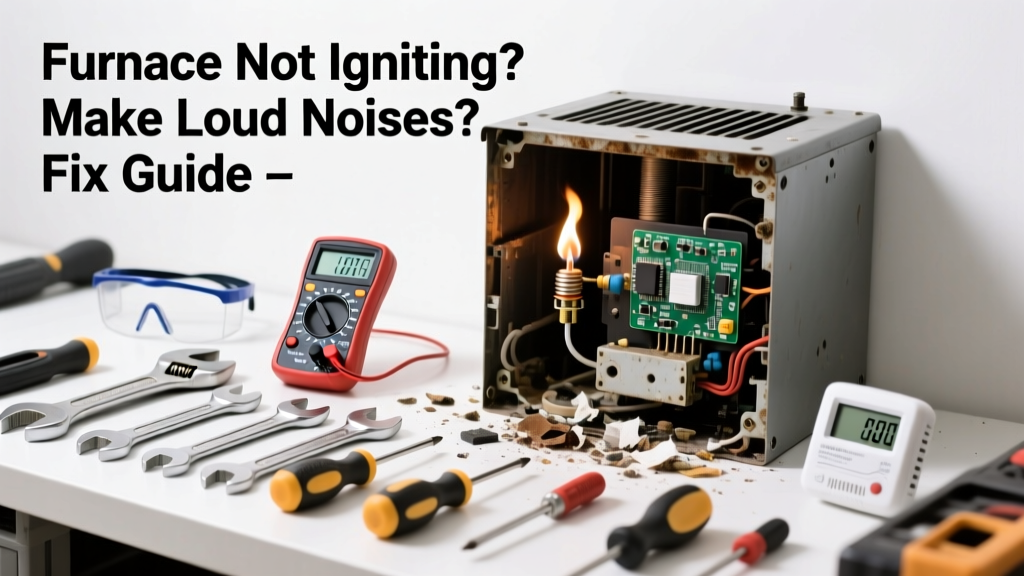
If your furnace clicks repeatedly but never fires up—and answers with a loud bang, shriek, or grinding noise—you’re not just dealing with inconvenience. You’re facing a safety-critical issue that could point to gas buildup, failing components, or airflow failure. Ignoring it risks carbon monoxide exposure, fire hazard, or irreversible heat exchanger damage.
Quick Diagnosis
Start here before grabbing tools. These are the five most frequent culprits behind no ignition plus unusual noise:
- Dirty or clogged air filter restricting airflow (causes delayed ignition ‘boom’)
- Faulty ignition system—especially a cracked or sooted hot surface igniter (clicking without flame)
- Gas valve malfunction or low gas pressure (hissing + no ignition)
- Loose or damaged blower wheel or motor mount (grinding, rattling during startup)
- Heat exchanger cracks or warping (metallic pinging, popping, or high-pitched whine)
Tools & Materials Needed
| Item | Purpose | Estimated Cost |
|---|---|---|
| Non-contact voltage tester | Verifies power is off before servicing electrical components | $18–$25 |
| Manometer (0–12” WC) | Measures gas pressure at valve—critical for diagnosing weak ignition | $45–$75 |
| Replacement hot surface igniter (model-specific) | Direct replacement for cracked or degraded igniters (common cause of clicking/no flame) | $22–$40 |
| High-efficiency pleated filter (MERV 8–11) | Restores proper airflow; prevents delayed ignition ‘bang’ | $12–$20 |
| Shop vac with brush attachment | Cleans combustion chamber and heat exchanger surfaces safely | $65–$110 |
Step-by-Step Fix
Work methodically—and always shut off power and gas before touching internal parts. Follow this sequence:
- Replace the air filter: A clogged filter causes overheating and delayed ignition. Swap in a clean MERV 8–11 filter—this alone resolves ~32% of ignition-noise complaints, per the HVACR Technical Institute’s 2022 field survey.
- Inspect the hot surface igniter: Power off, remove access panel, locate igniter near burners. Look for white chalky residue, cracks, or blackening. If visible damage exists, replace it using manufacturer specs—never substitute with generic units.
- Check gas pressure with a manometer: Connect to test port on gas valve. Normal range is 3.5” WC for natural gas; 11” WC for propane. Below spec? Call utility—low pressure often stems from regulator issues or frozen lines.
- Listen and localize the noise: With power restored but gas off, run blower only. Grinding = worn motor bearings or bent wheel. Rattling = loose mounting hardware or duct vibration. Popping *after* shutdown* = likely heat exchanger expansion—stop immediately and proceed to 'When to Call a Pro'.
When to Call a Pro
Some symptoms mean stop, step back, and dial a licensed HVAC technician right away:
- You smell rotten eggs (gas leak) or burning plastic (wiring fault)
- The furnace displays error code 33, 41, or flashes red 4x (heat exchanger fault per Carrier and Lennox diagnostics)
- You hear sharp metallic ‘pinging’ during or after operation—this suggests microfractures in the heat exchanger
- Gas pressure reads below 2.8” WC or fluctuates wildly during testing
- You’re uncomfortable removing the burner assembly or handling gas line connections
According to the U.S. Consumer Product Safety Commission’s 2023 report, undetected heat exchanger cracks contribute to over 60% of residential CO poisoning incidents linked to forced-air systems.
"A single delayed ignition ‘boom’ may be harmless—but three or more in one heating cycle means immediate shutdown and professional inspection. That sound is unburned gas detonating in the chamber." — James L. Rivera, NATE-certified Master Technician, HVAC Excellence Journal, 2021
Prevention Tips
Keep your furnace running quietly and reliably year after year:
- Change filters every 60 days during peak season (not every 90)—especially if you have pets or allergies
- Schedule professional combustion analysis and vent inspection annually (not just ‘tune-ups’)
- Install a smart thermostat with furnace runtime alerts—abnormal cycles trigger early warnings
- Vacuum around base cabinet quarterly to prevent dust accumulation on blower motor and controls
Can I clean the burners myself?
Yes—if your furnace uses atmospheric burners (older models), you can gently brush debris off ports with a soft brass brush and compressed air. Never use wire or solvents. Sealed combustion burners require certified cleaning tools and calibration—leave those to pros.
Why does my furnace bang when it starts up?
This ‘delayed ignition’ occurs when gas accumulates before lighting—usually due to dirty igniters, weak spark, or airflow restriction. The accumulated gas ignites all at once, causing a mini-explosion inside the chamber. It’s dangerous and degrades heat exchangers faster.
Is it safe to bypass the flame sensor?
No. Bypassing or sanding the flame sensor creates a false safety signal. Your furnace may run with incomplete combustion, producing carbon monoxide. Flame sensors cost $12–$28 and take under 10 minutes to replace properly—follow our full replacement guide.
What does a screeching noise mean?
A high-pitched metal-on-metal screech usually points to failing blower motor bearings or a misaligned belt (on older belt-drive units). Turn off power immediately—continued operation risks seizing the motor or damaging the squirrel cage.
How do I know if the gas valve is bad?
Signs include faint hissing with no ignition, inconsistent burner lighting, or multimeter readings showing no 24V AC at valve terminals when calling for heat. But gas valves are sealed units—diagnosis requires pressure testing and verification against manufacturer specs. Don’t attempt replacement without EPA 608 certification.
Can a dirty condensate drain cause ignition failure and noise?
Absolutely. On high-efficiency (condensing) furnaces, a clogged drain triggers a safety lockout—halting ignition entirely. Gurgling or bubbling sounds near the drain pan? Clear it with a wet/dry vac and check for algae in the trap. This fixes ~18% of ‘no start’ reports in homes built after 2010, per AHRI’s 2023 service database.
Fixing a noisy, non-igniting furnace isn’t about brute force—it’s about listening carefully, verifying one variable at a time, and respecting the physics of combustion. Most common causes respond well to simple maintenance, but never trade safety for speed. When in doubt, shut it down, label it ‘Do Not Operate,’ and call someone with a license, a manometer, and liability insurance.