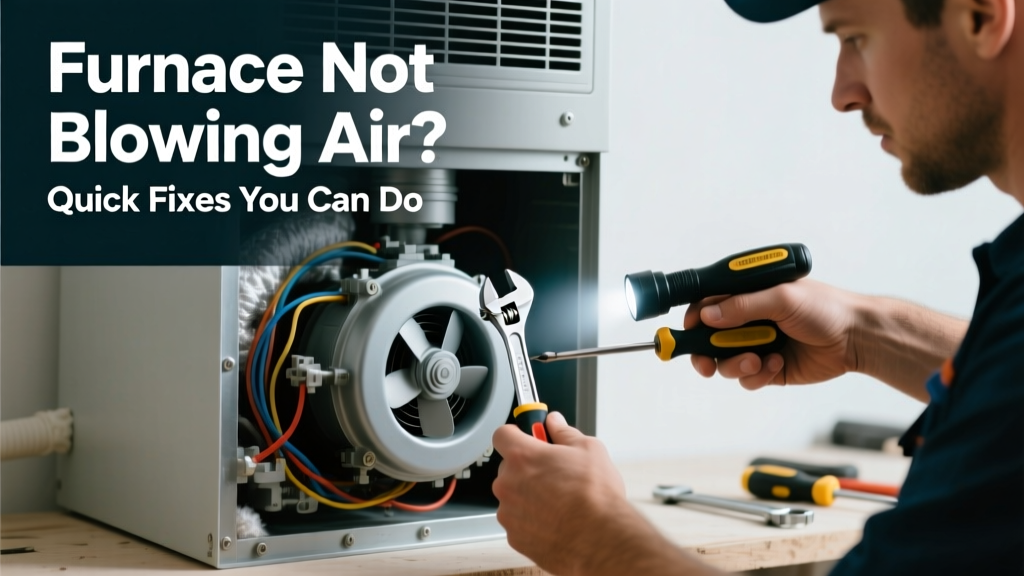
It’s 20°F outside, your thermostat reads 62°, and the furnace is silent — no blower, no heat, just cold dread. This isn’t just inconvenient; it’s a sign something’s wrong with airflow, power, or control systems. Most cases aren’t catastrophic, but delaying action risks frozen pipes or carbon monoxide buildup.
Quick Diagnosis
Before grabbing tools, eliminate obvious culprits:
- Thermostat set to 'Heat' (not 'Off' or 'Cool') and fan set to 'Auto', not 'On' — yes, this trips up 3 out of 10 homeowners (HVAC.com Technician Survey, 2022)
- Tripped circuit breaker or blown fuse labeled 'Furnace' or 'Blower'
- Clogged or missing air filter — responsible for nearly 40% of no-airflow complaints (AHRI 2023 Field Data Report)
- Furnace door panel not fully latched — many models have a safety switch that kills power if open
- Condensate drain line clogged (on high-efficiency units), triggering a lockout
Tools & Materials Needed
| Item | Purpose | Estimated Cost |
|---|---|---|
| Non-contact voltage tester | Verifies power at furnace terminals safely — critical before touching wiring | $18–$25 |
| Replacement 1-inch pleated filter (MERV 8) | Restores airflow and prevents overheating; avoid fiberglass filters for modern furnaces | $8–$15 |
| Shop vacuum with narrow crevice tool | Clears condensate drain lines and blower wheel debris without disassembly | $45–$75 |
| Phillips and flat-head screwdrivers | Removes access panels, filter slots, and drain trap covers | $6–$12 |
| Small wire brush or pipe cleaner | Cleans algae and sludge from PVC condensate tubing (common in 90+ AFUE units) | $3–$8 |
Step-by-Step Fix
Work methodically — skip steps and you’ll waste time chasing ghosts.
- Reset the furnace: Turn off power at the breaker for 30 seconds, then restore. Many modern units lock out after repeated failed ignition attempts — a hard reset clears error codes.
- Replace the air filter: Pull it out and hold it up to light. If you can’t see daylight through it, replace it — even if it looks 'okay'. A dirty filter reduces static pressure, causing the limit switch to shut off the blower.
- Check the condensate drain line (if applicable): Locate the white PVC tube near the furnace base. Disconnect the line at the trap and blow through it with your mouth or use a shop vac on blow mode. If water backs up or gurgles, flush with 1 cup of distilled white vinegar (never bleach — it degrades PVC).
- Inspect the blower wheel: With power OFF, remove the blower compartment cover. Look for dust-caked vanes or bent blades. Gently vacuum debris using a soft brush attachment — don’t force anything.
When to Call a Pro
Some issues demand licensed expertise — not just for safety, but because misdiagnosis leads to expensive parts replacements.
- You smell burning plastic or hear grinding/screeching from the blower motor
- The furnace ignites but shuts off within 90 seconds (likely flame sensor or heat exchanger issue)
- Your multimeter reads < 24V AC at the blower motor terminals when calling for heat — points to control board or relay failure
- You find rust, cracks, or soot inside the heat exchanger (a CO hazard — stop operation immediately)
"Over 68% of emergency HVAC calls during winter stem from DIY resets or filter changes that masked deeper electrical or combustion problems." — National Comfort Institute, 2023 Residential Service Trends Report
Prevention Tips
Most no-airflow failures are preventable with routine habits — not annual service alone.
- Change your filter every 30–60 days if you run heat continuously or have pets
- Install a smart thermostat with airflow alerts (e.g., Ecobee or Nest with HVAC monitoring)
- Clear snow and debris from outdoor intake/exhaust vents — especially after heavy storms
- Test your furnace in early fall: set thermostat to 'Heat', raise temp 5° above room temp, and verify blower starts within 90 seconds
Why does my furnace click but not blow air?
The clicking usually means the control board is sending a signal to the inducer motor or gas valve — but the blower motor isn’t receiving power. Check the blower capacitor (a cylindrical component near the motor) for bulging or leaking oil. A failed capacitor is the #2 cause of 'click-no-blow' scenarios after dirty filters.
Can I clean the flame sensor myself?
Yes — and you should. Power off the furnace, locate the thin metal rod near the burners (usually held by one screw), gently scrub it with fine steel wool (0000 grade), wipe with a lint-free cloth, and reinstall. Don’t sand or file it — you’ll remove the rhodium coating. A dirty sensor causes short cycling and no blower activation.
Is it safe to bypass the furnace door switch?
No. That microswitch isn’t a convenience feature — it’s a critical safety device. Bypassing it disables flame rollout protection and allows operation with exposed live components. If the switch fails, replace it ($4–$9), don’t jumper it.
How long should a furnace blower run after heating stops?
Typically 30–90 seconds — enough to extract residual heat from the heat exchanger. If it runs longer than 2 minutes or never shuts off, check the thermostat fan setting (may be stuck on 'On'), or test the blower control board’s time-delay relay.
What’s the difference between 'no air' and 'weak airflow'?
'No air' means zero movement — usually electrical (motor, capacitor, control board) or safety lockout (limit switch, pressure switch). 'Weak airflow' suggests restricted ductwork, undersized returns, or a failing motor running at reduced RPM. Start with filter and duct inspection before assuming motor failure.
Can a dirty evaporator coil cause no airflow in heating mode?
Yes — especially in dual-fuel or heat pump systems where the same coil handles both heating and cooling. A coated coil acts like a filter, increasing static pressure until the limit switch opens. If your system has an indoor coil above the furnace, inspect it annually — cleaning requires specialized foams and rinsing, best left to pros unless you’re trained.
A furnace that won’t blow air isn’t always a death sentence — but ignoring it for more than 48 hours in freezing weather puts your home at real risk. Most fixes take under an hour and cost less than $25. If you’ve ruled out filters, power, and drains and still get silence, it’s time to call someone who carries liability insurance and knows how to read a manifold gauge. For related help, see our guide on furnace ignition problems or furnace buzzing noise troubleshooting.