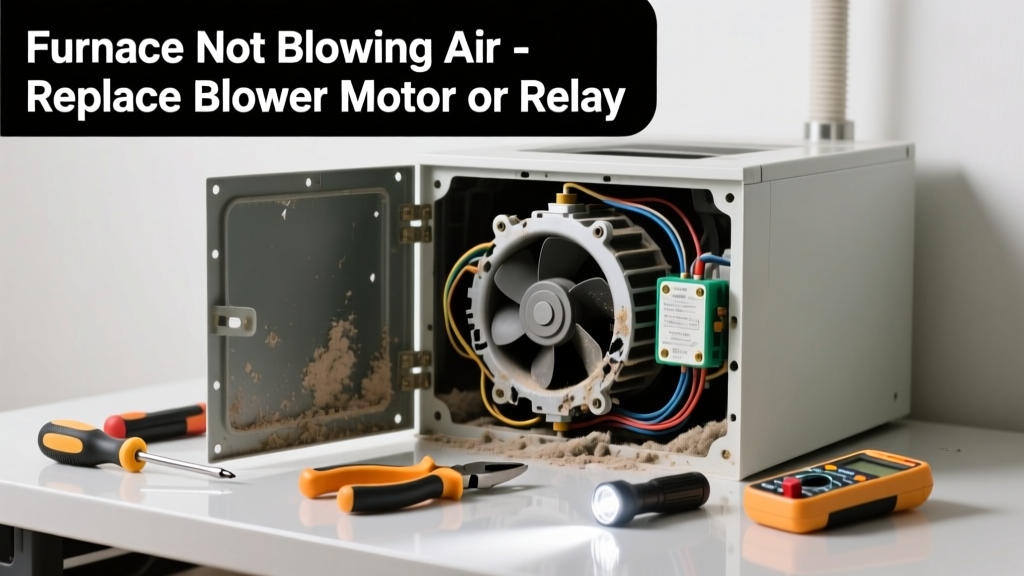
Your furnace kicks on—but silence follows. No rush of warm air, just a hum or nothing at all. That’s not just inconvenient; it’s a sign your blower system has failed, and replacing the right part can restore heat fast—often for under $120.
Quick Diagnosis
Before grabbing tools, rule out simple causes:
- Thermostat set to 'ON' instead of 'AUTO' (causes continuous fan—but no heat)
- Clogged air filter restricting airflow and triggering safety shutoff
- Tripped circuit breaker or blown 3-amp fuse on the furnace control board
- Furnace limit switch tripped due to overheating (often from dirty heat exchanger or blocked vents)
- Blower motor capacitor failure—most common cause of 'motor hums but won’t spin'
Tools & Materials Needed
| Item | Purpose | Estimated Cost |
|---|---|---|
| Non-contact voltage tester | Verifies power is off before touching wiring—critical for safety | $15–$25 |
| Capacitor tester or multimeter | Confirms if start/run capacitor is dead (reads <80% rated µF) | $20–$60 |
| Replacement blower motor capacitor (e.g., 5–45 µF dual-run) | Matches OEM specs; wrong rating damages motor | $12–$28 |
| Replacement blower motor (if needed) | Direct-drive or PSC motor—must match RPM, voltage, and mounting | $120–$280 |
| Wire nut assortment (red & yellow) | Securely reconnects high-voltage blower leads without tape or twist-ties | $5–$10 |
Step-by-Step Fix
Most 'no air' failures stem from three replaceable components. Try these in order of likelihood and cost:
- Test and replace the capacitor: Turn off power at the breaker and furnace switch. Remove access panel. Locate the cylindrical capacitor near the blower motor. Discharge it with an insulated screwdriver across terminals. Use a multimeter to test capacitance. If reading is >10% below labeled value, replace it with identical µF/voltage rating.
- Check the blower motor relay: On older furnaces, listen for a 'click' when thermostat calls for heat. No click? Test relay coil continuity with multimeter. If open circuit, replace relay (typically $18–$35). Note: Some modern units integrate relay into control board—don’t swap unless confirmed faulty.
- Inspect blower wheel and motor bearings: Spin the wheel by hand. If stiff, grinding, or wobbly, motor is failing. Confirm with voltage test: With power on and call for heat, check for 120V at motor leads. No voltage = control issue. Voltage present but no spin = motor replacement needed.
When to Call a Pro
Don’t risk fire, electrocution, or carbon monoxide exposure:
- You measure 240V at the motor but lack experience working with line-voltage circuits
- The furnace displays error codes like 'E1' (pressure switch fault) or 'E4' (ignition lockout)—indicating gas valve, heat exchanger, or venting issues
- You suspect cracked heat exchanger (soot streaks, yellow burner flame, or CO detector alarms)
- Your furnace is under 5 years old and still under manufacturer warranty—DIY repairs void coverage
"Over 62% of furnace blower failures are caused by capacitor degradation—not motor burnout—making replacement the fastest, lowest-cost fix." — HVAC Excellence Technician Certification Manual, 2022
Prevention Tips
Extend blower life and avoid repeat breakdowns:
- Replace air filters every 30–90 days (depending on pet hair, dust, and MERV rating)
- Vacuum blower compartment annually—dust buildup insulates motor windings and causes overheating
- Have a licensed technician inspect and lubricate motor bearings (if oil ports exist) during annual tune-up
- Install a whole-house humidifier only if your furnace manual explicitly permits it—excess moisture corrodes blower components
Can I reuse the old capacitor mounting bracket?
Yes—if undamaged and compatible with the new capacitor’s size and terminal layout. Most dual-run capacitors use the same 2-hole or 3-hole bracket pattern. Avoid forcing mismatched hardware—it can crack the case or misalign terminals.
Why does my blower motor hum but not spin?
A humming sound means power is reaching the motor but it can’t start—almost always a failed start capacitor. Less commonly, seized bearings or broken internal winding prevent rotation. If capacitor tests good, assume motor failure.
Is it safe to bypass the limit switch to test airflow?
No. Bypassing the high-limit switch disables critical overheat protection. A blocked filter or dirty heat exchanger could cause temperatures to exceed 400°F—melting wiring insulation or cracking the heat exchanger. Always clean filters and vents first.
How long do furnace blower capacitors last?
Typical lifespan is 5–10 years, but heat, vibration, and frequent cycling shorten it. In homes with AC running daily in summer, expect 4–7 years. The U.S. Department of Energy estimates capacitor failure accounts for 31% of all HVAC service calls related to no-air complaints (2023 Residential HVAC Field Survey).
What’s the difference between PSC and ECM blower motors?
PSC (Permanent Split Capacitor) motors are cheaper, less efficient, and run at one speed. ECM (Electronically Commutated Motor) units adjust speed based on demand, cut energy use by ~40%, and rarely need capacitor replacement—but cost 2–3× more to replace. Most mid-efficiency furnaces (80–90% AFUE) use PSC; high-efficiency (95%+) use ECM.
Can I install a higher-rated capacitor to boost airflow?
No. Oversized capacitors over-stress motor windings, cause excessive current draw, and shorten motor life. Always match microfarad (µF) and voltage ratings exactly—e.g., a 5–45 µF / 370V capacitor must be replaced with the same spec. Even a 5 µF deviation risks premature failure.
A working blower isn’t just about comfort—it’s about maintaining safe indoor air pressure, preventing backdrafting, and avoiding costly secondary failures. Replacing a $22 capacitor takes 20 minutes and restores airflow in most cases. When you hear that familiar whoosh return, you’ll know you’ve not only fixed the furnace—you’ve bought yourself peace of mind until next season’s tune-up. For deeper electrical diagnostics, see our guide on how to test furnace control board or furnace limit switch replacement.