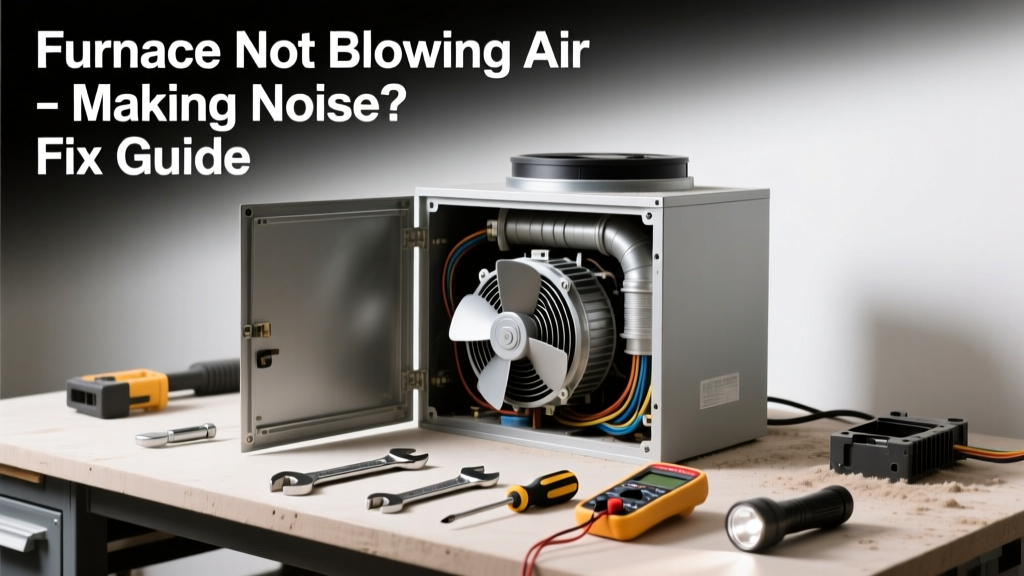
It’s 3 a.m., your thermostat says "heat on," but the vents are dead silent—and then you hear it: a metallic screech, a loud bang, or a low groan coming from the basement. When your furnace stops blowing air and starts making unusual noise, it’s not just inconvenient—it’s a red flag that something’s wrong with critical components.
Quick Diagnosis
Before grabbing tools, narrow down the issue using these common culprits:
- A clogged or collapsed air filter restricting airflow and overheating the heat exchanger
- A failed blower motor capacitor (causing humming or no startup)
- Loose or worn blower wheel causing rattling or scraping
- Cracked heat exchanger (banging or popping sounds during startup/shutdown)
- Faulty inducer motor or pressure switch (whining or delayed ignition)
Tools & Materials Needed
| Item | Purpose | Estimated Cost |
|---|---|---|
| Non-contact voltage tester | Confirms power is off before touching electrical components | $15–$25 |
| 1/4" and 5/16" nut drivers | Tightens blower assembly mounting bolts and access panel screws | $8–$12 |
| Blower motor capacitor tester (or multimeter) | Verifies if the start/run capacitor is within 10% of rated µF | $20–$45 |
| Replacement 5-in-1 air filter (MERV 8) | Prevents airflow restriction and reduces strain on blower motor | $12–$18 |
| Shop vacuum with crevice tool | Removes dust/debris from blower housing and heat exchanger fins | $35–$70 |
Step-by-Step Fix
Work methodically—power off at the breaker first. Never bypass safety controls.
- Check and replace the air filter: A dirty filter is responsible for over 60% of no-airflow complaints (ASHRAE 2022 Residential HVAC Field Study). Slide out the filter—if it’s gray-black or stiff, replace it immediately with a MERV 8 rated filter.
- Inspect the blower wheel and motor mount: Remove the blower compartment access panel. Spin the wheel by hand—if it wobbles, scrapes, or feels gritty, the bearings are failing. Tighten mounting bolts; if play remains, plan for motor replacement.
- Test the capacitor: Use a multimeter set to capacitance mode. Disconnect wires, discharge the capacitor with an insulated screwdriver across terminals, then test. If reading is >10% below labeled µF (e.g., 5 µF label reads 4.2 µF), replace it—it’s likely why the motor hums but won’t spin.
- Listen for inducer motor issues: Turn power back on and watch the small fan near the heat exchanger. If it spins slowly, stalls, or emits high-pitched whine, the motor’s bearing is seizing. This requires replacement—not repair.
When to Call a Pro
Some noises signal serious, potentially hazardous problems:
- Banging or booming at ignition—could indicate delayed gas ignition or cracked heat exchanger (carbon monoxide risk)
- Sharp metallic grinding with vibration—suggests failing furnace bearings or misaligned blower shaft
- Electrical burning smell or visible arcing inside control panel
- Code 33 or 41 error on digital display (high-limit switch trips or pressure switch failure)
According to the U.S. Consumer Product Safety Commission, improperly repaired furnaces account for 12% of home heating-related CO incidents annually (CPSC 2023).
"If your furnace makes a loud pop when starting up—or shuts off after 2–3 minutes—you’re likely dealing with restricted airflow or a heat exchanger crack. Don’t ignore it. That’s not just noise—it’s a safety warning." — James R. Loughlin, NATE-certified HVAC trainer, 2022
Prevention Tips
Extend your furnace life and prevent repeat failures:
- Replace filters every 30–90 days (more often with pets or allergies)
- Vacuum blower wheel and heat exchanger fins twice yearly—dust buildup reduces efficiency by up to 15% (DOE 2021)
- Keep return air grilles unobstructed (no furniture, rugs, or curtains blocking them)
- Install a smart thermostat with runtime alerts to catch abnormal cycling early
Why does my furnace make a loud bang when it turns on?
This is usually delayed ignition—gas builds up before lighting. Common causes include dirty burners, weak igniter, or gas valve issues. Clean burners with a wire brush and compressed air—but if banging persists, call a technician. A cracked heat exchanger can also cause this and must be verified with a combustion analyzer.
Can I lubricate the blower motor myself?
Most modern furnace blower motors are sealed and permanently lubricated—adding oil will damage them. If yours has oil ports (older belt-drive models), use only 1–2 drops of ISO 32 turbine oil per port annually. Over-lubrication attracts dust and causes sludge.
Is it safe to run the furnace if it’s making a whining noise?
A constant whine often means the inducer motor’s bearings are failing. It’s *not* safe to ignore: continued operation risks motor seizure, overheating, or triggering a lockout. Shut it down and replace the motor—don’t wait for total failure.
How do I know if the blower motor is burned out?
If the motor gets hot to the touch, emits a burnt odor, or draws >15% more amps than its nameplate rating (measured with a clamp meter), it’s failing. Also check for open windings with a multimeter—set to continuity; no beep across main winding terminals means internal break.
What’s the average cost to replace a furnace blower motor?
Parts alone run $180–$450 depending on model and whether it’s AC or DC variable-speed. Labor adds $225–$375. Replacing just the capacitor ($12–$22) often solves 40% of “humming but no spin” cases—so test that first before assuming motor failure.
Can a dirty flame sensor cause no airflow and noise?
No—flame sensors affect ignition and burner operation, not blower function. But a soot-covered sensor can cause short cycling, which stresses the blower and may amplify existing mechanical noise. Clean it with fine steel wool and isopropyl alcohol as part of routine maintenance, especially if you notice frequent shutdowns.
A noisy, non-blowing furnace isn’t just an annoyance—it’s your system screaming for attention. Most airflow and noise issues stem from simple oversights like neglected filters or aging capacitors. Tackle those first, stay grounded with proper safety checks, and know when to step back. Your comfort—and safety—depends on it. For related troubleshooting, see our guides on furnace won’t turn on and furnace blowing cold air.