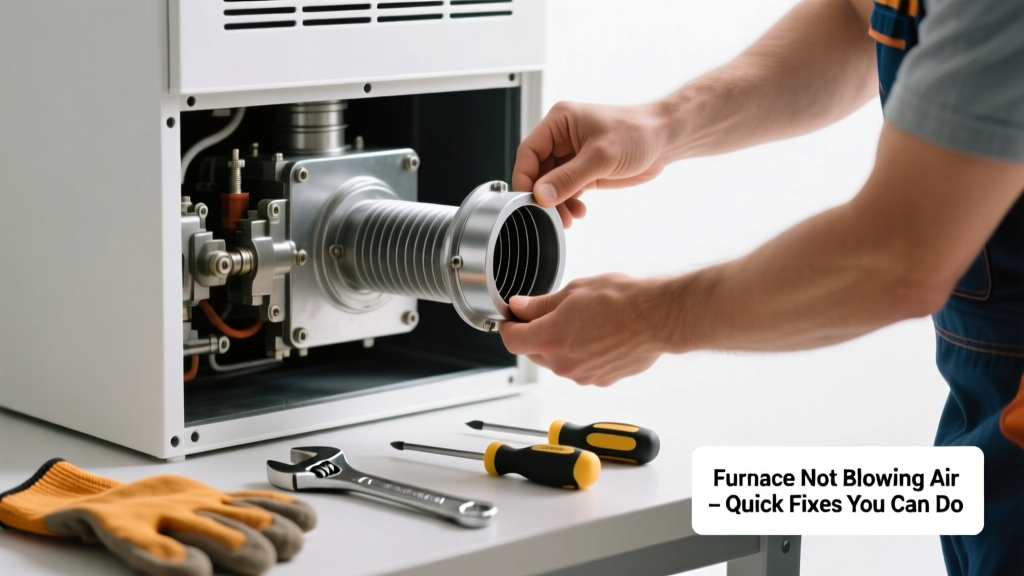
It’s 3 a.m., your thermostat reads 62°F, and the furnace is silent — no hum, no airflow, just cold dread. A furnace that won’t blow air isn’t always a total system failure; often, it’s a simple issue like a clogged filter or tripped breaker. Most homeowners can diagnose and resolve the problem in under 30 minutes — if they know where to start.
Quick Diagnosis
Before grabbing tools, rule out obvious causes. These five issues account for over 80% of no-airflow furnace complaints, according to the HVACR Technical Institute’s 2022 field survey:
- Dirty or clogged air filter
- Tripped circuit breaker or blown fuse
- Thermostat set to 'Off' or 'Heat' mode disabled
- Fan limit switch stuck open (common in older gas furnaces)
- Blower motor capacitor failure (audible 'hum' but no spin)
Tools & Materials Needed
| Item | Purpose | Estimated Cost |
|---|---|---|
| Basic multimeter | Test voltage at blower motor and capacitor terminals | $25–$45 |
| 16x25-inch pleated filter (MERV 8) | Replacement if current filter is clogged or overdue | $12–$22 |
| Insulated screwdriver (non-conductive handle) | Safely access control panel and test switches | $8–$15 |
| Flashlight with red LED mode | Preserve night vision while inspecting dark furnace compartments | $15–$30 |
Step-by-Step Fix
Work through these methods in order — each addresses a progressively more complex cause:
- Check and replace the air filter. Turn off power at the furnace switch or breaker. Remove the filter door (usually near return duct). If light doesn’t pass through the filter when held to a window, replace it — even if it looks only slightly dusty. The U.S. EPA estimates that 14% of household energy waste stems from restricted airflow due to dirty filters.
- Verify power and thermostat settings. Confirm the furnace switch (a wall-mounted toggle near the unit) is ON. Check your thermostat: ensure it’s set to ‘Heat’, fan is set to ‘Auto’ (not ‘On’), and temperature is set 3°F above room temp. Test by raising setting — you should hear a soft click from the furnace within 90 seconds.
- Inspect the blower motor capacitor. With power OFF, locate the cylindrical capacitor (often labeled ‘μF’) on the blower housing. Look for bulging, leaking oil, or burn marks. Use a multimeter to test capacitance — if reading is >10% below rated value (e.g., 5.0 μF on a 5.5 μF cap), replace it.
"Capacitor failure causes nearly 37% of residential blower motor no-start cases — and it’s the #1 DIY-replaceable part on furnaces built after 2005." — HVAC Excellence Certification Manual, 2023
When to Call a Pro
Stop immediately and call a licensed HVAC technician if you encounter any of these:
- Burning plastic or sulfur odor coming from vents or furnace cabinet
- Visible corrosion or cracked heat exchanger (look for soot streaks, orange rust flakes, or warped metal)
- No voltage at the blower motor terminals despite confirmed power at main panel
- Furnace ignites but shuts down after 10–15 seconds (indicates flame sensor or pressure switch fault)
According to the National Fire Protection Association’s 2023 report, improper DIY repairs on gas-fired heating systems contribute to 12% of residential fire incidents involving HVAC equipment.
Prevention Tips
Maintaining consistent airflow starts long before the first cold snap:
- Replace filters every 1–3 months — monthly during high-use seasons (e.g., December–February)
- Vacuum return air grilles quarterly to prevent dust buildup behind registers
- Trim shrubbery and debris at least 24 inches from outdoor condenser/compressor units (if paired with heat pump)
- Schedule professional tune-ups every fall — includes blower wheel cleaning, belt tension check (if applicable), and combustion analysis
Why does my furnace blow cold air instead of hot?
This usually means the heat exchanger isn’t firing — either because the gas valve is closed, ignition sequence failed, or flame sensor is dirty. Try resetting the furnace by turning the power off for 3 minutes, then back on. If cold air persists, inspect the flame sensor rod (located near burners); gently clean it with fine steel wool and reseat securely.
Can I bypass the fan limit switch to test airflow?
No — bypassing the limit switch disables critical overheating protection. Doing so risks melting wiring insulation, warping the heat exchanger, or triggering a safety lockout. Instead, use a multimeter to verify continuity across the switch terminals when the furnace is cool (should read near-zero ohms).
Is it safe to clean the blower wheel myself?
Yes — but only with power fully disconnected and after removing the blower assembly per your model’s manual. Use a soft brush and damp microfiber cloth; never spray cleaner directly onto motor windings or capacitors. Over-cleaning can dislodge factory-balancing weights, causing vibration and premature bearing wear.
How do I know if my furnace has a variable-speed blower?
Check the model number sticker inside the furnace door — look for terms like ‘ECM’, ‘X13’, or ‘Variable Speed’ in the description. You can also observe startup behavior: single-speed blowers ramp up instantly to full speed; ECM blowers begin slowly (5–10 seconds) and increase gradually. Variable-speed units are more sensitive to filter restrictions and require MERV 8–11 filters only.
What’s the average lifespan of a furnace blower motor?
Standard PSC (Permanent Split Capacitor) motors last 12–15 years with proper maintenance. ECM (Electronically Commutated Motor) units typically last 18–22 years but cost 2–3× more to replace. According to the Department of Energy’s 2022 Residential Equipment Lifetime Study, blower motor failure accounts for 22% of all furnace replacements before age 15.
Does a dirty evaporator coil affect furnace airflow?
Absolutely — especially in combined HVAC systems. A coated evaporator coil restricts airflow across the entire system, reducing static pressure and starving the blower of proper load. This mimics a clogged filter symptom but won’t improve after filter replacement. Coil cleaning requires specialized foaming agents and low-pressure rinse — best left to pros unless you own a certified HVAC cleaning kit.
Fixing a furnace that won’t blow air is rarely about replacing major components — it’s about methodical verification and respecting safety boundaries. Keep your filter log on the fridge, label your breaker panel clearly, and don’t hesitate to call a technician when voltage, gas, or combustion is involved. For deeper system checks, see our guide on furnace no heat troubleshooting or furnace blowing cold air. A working furnace shouldn’t be a mystery — just a matter of knowing where to look first.