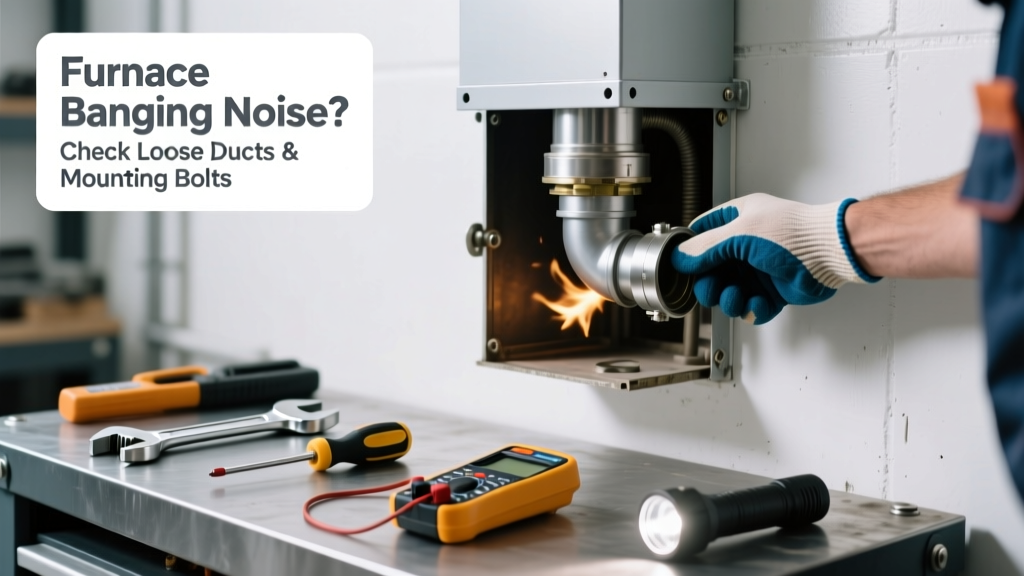
That loud banging sound when your furnace kicks on isn’t just annoying—it’s a red flag. It often signals delayed ignition, ductwork stress, or failing components that could worsen quickly. Ignoring it risks carbon monoxide leaks, fire hazards, or costly system failure before winter peaks.
Quick Diagnosis
Start here—most banging issues fall into one of these five categories:
- Delayed ignition: Gas builds up then ignites violently (most common cause of loud bangs)
- Dirty or misaligned burners: Causes uneven flame spread and combustion instability
- Loose or warped heat exchanger: Metal flexes rapidly during heating cycles, creating sharp metallic pops
- Over-pressurized ductwork: Especially in older homes with undersized or blocked supply vents
- Failing inducer motor or blower assembly: Vibration transfers through sheet metal, sounding like banging
Tools & Materials Needed
| Item | Purpose | Estimated Cost |
|---|---|---|
| Combustible gas detector | Verifies no gas leaks before servicing burners or ignition system | $45–$120 |
| Soft-bristle burner brush (stainless steel) | Cleans debris from burner ports without damaging orifice alignment | $8–$15 |
| Digital multimeter | Tests voltage to igniter, pressure switch, and inducer motor windings | $25–$65 |
| 1/4" hex bit set + ratchet | Accesses tight mounting screws on heat exchanger access panels and blower housing | $12–$28 |
| Manometer (water column gauge) | Measures gas pressure at manifold—critical for diagnosing delayed ignition | $35–$95 |
Step-by-Step Fix
Work only with power and gas shut off. Verify lockout with a multimeter before touching any component.
- Clean the burners and igniter: Remove front access panel. Use compressed air (not shop vac) and the soft-bristle brush to clear soot and spider webs from burner ports and electrode tip. Realign igniter so gap is exactly 1/8" from burner port per manufacturer specs.
- Check gas pressure: Attach manometer to test port on gas valve. Normal range is 3.5 ± 0.2 inches WC for natural gas. If below 3.2, contact your utility—low pressure causes delayed ignition and banging. Do not adjust regulator yourself.
- Inspect heat exchanger for cracks or warping: Shine a flashlight into primary and secondary heat exchangers. Look for orange discoloration, hairline cracks, or buckled seams. If found, stop immediately—replacement is mandatory.
- Verify duct static pressure: With furnace running on heat, hold hand over nearest supply vent. If airflow feels weak or pulsing, measure static pressure with a manometer across return and supply plenums. Above 0.5" WC indicates restriction—clean filters, check for collapsed ducts or closed dampers.
When to Call a Pro
Stop and call a licensed HVAC technician if you encounter any of these:
- Gas smell (rotten egg odor) near furnace or vent pipes
- Carbon monoxide alarm activation or unexplained headaches/nausea in home
- Visible cracks, holes, or corrosion inside heat exchanger
- Furnace fails to ignite after three reset attempts
- Ignition sequence includes sustained yellow flame or flame rollout (flame escaping combustion chamber)
"Delayed ignition accounts for over 68% of reported furnace banging incidents—and 42% of those involve dangerously high unburned gas accumulation before ignition," according to the National Fire Protection Association's 2022 Residential Heating Equipment Report.
Prevention Tips
Extend your furnace’s life and avoid banging by doing these quarterly and annually:
- Replace 1-inch pleated filter every 30 days; upgrade to MERV 8–11 for better particle capture without restricting airflow
- Clear snow, leaves, and debris from outdoor condenser/combo unit intakes and exhaust vents
- Schedule professional tune-up every fall—including gas pressure verification, heat exchanger inspection, and blower balancing
- Install a smart thermostat with equipment monitoring (e.g., ecobee SmartThermostat with Voice Control) to detect abnormal startup patterns early
Why does my furnace bang only when it first turns on?
This points strongly to delayed ignition. Gas accumulates in the combustion chamber for 1–3 seconds before the igniter sparks, causing a mini-explosion. Clean burners and verify gas pressure—don’t ignore this. It’s the most common precursor to cracked heat exchangers.
Can a dirty air filter cause banging noises?
Yes—but indirectly. A clogged filter reduces airflow, causing the heat exchanger to overheat and expand rapidly. That thermal stress creates popping or banging as metal flexes. Replace it monthly during heavy use, and never run the furnace without a filter.
Is it safe to reset my furnace repeatedly if it bangs?
No. Each reset attempt risks reigniting accumulated gas. The control board allows only 3–5 retries before locking out. If it locks out, leave power off and call a pro—don’t bypass safety controls.
What’s the difference between a bang and a pop?
A sharp, single bang usually means delayed ignition or duct slam. A rhythmic pop (every 30–90 sec) suggests heat exchanger expansion/contraction—often due to age or rapid temperature swings. Both warrant inspection, but the former is more urgent.
How long should a furnace last before banging becomes normal?
Banging is never normal—even in older units. According to the U.S. Department of Energy, furnaces over 15 years old have a 37% higher risk of combustion-related failures, but banging always indicates an active fault needing correction, not wear-and-tear acceptance.
Can I lubricate the blower motor to stop banging?
No. Most modern blower motors are sealed and permanently lubricated. Adding oil can damage internal bearings or attract dust, worsening vibration. If blower noise accompanies banging, check for loose mounting bolts or bent fan blades instead.
A banging furnace isn’t just noisy—it’s sending urgent signals about combustion safety, airflow integrity, or structural fatigue. Address it methodically: start with burner cleaning and gas pressure, escalate to heat exchanger inspection, and know when your skill level ends and professional help begins. Regular maintenance doesn’t eliminate all surprises, but it prevents most banging—and keeps your family warm and safe all winter.