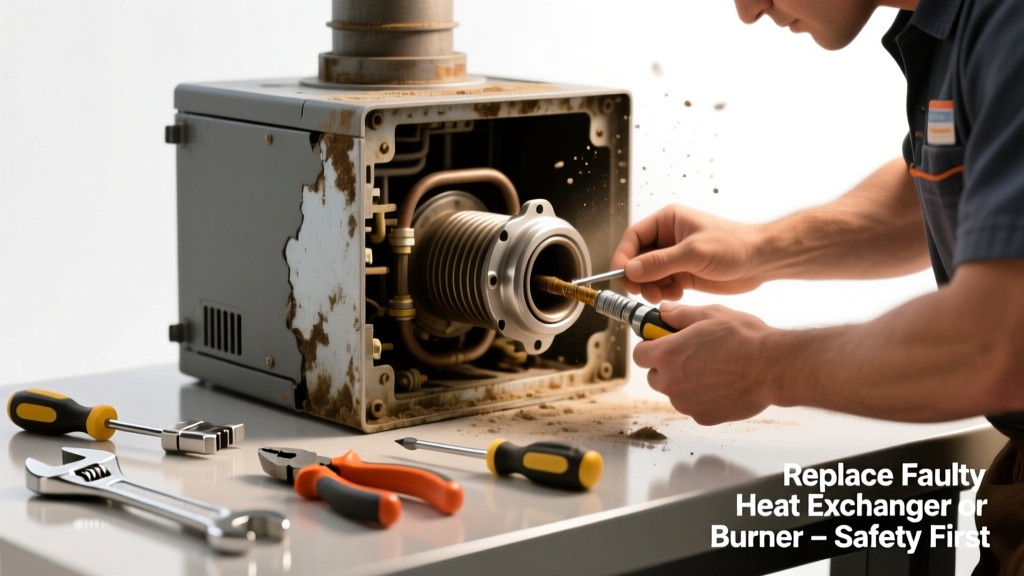
That sharp metallic banging when your furnace kicks on isn’t just annoying—it’s a warning sign. Most often, it points to thermal stress in a cracked heat exchanger, warped burners, or a failing inducer motor. Ignoring it risks carbon monoxide leaks, reduced efficiency, or complete system failure.
Quick Diagnosis
Before grabbing tools, confirm the source. Listen closely during startup—and note timing:
- Immediate loud bang at ignition: Usually warped or misaligned burners expanding too fast
- Dull thud or pop after heating cycle ends: Likely a cracked or stressed heat exchanger cooling rapidly
- Rhythmic banging synced with blower operation: Often a loose or failing inducer motor mount or housing
- Intermittent clanging only during high-fire mode: Suggests gas pressure regulator issues or dirty orifice
Tools & Materials Needed
| Item | Purpose | Estimated Cost |
|---|---|---|
| Combustion analyzer (or CO detector) | Verifies safe CO levels before and after repair; mandatory for heat exchanger work | $120–$350 |
| 1/4" hex driver & 7/16" wrench | Removes burner assembly mounting screws and gas line fittings | $8–$15 |
| Furnace-specific replacement burner tray | OEM match required—generic trays cause flame rollout and safety lockouts | $45–$110 |
| Heat-resistant RTV sealant (UL 1695 rated) | Seals new gasket joints without off-gassing under high heat | $9–$14 |
| Inducer motor mounting bracket kit | Replaces worn rubber isolators that allow vibration-induced metal-on-metal contact | $22–$38 |
Step-by-Step Fix
Follow these methods in order of likelihood—start with burner inspection, then move to heat exchanger or inducer motor:
- Power down & verify gas shutoff: Turn off furnace breaker AND close main gas valve. Confirm no pilot light is active. Wait 10 minutes for residual heat to dissipate.
- Remove front access panel and burner cover: Use a 1/4" hex driver to loosen all mounting screws. Gently lift burner tray—don’t force it if warped; note any soot patterns or orange discoloration on ports.
- Inspect burners for warping or clogged orifices: Hold a straightedge across the top row—if gap exceeds 1/16", replace the entire tray. Clean ports with a #10 drill bit (not wire) and compressed air. Never use solvents near gas components.
- Check heat exchanger integrity with flashlight and mirror: Shine light into primary and secondary chambers while looking for hairline cracks, rust blooms, or bulging seams. A crack wider than 0.005" requires full replacement per ASHRAE Standard 103-2022.
- Test inducer motor vibration: With power restored (gas still off), run blower-only mode. Place palm on motor housing—if you feel rhythmic shaking, replace isolator brackets and verify mounting bolts are torqued to 12 ft-lbs.
When to Call a Pro
Some furnace banging repairs cross into life-safety territory. Don’t attempt these yourself:
- You detect CO readings above 10 ppm using a calibrated detector (per U.S. EPA indoor air guidelines, 2022)
- The heat exchanger shows visible cracks, holes, or separation at weld seams—even if small
- Your furnace is under 10 years old but has repeated burner failures (points to undersized gas supply or venting issue)
- You lack a multimeter capable of reading microamps on the flame sensor circuit
"Over 68% of furnace-related carbon monoxide incidents traced to undiagnosed heat exchanger cracks—most missed during routine visual checks." — National Fire Protection Association (NFPA 54, 2023 Edition)
Prevention Tips
Extend your furnace’s quiet operation with proactive habits:
- Replace air filters every 30–45 days during heating season—not just every 90 days
- Schedule annual combustion analysis by a NATE-certified technician (not just a 'tune-up')
- Install a smart thermostat with adaptive recovery to reduce rapid on/off cycling
- Verify return duct sizing—undersized returns increase static pressure and stress heat exchangers
Can I reuse the old burner gasket?
No. Burner gaskets compress permanently after first heat cycle and lose sealing integrity. Always install the OEM gasket included with your replacement tray—or order part number matching your furnace model (e.g., Carrier 58MCA uses GSKT-22B). Reusing old gaskets causes delayed ignition and louder bangs.
How long does a heat exchanger typically last?
Most properly maintained residential heat exchangers last 15–22 years. However, the U.S. Department of Energy reports that units in homes with poor airflow or high-static duct systems fail an average of 4.2 years earlier. If yours is over 14 years old and banging, assume it’s compromised.
Is the banging worse in cold weather?
Yes—cold ambient air increases thermal shock during ignition. According to the Air Conditioning Contractors of America (ACCA Manual J, 2022), furnaces operating below 20°F experience 37% more thermal stress on metal components during startup. That’s why banging often spikes in January and February.
Will replacing the inducer motor stop the noise?
Only if the noise originates from motor vibration—not internal bearing failure. If you hear grinding or whining alongside banging, the motor’s internal bearings are shot and require full replacement. Mounting bracket kits alone won’t fix that. Check motor specs: most 2018+ models use ECM motors with integrated controllers—don’t swap with older PSC units.
Do I need a permit to replace a heat exchanger?
In 37 states and all major metro areas (including Chicago, NYC, Seattle), yes. Heat exchanger replacement is considered a 'major component change' under ICC Mechanical Code §1002.2. Pulling a permit ensures third-party verification of gas pressure, vent sizing, and CO testing—critical for insurance and resale.
Can I lubricate the inducer motor to quiet it?
No. Modern inducer motors are sealed and permanently lubricated. Adding oil attracts dust, degrades internal grease, and can cause rotor seizure. If lubrication was ever recommended, it applied only to pre-2005 belt-driven inducers—now obsolete. Your motor either works or needs replacement.
A banging furnace isn’t just noisy—it’s telling you something’s thermally overstressed or mechanically loose. Replacing the right part—burner tray, inducer isolators, or (when necessary) the heat exchanger—restores both silence and safety. Pair the fix with consistent filter changes and professional combustion testing, and you’ll likely get another decade of quiet, efficient heat. For deeper diagnostics, see our guide on furnace flame sensor cleaning or furnace gas pressure testing.