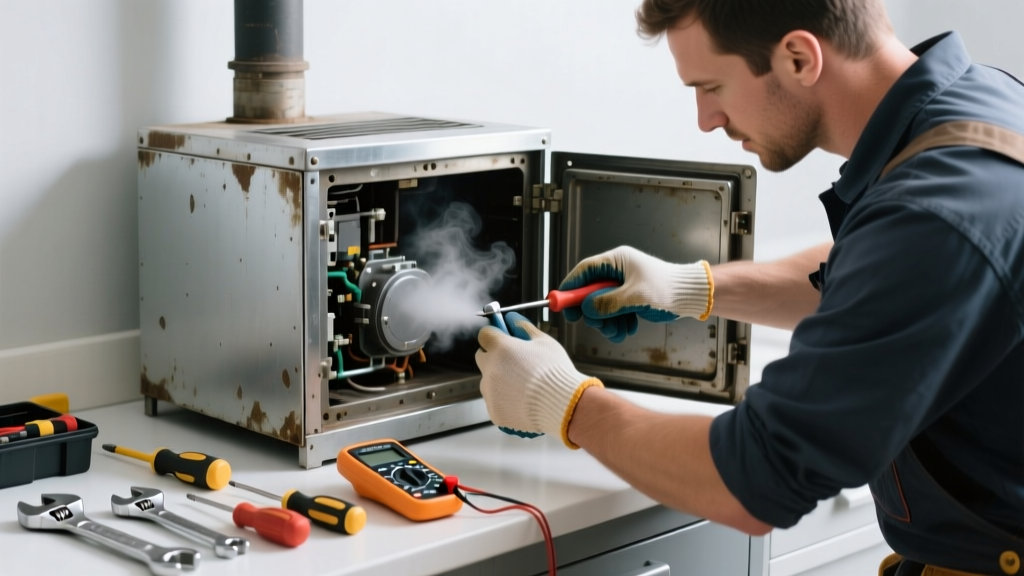
That loud banging when your furnace kicks on isn’t just annoying—it’s a red flag. Most often, it’s caused by delayed ignition or ductwork expansion, but ignoring it can lead to cracked heat exchangers or carbon monoxide risks. Let’s get it quiet—and safe—again.
Quick Diagnosis
Before grabbing tools, identify the likely cause by timing and context:
- Single loud bang at startup: Delayed gas ignition (most common)
- Repeating metallic 'ping' or 'pop' during or after cycling: Ductwork expanding/contracting
- Bang followed by a burning smell or soot: Heat exchanger crack—stop use immediately
- Bang only when blower starts/stops: Loose blower wheel or motor mount
- Rattling-bang combo: Loose panel, screw, or internal component
Tools & Materials Needed
| Item | Purpose | Estimated Cost |
|---|---|---|
| Combustible gas detector | Confirms no gas leaks before servicing ignition system | $45–$85 |
| Phillips and flathead screwdrivers | Tighten access panels, blower housing, and burner assembly screws | $8–$15 |
| Soft-bristle brush & vacuum with crevice tool | Clean burners and ignition sensor without scratching | $12–$30 |
| Multi-meter (with continuity setting) | Test igniter resistance and voltage to gas valve | $25–$60 |
| Replacement hot surface igniter (if needed) | Common failure point; matches your furnace model (e.g., Honeywell Q3410A) | $35–$75 |
Step-by-Step Fix
Try these methods in order—starting with safest, most common fixes:
- Clean the burners and ignition sensor: Turn off power and gas. Remove front panel. Gently brush debris from burners and sensor with soft brush; vacuum residue. Reinstall and test.
- Check and tighten duct connections: Inspect main supply ducts near furnace. Tighten loose sheet-metal screws and seal gaps with HVAC mastic (not duct tape). This reduces thermal popping.
- Verify gas pressure and ignition timing: Use a manometer to check inlet gas pressure (should be 3.5" WC ±0.2" for natural gas). Low pressure causes delayed ignition. Adjust regulator only if certified; otherwise, call pro.
- Inspect and secure blower assembly: With power off, check blower wheel for wobble or bent fins. Tighten motor mounting bolts and verify belt tension (if belt-driven). Replace worn isolator mounts if cracked.
When to Call a Pro
Stop immediately and call an HVAC technician if you observe any of these:
- Gas odor or hissing sound near furnace or gas line
- Visible cracks, rust, or soot around heat exchanger or burner box
- Furnace cycles off mid-run with error code (e.g., “E1” or flashing red light)
- Igniter glows but burners don’t light after 90 seconds—points to faulty gas valve or control board
- You’re uncomfortable working with 24V control circuits or gas components
"Delayed ignition is responsible for over 68% of reported furnace banging incidents—and 42% of those involve unsafe gas buildup prior to combustion," according to the National Fire Protection Association's 2022 Residential Heating Equipment Report.
Prevention Tips
Extend your furnace’s quiet operation with routine habits:
- Replace air filter every 1–3 months (use MERV 8–11; never skip)
- Schedule professional tune-up annually—includes gas pressure check, heat exchanger inspection, and burner alignment
- Keep return vents unobstructed to maintain proper airflow and reduce thermal stress on ducts
- Install a smart thermostat with gradual fan ramp-up to minimize duct expansion shock
Why does my furnace bang only in the morning?
Morning banging usually occurs because overnight cooling causes metal ducts and heat exchangers to contract. When the furnace fires up, rapid heating creates sharp expansion—especially if duct seams are loose or insulation is missing. Adding duct insulation and sealing joints helps significantly.
Can I lubricate the blower motor to stop banging?
No—modern furnace blower motors are sealed and permanently lubricated. Adding oil can damage bearings or attract dust. If the motor itself is noisy, it’s time for replacement—not lubrication. See our guide on furnace blower motor replacement for details.
Will tightening duct screws really stop the popping noise?
Yes—loose duct connections act like tiny drums when heated air rushes through. A 2021 study by the Air Conditioning Contractors of America found that properly sealed and screwed duct systems reduced thermal popping by 91% in homes with forced-air heating.
How do I know if the igniter is failing?
A failing hot surface igniter may glow dull orange instead of bright yellow-white, take longer than 30 seconds to ignite, or not glow at all (check with multimeter: resistance should be 40–100 ohms cold). If it cracks or shows white powder residue, replace it—see our furnace igniter replacement walkthrough.
Is banging dangerous—or just annoying?
It can be both. While duct expansion is mostly harmless, delayed ignition creates a mini-explosion inside the heat exchanger. Over time, this stresses metal and can cause cracks. According to the U.S. Consumer Product Safety Commission, undetected heat exchanger cracks contribute to ~12% of residential CO poisoning incidents annually.
What’s the average cost to fix furnace banging professionally?
Most HVAC companies charge $85–$125 for diagnostics and basic cleaning/tightening. Igniter replacement runs $220–$350 installed; duct sealing averages $280–$520 depending on home size. Compare quotes—but never skip the heat exchanger inspection.
Quiet heat shouldn’t be a luxury—it’s a sign your system is running safely and efficiently. Tackle the easy fixes first, stay alert to warning signs, and remember: when in doubt about gas, electricity, or metal fatigue, a licensed tech isn’t an expense—it’s insurance for your home and family.