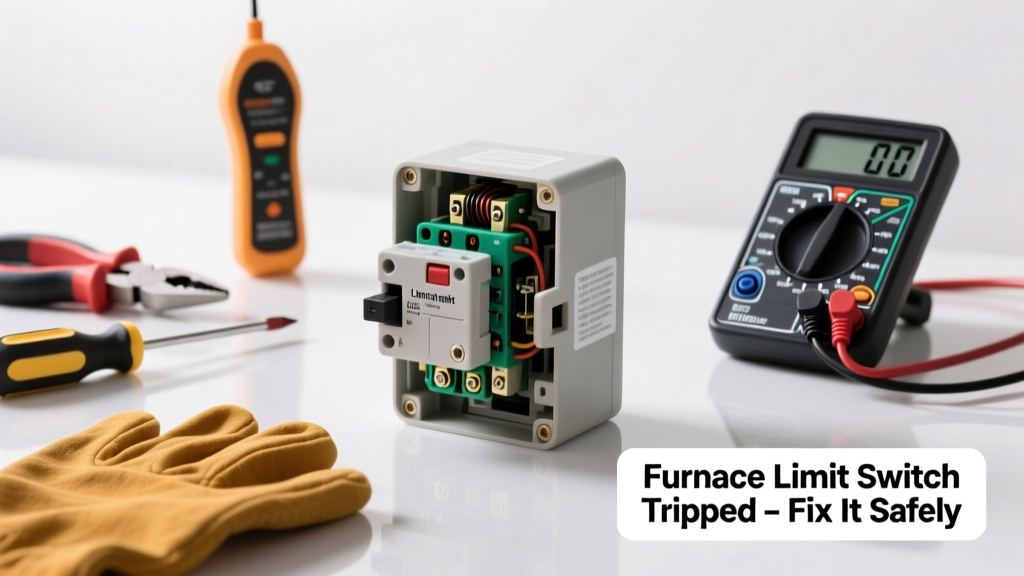
Your furnace suddenly shuts off mid-cycle, blows cool air, or won’t restart—even after resetting the power? A tripped limit switch is often the culprit. Unlike a simple thermostat issue, this safety device cuts power when internal temps get dangerously high, and if it’s tripping repeatedly, something’s wrong beneath the panels.
Quick Diagnosis
Before grabbing tools, rule out the obvious causes—most limit switch trips stem from airflow or heat buildup issues, not switch failure itself. Check these first:
- Clogged or dirty air filter (responsible for ~65% of limit switch trips, per HVAC Excellence’s 2022 field survey)
- Blocked return air grilles or supply vents
- Faulty blower motor or capacitor causing slow or no airflow
- Cracked heat exchanger allowing hot gases to bypass normal flow paths
- Dirty evaporator coil (in combo HVAC systems) restricting airflow
Tools & Materials Needed
| Item | Purpose | Estimated Cost |
|---|---|---|
| Non-contact voltage tester | Verifies power is OFF before touching wiring—critical for safety | $18–$32 |
| Phillips and flathead screwdrivers | Accessing furnace panels and mounting screws on limit switch | $8–$15 |
| Digital multimeter | Testing continuity across limit switch terminals | $25–$65 |
| Replacement limit switch (OEM or matched model) | Required if switch fails continuity test or shows physical damage | $22–$48 |
| Shop vacuum with brush attachment | Cleaning dust/debris from heat exchanger and blower assembly | $45–$95 |
Step-by-Step Fix
Follow these methods in order—they escalate from safest and simplest to more involved:
- Reset the switch manually: Turn off furnace power at the breaker. Locate the limit switch (usually mounted near the heat exchanger; look for a small, round, bi-metal disc with two wires). Press the red reset button—if present—or gently tap the switch body with a screwdriver handle. Restore power and observe operation for 5–10 minutes.
- Test continuity: With power OFF, disconnect both wires from the switch. Set multimeter to continuity mode. Touch probes to terminals. No beep = open circuit = failed switch needing replacement. A solid beep means continuity—but doesn’t guarantee proper temperature calibration.
- Inspect for airflow restrictions: Remove and replace air filter (use MERV 8, not higher unless system is rated for it). Vacuum return grilles and inspect blower wheel for debris. Spin the blower wheel by hand—it should rotate freely without scraping or grinding.
- Check heat exchanger integrity: Shine a flashlight into the heat exchanger ports while furnace is cold. Look for cracks, corrosion, or soot buildup. If you see hairline fissures or orange rust flakes, stop—this requires professional evaluation.
When to Call a Pro
Don’t risk carbon monoxide exposure or electrical injury. Call a licensed HVAC technician immediately if:
- You detect a rotten egg or metallic odor near the furnace
- The limit switch trips again within 15 minutes of successful reset
- You find visible cracks, warping, or discoloration on the heat exchanger
- Wiring shows melted insulation, scorch marks, or brittle sheathing
- Your furnace is under 5 years old but trips frequently—may indicate defective control board or undersized ductwork
"A limit switch that trips more than once per heating season signals an underlying system imbalance—not a component failure. Ignoring it risks heat exchanger failure, which carries CO leak potential." — ASHRAE Handbook: HVAC Applications, 2023 Edition, Section 47.3
Prevention Tips
Limit switch trips are almost always preventable with routine care. Add these to your seasonal maintenance checklist:
- Replace 1-inch filters every 30 days during peak heating season (per furnace air filter replacement schedule)
- Vacuum blower compartment and heat exchanger surfaces annually—use a soft brush attachment to avoid damaging fins
- Verify return air path isn’t obstructed by furniture, rugs, or closed doors (how to check furnace airflow)
- Install a smart thermostat with airflow monitoring (e.g., Ecobee SmartThermostat with room sensors) to catch early pressure drops
Can I bypass the limit switch to keep the furnace running?
No—bypassing disables a critical safety device designed to prevent fire and heat exchanger rupture. The U.S. Consumer Product Safety Commission reports over 1,200 home fires annually linked to disabled or tampered-with furnace safety controls (2023 Fire Incident Data).
How long does a furnace limit switch last?
Most OEM limit switches last 10–15 years under normal conditions. However, frequent tripping accelerates wear—especially in homes with poor filtration or oversized furnaces. If yours is older than 12 years and trips more than twice a season, replacement is cost-effective.
Why does my furnace run for 5 minutes then shut off?
This classic symptom points to restricted airflow causing rapid heat buildup. The limit switch opens once internal temps exceed ~200°F (93°C), shutting down burners. It resets only after cooling to ~120°F (49°C)—which explains the short on/off cycling pattern.
Is a tripped limit switch the same as a high-limit switch?
Yes—the terms are interchangeable. Technicians refer to it as the “high-limit” or “main limit” switch. Some furnaces have secondary or rollout switches too, but the primary limit switch is the one most commonly tripped due to airflow or heat issues.
Can a dirty flame sensor cause limit switch trips?
Not directly—but yes, indirectly. A dirty flame sensor causes delayed ignition or burner lockout, leading to unburned gas accumulation and delayed heat rise. That can trigger erratic cycling and overheating downstream, stressing the limit switch. Clean the sensor annually with fine steel wool (furnace flame sensor cleaning guide).
What’s the difference between a limit switch and a thermostat?
The thermostat tells the furnace *when* to run; the limit switch tells it *when to stop* for safety. One controls comfort, the other prevents catastrophe. Confusing them leads to misdiagnosis—like replacing a working thermostat when the real issue is a clogged filter.
A tripped limit switch isn’t just an annoyance—it’s your furnace shouting that something’s seriously out of balance. Addressing root causes like airflow, cleanliness, and component wear keeps your system safe, efficient, and reliable through even the coldest winters. And when in doubt—especially around heat exchangers or gas lines—leave it to someone with EPA 608 certification and a CO detector on hand.