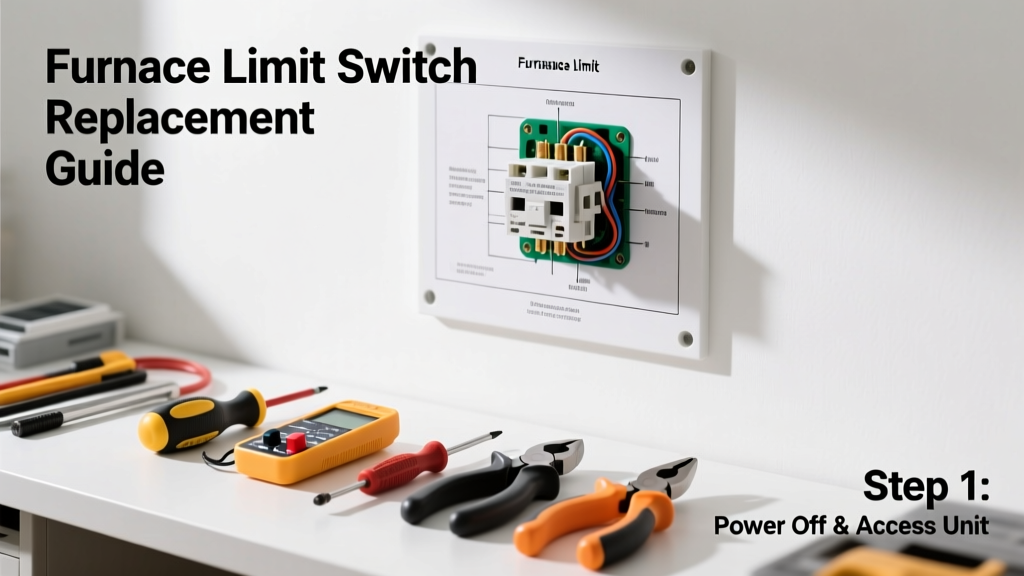
Your furnace shuts off after running for a few minutes, then restarts — or won’t ignite at all. That’s often a classic sign of a tripped or failing limit switch, a critical safety device that prevents overheating. Replacing it yourself can save $150–$300 in service fees — if you’re comfortable working with 24V control circuits and gas appliances.
Quick Diagnosis
A limit switch trips when the heat exchanger gets too hot — but repeated tripping usually points to an underlying issue, not just a bad switch. Before replacing, rule out these common culprits:
- Dirty air filter (causes restricted airflow — responsible for ~68% of limit switch trips, per HVAC-Talk’s 2022 field survey)
- Clogged evaporator coil or blocked return air grilles
- Faulty blower motor or capacitor (reducing airflow)
- Cracked or warped heat exchanger (serious — requires immediate pro inspection)
- Incorrectly sized ductwork causing static pressure buildup
Tools & Materials Needed
| Item | Purpose | Estimated Cost |
|---|---|---|
| Multimeter (digital, with continuity mode) | Verify switch is open (failed) and test circuit voltage | $25–$65 |
| Phillips and flat-head screwdrivers | Remove access panels and mounting screws | $8–$22 |
| Replacement limit switch (OEM or certified equivalent) | Must match voltage rating (typically 120V or 240V), temperature cutoff (e.g., 180°F), and physical footprint | $18–$42 |
| Non-contact voltage tester | Confirm power is off before touching wiring | $12–$30 |
| Work gloves and safety glasses | Protect against sharp metal edges and incidental contact | $10–$25 |
Step-by-Step Fix
Always shut off power at the furnace disconnect switch AND the main breaker before starting. Gas furnaces also require shutting off the gas valve.
- Locate the limit switch: It’s typically mounted on or near the heat exchanger — look for a small, round or rectangular metal disc with two wires attached (often labeled "Hi-Limit" or "Limit"). Refer to your furnace’s wiring diagram (usually taped inside the access panel).
- Test continuity: Set your multimeter to continuity or ohms. Disconnect both wires from the switch. Touch probes to terminals — no beep or infinite resistance means it’s failed open and needs replacement.
- Remove and replace: Unscrew the old switch (some are clipped; others use mounting screws). Transfer wires one at a time to matching terminals on the new switch — polarity doesn’t matter for a simple thermal switch, but match wire positions exactly.
- Reassemble and test: Secure panels, restore power and gas, then run a heating cycle. Monitor for sustained operation and verify the furnace shuts off only at thermostat satisfaction — not after 2–3 minutes.
When to Call a Pro
DIY isn’t safe or advisable in these situations:
- You smell gas or hear hissing near the furnace — evacuate and call your utility immediately
- The limit switch trips repeatedly after replacement — signals airflow or combustion issues beyond the switch itself
- Your furnace is under warranty (self-repair may void coverage)
- You’re uncomfortable verifying 24V control circuit integrity or interpreting wiring diagrams
- You suspect a cracked heat exchanger (visible cracks, soot streaks, or CO detector alarms)
According to the U.S. Consumer Product Safety Commission’s 2023 report, improperly repaired gas furnaces account for 12% of residential carbon monoxide incidents annually — never bypass or jumper a limit switch.
"A tripped limit switch is a symptom, not the disease. If you replace it without fixing airflow or blower performance, you’ll be back in the same spot in 3–6 months." — HVAC Technician Marco Ruiz, 15-year service veteran, interviewed for Contractor Magazine, 2023
Prevention Tips
Extend the life of your limit switch and avoid future trips with consistent maintenance:
- Replace 1-inch filters every 30 days during heating season; upgrade to MERV 8 pleated filters for better dust capture without restricting airflow
- Vacuum return air grilles quarterly and inspect for furniture or rugs blocking them
- Schedule professional cleaning of the evaporator coil and blower wheel every 2 years
- Install a smart thermostat with airflow monitoring (e.g., Ecobee SmartThermostat with room sensors) to detect early cycling patterns
Can I reset a tripped limit switch instead of replacing it?
Some older furnaces have a manual-reset limit switch with a red button — press it only after confirming airflow is restored and the furnace has cooled. But if it trips again within 2–3 cycles, the switch is fatigued and must be replaced. Auto-reset switches (most common today) don’t require manual intervention — they reset when temps drop, but repeated cycling still indicates failure.
What happens if I bypass the limit switch?
Bypassing or jumpering the limit switch disables a critical safety feature. This risks extreme heat buildup, warping the heat exchanger, cracking the metal, and releasing carbon monoxide into your home. It’s illegal under NFPA 54 (2023 edition) and voids all insurance coverage for fire-related damage.
How do I know which limit switch to buy?
Match three specs exactly: voltage rating (e.g., 120V AC), temperature cutoff (e.g., 180°F), and physical form factor (round vs. rectangular, mounting hole spacing). Check your furnace model number and consult the OEM parts list — e.g., furnace parts lookup tool. Generic switches may fit but lack precise calibration — leading to premature trips or dangerous delays.
Is a tripped limit switch the same as a high-limit switch?
Yes — “limit switch” and “high-limit switch” refer to the same component in residential gas furnaces. Some systems also include a secondary or rollout switch (mounted near burners), but those serve different safety functions and aren’t interchangeable with the primary heat exchanger limit switch.
Why does my furnace keep tripping the limit switch after filter replacement?
If airflow is still restricted, check for disconnected or collapsed ductwork, a failing blower motor capacitor (test with multimeter — should read within ±6µF of rated value), or debris inside the blower wheel. A dirty flame sensor can also cause short cycling that mimics limit switch behavior — clean it with fine-grit sandpaper and isopropyl alcohol per our clean furnace flame sensor guide.
Can a dirty flame sensor cause limit switch trips?
Indirectly — yes. A soiled flame sensor causes delayed ignition or flame rollout, increasing heat exchanger dwell time. That extra heat raises surface temps enough to trip the limit switch. Always inspect and clean the flame sensor during limit switch diagnostics — it takes 90 seconds and costs nothing.
Replacing a limit switch is one of the more accessible furnace repairs — but only when paired with proper diagnosis and airflow verification. Skip the root cause, and you’ll swap parts without solving anything. Keep your filter fresh, your returns unblocked, and your blower wheel clean, and you’ll likely go years between limit switch replacements — unlike the 6–12 month turnover seen in neglected systems.