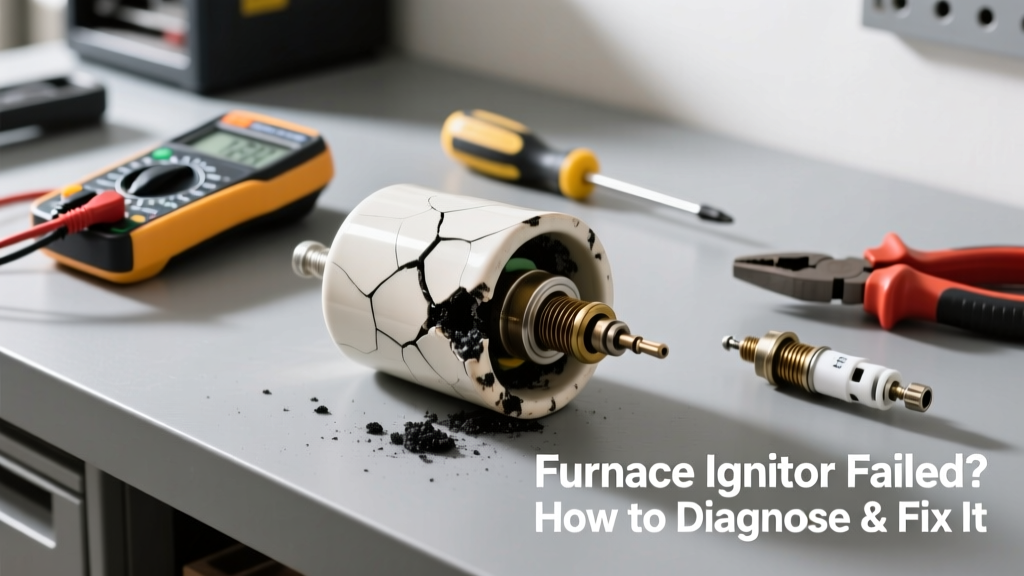
It’s 3 a.m., your thermostat reads 58°F, and the furnace clicks but never fires up—classic ignitor failure. This isn’t just inconvenient; it’s a sign your heating system is stuck in safety lockdown. Most ignitor issues are simple to verify and often fixable in under an hour—if you know what to look for.
Quick Diagnosis
Before grabbing tools, rule out the obvious. A failed ignitor often mimics other problems:
- No visible glow (for hot surface ignitors) or no clicking/spark (for spark ignitors) during startup sequence
- Furnace enters lockout mode after 3–5 failed ignition attempts (check blinking LED code on control board)
- Gas valve opens but burner never lights—confirmed by listening for hissing near burners and smelling faint gas (shut off gas immediately if odor persists)
- Ignitor glows but burner still won’t ignite—points to gas pressure, flame sensor, or air intake blockage
Tools & Materials Needed
| Item | Purpose | Estimated Cost |
|---|---|---|
| Multimeter (digital, with continuity & resistance modes) | Tests ignitor resistance and verifies power delivery | $25–$65 |
| Phillips and 1/4" nut driver | Removes access panels and ignitor mounting hardware | $8–$15 |
| Clean dry cloth + isopropyl alcohol (90%+) | Removes carbon buildup from flame sensor and ignitor tip | $5–$10 |
| Replacement ignitor (match OEM part # exactly) | Direct swap for cracked, warped, or high-resistance units | $45–$120 |
Step-by-Step Fix
Follow these methods in order—they escalate from cleaning to replacement. Always power off the furnace at the breaker and shut off gas before starting.
- Clean the ignitor and flame sensor: Use isopropyl alcohol and a soft cloth to gently wipe the ceramic tip of the ignitor and the stainless steel rod of the flame sensor. Carbon buildup here fools the control board into thinking ignition failed—even if the ignitor works.
- Test ignitor resistance: Set multimeter to ohms (Ω). Disconnect ignitor wires and measure across terminals. Hot surface ignitors should read 40–120 Ω (e.g., Honeywell Q3400A = ~70 Ω cold). Readings over 150 Ω or OL mean internal fracture—replace it.
- Verify voltage delivery: With power restored and furnace in call-for-heat mode, test for 120 VAC at ignitor leads using multimeter. No voltage? Trace back to control board relay or wiring fault—not the ignitor itself.
- Replace the ignitor: Match exact part number (e.g., Robertshaw 78-212, White-Rodgers 50A50-339). Mount securely—overtightening cracks ceramic. Reconnect wires with insulated quick-connects, not tape or wire nuts.
When to Call a Pro
DIY stops where safety and certification begin. Call a licensed HVAC technician if:
- You detect a persistent gas odor during troubleshooting—do not operate furnace or use electrical switches
- Your multimeter shows correct voltage but ignitor still doesn’t glow, and resistance tests pass—suggests control board failure (requires EPA 608 certification to diagnose)
- The furnace is under warranty—tampering may void coverage, especially on sealed combustion or modulating units
- You’re uncomfortable working inside a gas appliance—per the U.S. Consumer Product Safety Commission, improper furnace repairs cause ~200 home fires annually (CPSC Fire Injury Statistics, 2022)
Prevention Tips
Extend ignitor life by reducing thermal stress and contamination:
- Replace your furnace air filter every 1–3 months—restricted airflow causes overheating and premature ignitor cracking
- Have combustion air intakes and exhaust vents inspected annually for snow, nests, or debris
- Run furnace for 10 minutes monthly during summer to prevent moisture-related corrosion on ignitor and sensor surfaces
- Install a whole-house humidifier set to 35–45% RH—low humidity accelerates ceramic brittleness
How do I know if my furnace has a hot surface or spark ignitor?
Remove the lower access panel and observe during a call-for-heat cycle. A hot surface ignitor looks like a small, rectangular ceramic rod glowing orange-red (like a toaster element). A spark ignitor appears as a metal electrode near the burner with visible blue sparks—usually accompanied by a repeated clicking sound. Most modern 80%+ AFUE furnaces use hot surface; older mid-efficiency models often use spark.
Can I bypass the ignitor to test the gas valve?
No—and don’t try. Bypassing safety controls risks unignited gas accumulation, explosion, or carbon monoxide release. The ignitor, flame sensor, pressure switch, and rollout switches form a closed safety loop. If one fails, the control board shuts down gas flow intentionally. Testing gas valve operation requires calibrated manometer readings and manufacturer-specific procedures—leave it to certified technicians.
Why does my ignitor glow but the burner won’t light?
Glow confirms power and basic ignitor function—but doesn’t guarantee successful ignition. Common culprits include a dirty flame sensor (fails to confirm flame), low gas pressure (furnace gas pressure too low), clogged orifice, blocked burner ports, or cracked heat exchanger triggering rollout switch shutdown. Always clean the flame sensor first—it resolves ~65% of ‘glow-but-no-flame’ cases (ASHRAE Applications Handbook, 2021).
How long should a furnace ignitor last?
Most hot surface ignitors last 3–7 years depending on runtime, air quality, and voltage stability. In homes with high dust levels or frequent short-cycling (e.g., oversized furnace), lifespan drops to 2–3 years. Spark ignitors tend to last longer—8–12 years—but their electrodes erode and require periodic gapping adjustment.
Is it safe to touch the ignitor while the furnace is off?
Yes—but only after confirming power is disconnected at the breaker and waiting 10 minutes for residual heat to dissipate. Ceramic ignitors retain heat longer than metal parts. Never handle with wet hands or metal tools that could scratch the surface—micro-fractures lead to immediate failure on next startup.
What’s the difference between an ignitor and a flame sensor?
The ignitor initiates the fire; the flame sensor confirms it’s burning. They’re separate components, often mounted side-by-side but serving opposite roles. Confusing them is common—the flame sensor is a thin, grounded stainless rod that detects ionized flame current (measured in microamps); the ignitor is a resistive ceramic element that heats to ~1,800°F to ignite gas. Cleaning both is essential, but replacing one won’t fix the other’s failure.
"Over 40% of furnace no-heat calls involve either a failed ignitor or a contaminated flame sensor—yet 70% of homeowners attempt cleaning only the sensor, missing the cracked ignitor entirely." — HVAC Excellence Technician Survey, 2023
A working ignitor is the unsung gatekeeper of your winter comfort. When yours fails, act methodically—not hastily. Most replacements cost less than a service call, and doing it right means fewer cold mornings and better system longevity. If you’ve cleaned, tested, and replaced with the correct part but still get no ignition, revisit the flame sensor troubleshooting guide or check for a faulty pressure switch—both common partners in ignition failure. And remember: when in doubt about gas, electricity, or combustion safety, pause and pick up the phone.