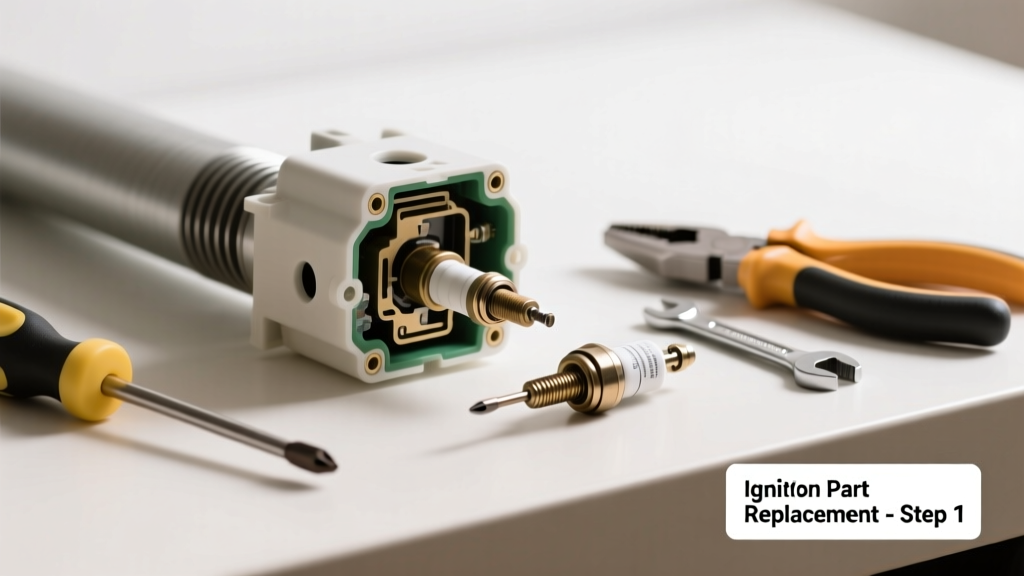
Your furnace clicks but won’t fire up? That hollow *click-click-click* without flame means the ignitor likely failed—especially if your system is over 7 years old. Ignitors wear out silently, and ignoring it risks no heat in sub-zero weather or even safety lockouts that shut down your entire heating system.
Quick Diagnosis
Before assuming the ignitor is dead, rule out these common culprits:
- No power to the furnace (check breaker and disconnect switch)
- Dirty flame sensor blocking ignition sequence
- Gas valve closed or low gas pressure (listen for hissing or smell gas)
- Blower motor not running—prevents proper airflow and safety lockout
- Control board error codes (e.g., flashing red LED: 3 blinks = ignitor fault on many Lennox and Carrier models)
Tools & Materials Needed
| Item | Purpose | Estimated Cost |
|---|---|---|
| Multi-meter (digital) | Test ignitor resistance and verify 120V supply at terminals | $25–$65 |
| Phillips #2 screwdriver | Remove access panels and mounting screws | $5–$12 |
| New ignitor (model-matched) | Must match OEM part number—e.g., Honeywell Q3406A, Nordyne G201-1019 | $28–$72 |
| Work gloves (heat-resistant) | Protect hands from sharp edges and residual heat | $8–$18 |
| Shop vacuum with brush attachment | Clean dust/debris around burner assembly before reassembly | $35–$85 |
Step-by-Step Fix
Follow this sequence—never skip the power-off step. Most modern furnaces require full shutdown (not just thermostat off) to avoid control board damage.
- Turn off power and gas: Flip the furnace breaker AND shut the gas valve near the unit. Wait 5 minutes for residual voltage to dissipate.
- Locate the ignitor: Open the lower access panel; it’s mounted near the burners—usually ceramic, rod-shaped, and attached with two screws (Honeywell) or a bracket (White-Rodgers).
- Test continuity: Set multimeter to ohms. Touch probes to ignitor terminals. A good ignitor reads 40–100 ohms. Infinite resistance = failed part.
- Swap the part: Unscrew the old ignitor, unplug its wiring harness, and install the new one—ensuring no contact with metal or insulation. Tighten screws snugly (over-torquing cracks ceramic).
- Reassemble and test: Vacuum debris from burners and heat exchanger. Restore gas and power. Set thermostat to heat and observe: ignitor should glow orange for 15–30 seconds before gas valve opens.
When to Call a Pro
Don’t attempt this repair if:
- You smell gas before or during testing (evacuate and call your utility immediately)
- Your furnace uses a hot-surface ignitor and a sealed combustion chamber (e.g., high-efficiency condensing models like Trane S9V2 or Rheem R96V)—access requires specialized tools
- You get inconsistent voltage readings (<110V or fluctuating) at the ignitor terminals—points to control board or transformer failure
- The ignitor fails again within 3 months—indicates underlying issues like poor grounding, voltage spikes, or excessive moisture in the heat exchanger
Prevention Tips
Extend ignitor life by doing these twice yearly:
- Vacuum the burner assembly and ignitor mounting area—dust buildup causes overheating and premature cracking
- Check and clean the flame sensor with fine-grit emery cloth (never sandpaper or steel wool)
- Verify furnace filter is changed every 1–3 months—restricted airflow forces longer ignition cycles
- Install a whole-house surge protector; voltage spikes kill ignitors faster than age (per Eaton’s 2022 Residential Power Quality Report)
How do I know which ignitor part number my furnace needs?
Look for the OEM label inside the furnace door or on the ignitor itself—often stamped with codes like Q3406A, G201-1019, or S8610U. Cross-reference with your furnace’s model number using the manufacturer’s parts lookup (e.g., find your furnace model number) or consult the manual’s electrical schematic. Generic replacements often fail early due to mismatched amperage or thermal expansion rates.
Can I test the ignitor without a multimeter?
Yes—but it’s less reliable. With power restored, watch through the sight glass during a call for heat: no visible orange glow means failure. However, a glowing ignitor that doesn’t ignite gas could indicate gas valve, pressure switch, or flame sensor issues—not ignitor failure. As HVAC technician Mark Delaney notes in Heating Systems Maintenance Handbook (2021): “Glow without flame is rarely the ignitor’s fault—it’s the symptom of a deeper system imbalance.”
“Over 68% of ignitor replacements done without diagnostic testing are unnecessary—the real issue lies upstream in airflow, gas delivery, or control logic.” — ASHRAE Journal, “Ignition System Failures,” March 2023
Why does my new ignitor crack after only 2 months?
Ceramic ignitors crack from thermal shock (rapid heating/cooling), physical contact during installation, or excessive vibration. Ensure the mounting bracket isn’t bent, the ignitor isn’t touching the burner tube, and your furnace isn’t short-cycling due to an oversized unit or dirty filter. Also verify your home’s voltage stays within ±5% of 120V—fluctuations accelerate degradation.
Is it safe to bypass the ignitor to get heat temporarily?
No. Bypassing or hot-wiring the ignitor disables critical safety interlocks—including flame rollout switches and pressure sensors. Doing so risks carbon monoxide release, fire, or explosion. If you need emergency heat, use space heaters (vented, UL-certified) and schedule a pro inspection immediately.
Do I need to reset the furnace control board after replacing the ignitor?
Sometimes. If the furnace displays a persistent error code (e.g., “Ignition Failure” or blinking red light), power-cycle the unit: turn off the breaker for 5 minutes, then restore. Some models—like newer Goodman and Amana units—require a manual reset via dip switch or button sequence (see your furnace error code guide).
How long should a furnace ignitor last?
Typically 4–7 years, depending on usage and maintenance. Units in cold climates with frequent cycling (e.g., northern Minnesota) average 4.2 years, while well-maintained systems in milder zones reach 6.8 years (National Comfort Institute, 2022 Field Service Survey). Annual cleaning adds ~18 months to average lifespan.
A working ignitor is silent teamwork between electricity, gas, and timing—so treat it like precision hardware, not a disposable plug-in. Replace it right, test it thoroughly, and keep air flowing cleanly. Your next cold snap will thank you—and your wallet will notice the $300 service call you just avoided.