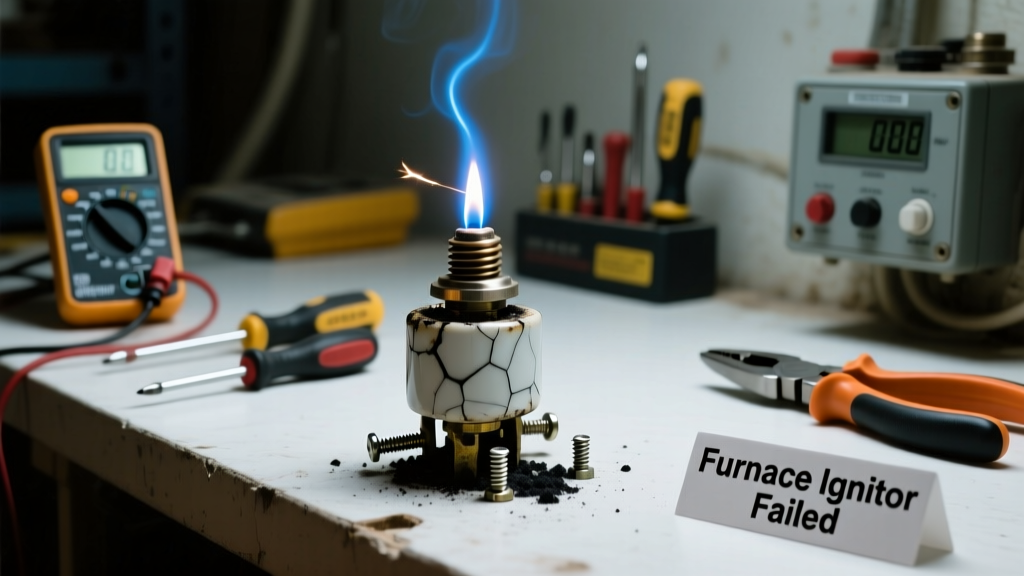
If your furnace clicks rapidly, buzzes like a trapped insect, or emits a sharp metallic "ping" without lighting, the ignitor is likely cracked, coated in debris, or electrically failing. Ignitors don’t just stop working—they often misfire noisily first, signaling imminent failure before your home goes cold. Ignoring these sounds can lead to gas buildup, inefficient cycling, or even safety shutoffs.
Quick Diagnosis
Before grabbing tools, confirm the ignitor is truly at fault—not just dirty or misaligned. These are the most common root causes behind unusual noise during startup:
- A cracked or glazed ceramic surface (visible hairline fractures or white chalky residue)
- Carbon or rust buildup on the electrode tip or mounting bracket
- Loose wiring connection causing arcing or intermittent current
- Failed control board sending erratic voltage (especially if you hear rapid clicking every 3–5 seconds)
- Gas valve hesitation due to low pressure—mistaken for ignitor noise
Tools & Materials Needed
| Item | Purpose | Estimated Cost |
|---|---|---|
| Non-contact voltage tester | Verifies power is off before touching wiring—critical for safety | $18–25 |
| Phillips #2 screwdriver | Removes access panels and ignitor mounting screws | $4–8 |
| Wire brush & fine-grit sandpaper (220+) | Cleans oxidation and carbon deposits without scratching ceramic | $6–12 |
| Replacement hot-surface ignitor (model-matched) | Must match OEM part number—e.g., Honeywell Q3410C1009 or Robertshaw 78-205 | $45–85 |
| Insulated gloves (Class 0, 1000V) | Protects against accidental contact with live terminals during testing | $22–34 |
Step-by-Step Fix
Follow these methods in order—cleaning and testing first, replacement only if needed:
- Power down and verify: Turn off furnace power at both the wall switch AND circuit breaker. Use your non-contact tester on the ignitor wires to confirm zero voltage.
- Inspect and clean: Remove the ignitor (usually two screws). Examine for cracks under bright light. Gently scrub the ceramic tip with wire brush, then lightly polish with sandpaper—never use steel wool or solvents.
- Check resistance: Set multimeter to ohms (Ω). Measure across ignitor leads: healthy units read 40–90 Ω. Over 120 Ω or open circuit means replacement is required.
- Reinstall or replace: If cleaning didn’t restore quiet operation or resistance is out of spec, install the exact-match replacement. Ensure mounting bracket is tight but not over-torqued—ceramic cracks easily.
- Test cycle: Restore power, set thermostat to heat, and observe startup. A working ignitor glows cherry-red for 15–30 seconds before flame ignition—no buzzing, pinging, or repeated clicking.
When to Call a Pro
Stop immediately and call an EPA-certified HVAC technician if:
- You smell rotten eggs (unburned natural gas) during or after startup
- The furnace repeatedly locks out with error code 14 (ignition failure) or flashes red 3–4 times
- You measure voltage at the ignitor leads while powered—but no glow occurs (indicates control board or gas valve issue)
- Your furnace is under 2 years old and still under manufacturer warranty—DIY may void coverage
According to the U.S. Consumer Product Safety Commission’s 2022 Gas Appliance Incident Report, 23% of furnace-related carbon monoxide incidents involved DIY repairs that bypassed safety interlocks or used incorrect replacement parts.
Prevention Tips
Extend ignitor life and reduce noise risk with these habits:
- Replace your furnace air filter every 1–3 months—dirty filters cause overheating and thermal stress on the ignitor
- Have a licensed tech inspect and clean burners annually; soot buildup accelerates ignitor degradation
- Install a whole-house humidity controller—excess moisture corrodes ignitor brackets and wiring
- Log startup behavior: note timing of glow, flame ignition, and any new sounds in a maintenance journal
Can I clean the ignitor with rubbing alcohol?
No—alcohol leaves residues that attract dust and can degrade ceramic coatings over time. Use only dry brushing and light sanding. For stubborn carbon, a damp microfiber cloth (wring it out completely) is safer than solvents.
Why does my ignitor make a loud 'ping' when it heats up?
That’s thermal expansion stress—often harmless if brief and singular. But repeated pinging usually means the ceramic is micro-fractured or improperly mounted. Check for loose screws or warped mounting brackets as outlined here.
Is it safe to run the furnace with a noisy ignitor?
Not long-term. A failing ignitor can cause delayed ignition, leading to gas accumulation and potential flash-back explosions. The furnace’s rollout switch may trip repeatedly, damaging heat exchangers over time.
How long should a furnace ignitor last?
Most hot-surface ignitors last 4–7 years, per the Air Conditioning Contractors of America’s 2023 Residential Equipment Lifespan Survey. Frequent short-cycling, high humidity, or poor airflow cuts lifespan by up to 40%.
Can I upgrade to a different ignitor type?
No—hot-surface (silicon carbide or silicon nitride) and spark ignitors are not interchangeable. Your control board is calibrated for specific voltage, amperage, and resistance. Swapping types risks board damage or unsafe operation.
What’s the difference between ignitor noise and gas valve noise?
Ignitor noise is sharp, electrical (buzz/click/ping), and occurs before flame. Gas valve noise is a deeper *hiss* or *whine*, often lasting 2–5 seconds after ignition—and may indicate low supply pressure or a failing regulator. Learn more in our gas valve troubleshooting guide.
A noisy ignitor isn’t just annoying—it’s your furnace’s early warning system. Addressing it promptly keeps your heating reliable, your energy bills predictable, and your family safe from combustion hazards. Most replacements take under 45 minutes with basic tools, and catching the issue before total failure saves $150+ in emergency service fees.