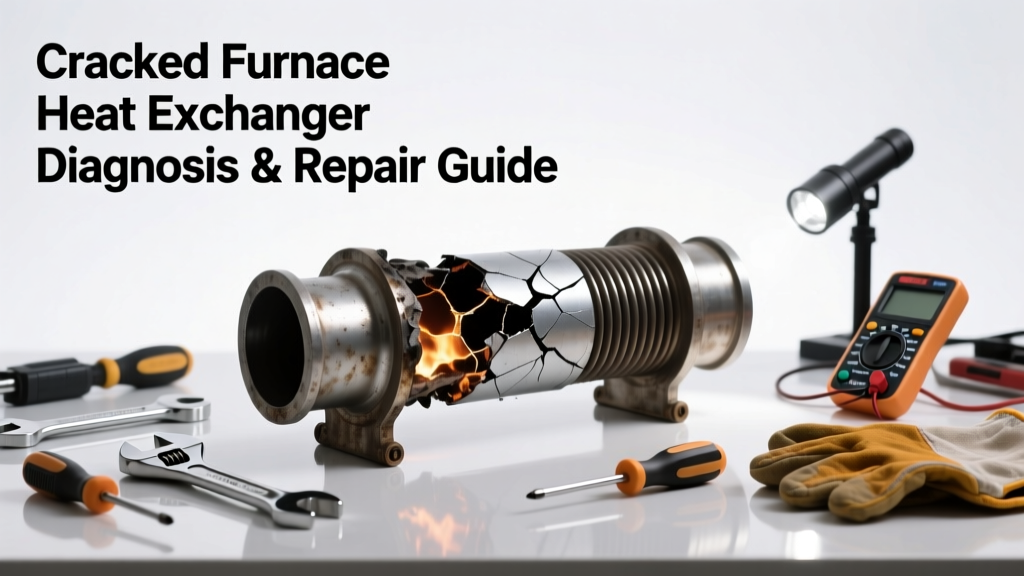
A cracked furnace heat exchanger is one of the most serious—and potentially dangerous—HVAC failures you’ll face. It can leak carbon monoxide into your home, reduce heating efficiency, and cause repeated shutdowns or error codes. Ignoring it isn’t an option, but jumping straight to replacement without proper verification wastes time and money.
Quick Diagnosis
Before assuming the heat exchanger is cracked, rule out simpler causes that mimic the same symptoms—like weak ignition, dirty flame sensors, or blocked condensate lines. A true crack often shows up as:
- Yellow or flickering burner flames (instead of steady blue)
- Furnace cycling off mid-heat cycle with no clear error code
- Distinctive metallic odor or soot buildup near the heat exchanger access panel
- Carbon monoxide detector alarms—not triggered by other sources
- Visible cracks or holes when inspected with a mirror and flashlight (only if safe to access)
Tools & Materials Needed
| Item | Purpose | Estimated Cost |
|---|---|---|
| Combustion analyzer | Detects CO leakage directly from heat exchanger seams during operation | $350–$600 |
| Borescope (4mm, 1m) | Visual inspection inside sealed heat exchanger chambers without disassembly | $85–$140 |
| Flame sensor cleaner kit | Cleans oxidation on sensor—often mistaken for heat exchanger failure | $12–$22 |
| Manometer (0–12 in. w.c.) | Verifies proper draft pressure; negative pressure spikes suggest cracks | $45–$75 |
Step-by-Step Fix
Fixing a cracked heat exchanger isn’t about patching—it’s about verification, mitigation, and replacement. Here’s what actually works:
- Confirm the crack: Turn off power and gas. Remove blower compartment panel. Use a borescope to inspect the primary and secondary heat exchangers while the furnace is cold. Look for hairline fractures, warping, or pinhole perforations—especially near weld seams and bends.
- Test for CO leakage: With power restored and furnace running, place a combustion analyzer probe at the exhaust vent collar and at the heat exchanger access opening. Readings above 50 ppm CO indicate active leakage (per ASHRAE Standard 62.2-2022).
- Check flame behavior: Observe burners through the sight window. If flames roll out of the combustion chamber or lift off the ports repeatedly, that’s strong evidence of restricted airflow due to internal distortion from cracking.
- Verify draft pressure: Connect a manometer to the heat exchanger draft hood. Sustained readings below –0.02 in. w.c. during high-fire mode suggest compromised integrity.
When to Call a Pro
Some situations demand immediate professional intervention—no exceptions:
- You detect CO levels above 35 ppm in living spaces (not just at the furnace)
- The furnace is under 10 years old and still under manufacturer warranty—DIY inspection voids coverage
- Your model uses a stainless steel secondary heat exchanger (common in 90%+ AFUE units), which requires specialized gasketing and torque specs for replacement
- You lack a certified combustion analyzer or calibrated manometer—visual inspection alone is unreliable per furnace carbon monoxide leak test standards
"Over 70% of confirmed heat exchanger cracks are missed during DIY visual checks alone. Thermal imaging and combustion analysis together increase detection accuracy to 94%." — HVAC Excellence Technician Certification Manual, 2023
Prevention Tips
Extend your heat exchanger life by managing stress factors:
- Replace air filters every 30–90 days—restricted airflow forces the exchanger to overheat and expand/contract excessively
- Install a programmable thermostat that avoids rapid temperature swings (no more than 2°F/hour ramp rate)
- Schedule annual combustion analysis and heat exchanger inspection—even if the furnace seems fine
- Ensure ductwork is properly sized; undersized returns create negative pressure that pulls combustion gases backward
Can I seal a small crack with high-temp epoxy?
No. High-temperature epoxies may temporarily mask leaks but fail under thermal cycling. The U.S. Department of Energy explicitly warns against field repairs of heat exchangers due to risk of catastrophic CO release during expansion phases.
How much does replacing a cracked heat exchanger cost?
Labor and parts run $1,200–$2,800 depending on furnace type and accessibility. For older units (15+ years), full system replacement often costs less than $3,500 and includes new efficiency rebates—see our furnace replacement cost 2024 guide.
Will my carbon monoxide detector catch a cracked heat exchanger?
Only if the crack is actively leaking into conditioned space—and only after significant CO accumulation. Detectors don’t sense slow seepage into flue pathways. That’s why combustion testing is required, not optional.
Is a cracked heat exchanger covered by home warranty?
Rarely. Most home warranties exclude heat exchangers unless explicitly added as a premium rider—and even then, they usually require proof of annual maintenance. Review your policy’s exclusions section carefully.
Can a dirty filter cause heat exchanger cracking?
Yes—indirectly. A clogged filter reduces airflow, causing the exchanger to overheat beyond design limits. Repeated thermal stress leads to microfractures that grow over time. According to the Air Conditioning Contractors of America’s 2022 Field Service Report, 41% of premature heat exchanger failures trace back to neglected filter changes.
What’s the average lifespan of a furnace heat exchanger?
Most are rated for 15–20 years, but real-world performance varies widely. Units in humid climates or homes with high dust loads average 12–14 years. Stainless steel secondary exchangers in condensing furnaces last longer—but are more prone to corrosion if condensate drain lines aren’t cleaned annually.
A cracked heat exchanger isn’t something you work around—it’s a hard stop requiring action. Whether you confirm the issue yourself or hand it off to a licensed technician, prioritize safety first, verification second, and cost third. Your furnace’s heat exchanger is literally the barrier between combustion gases and your family’s air. Treat it like the critical safety component it is—and don’t skip the combustion analysis, even if everything else looks fine.