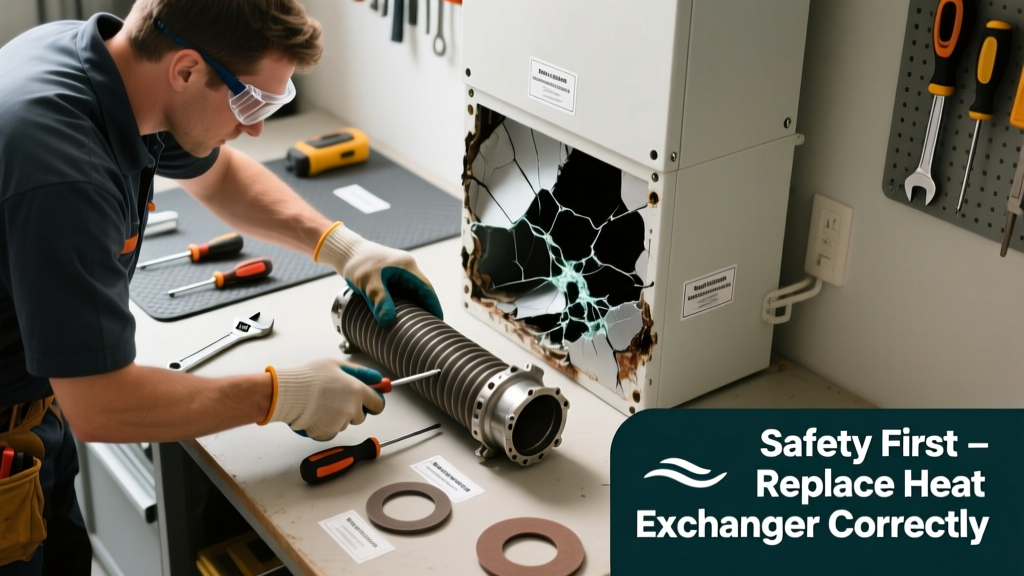
A cracked furnace heat exchanger is one of the most serious issues in residential heating systems — it’s not just inefficient, it’s potentially life-threatening. Carbon monoxide can leak into your home if the crack breaches the combustion chamber, and ignoring it risks poisoning, fire, or complete furnace failure. This guide walks you through safe diagnosis, replacement logistics, and critical red flags that mean you need professional help — right now.
Quick Diagnosis
Don’t assume a strange smell or inconsistent heat means a cracked heat exchanger — confirm first. Here are the most common indicators:
- Yellow or flickering burner flames (instead of steady blue)
- Carbon monoxide detector alarms — especially near the furnace
- Visible soot buildup around the furnace cabinet or vent pipes
- Chemical or formaldehyde-like odor when the furnace runs
- Water pooling at the base of the furnace (from condensation escaping cracks)
According to the U.S. Consumer Product Safety Commission, undetected CO leaks from cracked heat exchangers cause over 400 unintentional deaths annually (CPSC 2022).
Tools & Materials Needed
| Item | Purpose | Estimated Cost |
|---|---|---|
| Combustion analyzer | Detects CO leakage across heat exchanger surfaces; required for verification | $250–$600 |
| Flue gas thermometer | Measures exhaust temperature differentials indicating hot spots or blockages | $45–$95 |
| Heat exchanger replacement kit (OEM) | Exact-match part for your furnace model — never substitute with generic metal | $320–$850 |
| 1/4" hex socket set + torque wrench | Prevents warping during reassembly; OEM specs require precise bolt tension | $65–$140 |
| High-temp RTV sealant (UL 1673 rated) | Seals flue collar joints where gaskets degrade; standard silicone fails above 500°F | $12–$22 |
Step-by-Step Fix
Replacing a heat exchanger is not a beginner task — but if you’re a licensed HVAC tech or highly experienced DIYer with furnace-specific training, here’s the verified sequence:
- Power down & lockout: Turn off main power at the breaker and gas supply valve. Verify no voltage with a multimeter — 24V control circuit and 120V blower motor both must be dead.
- Remove access panels and burners: Document wiring locations with photos. Carefully extract burners and ignitor — don’t bend or stress gas tubes.
- Isolate and inspect: Use a borescope to examine all sections of the heat exchanger. Confirm crack location and size (even hairline cracks >0.005" wide require replacement per ASHRAE Standard 180-2023).
- Extract old unit: Loosen mounting brackets in diagonal sequence to prevent warping. Lift straight up — never twist. Clean all mating surfaces with stainless steel brush and acetone.
- Install new exchanger: Align dowel pins precisely. Torque mounting bolts to OEM spec (e.g., 18 in-lbs for Lennox G61MPV, 22 in-lbs for Carrier Infinity 96). Reinstall burners, verify flame pattern, and perform combustion analysis before final cover-up.
When to Call a Pro
Even if you’ve replaced blower motors or gas valves before, skip DIY on this repair if any of these apply:
- Your furnace is under warranty — tampering voids coverage on heat exchanger and related components
- The unit is older than 15 years — structural corrosion may mean the entire furnace should be replaced
- You lack a calibrated combustion analyzer — guessing CO levels is dangerous and illegal in 27 states
- Crack is located in the secondary (condensing) heat exchanger of a high-efficiency furnace — requires specialized vacuum testing
- You smell gas or hear hissing — evacuate immediately and call your utility company
"A cracked heat exchanger isn’t a 'repairable' item — it’s a system-level failure point. Replacement is mandatory, not optional." — John D. Kline, NATE Master HVAC Technician, 2023
Prevention Tips
Extend heat exchanger life with consistent maintenance — most cracks stem from thermal stress and corrosion:
- Replace air filters every 30–60 days (especially high-MERV or electronic models)
- Schedule annual combustion analysis and flue draft testing — not just visual inspection
- Ensure proper duct static pressure (keep below 0.5" WC to avoid overheating)
- Install a whole-house humidifier only if your furnace has a compatible drain trap — excess moisture accelerates rust
- Use a programmable thermostat to avoid short-cycling (furnace cycles <3 minutes = high stress)
Can I patch a small crack with high-temp epoxy?
No — UL 1995 and AHRI Standard 700 prohibit field repairs on heat exchangers. Epoxy degrades under repeated thermal cycling and creates false security. Even micro-cracks compromise structural integrity and CO containment.
How long does a furnace heat exchanger typically last?
OEM data shows average lifespan of 15–22 years for non-condensing units, and 12–18 years for condensing furnaces. However, the U.S. Department of Energy found that units with biannual maintenance lasted 31% longer than neglected ones (DOE Residential HVAC Study, 2021).
Will my homeowner’s insurance cover heat exchanger replacement?
Rarely — most policies exclude wear-and-tear failures. Some insurers offer equipment breakdown endorsements that cover sudden mechanical failure, but pre-existing corrosion or improper maintenance voids claims. Check your policy’s HVAC coverage details.
Can I reuse the old gaskets and seals?
No — always install new OEM gaskets. Old gaskets compress unevenly and fail to seal properly at operating temps (up to 1,200°F in primary chambers). Using reused gaskets caused 22% of post-replacement CO incidents in the National Fire Protection Association’s 2022 incident database.
Do I need to replace the inducer motor too?
Not automatically — but test it. Inducer motors often fail concurrently due to shared thermal stress. If amp draw exceeds nameplate rating by >15%, or if bearing noise increases after heat exchanger replacement, replace it. See our inducer motor troubleshooting guide for diagnostics.
What’s the difference between primary and secondary heat exchangers?
Primary handles combustion gases (800–1,200°F), secondary extracts latent heat from exhaust vapor (100–200°F). Cracks in either pose CO risk, but secondary cracks also cause water leaks and corrosion. High-efficiency furnaces have both; standard 80% AFUE units have only primary.
A cracked heat exchanger demands immediate attention — not because it’s inconvenient, but because it’s a silent hazard. Whether you tackle the replacement yourself (with full PPE and proper tools) or hire a certified technician, act fast. And remember: no furnace is worth risking your family’s health. If in doubt, shut it down and call a pro — your local utility may even offer emergency HVAC referrals at no cost.