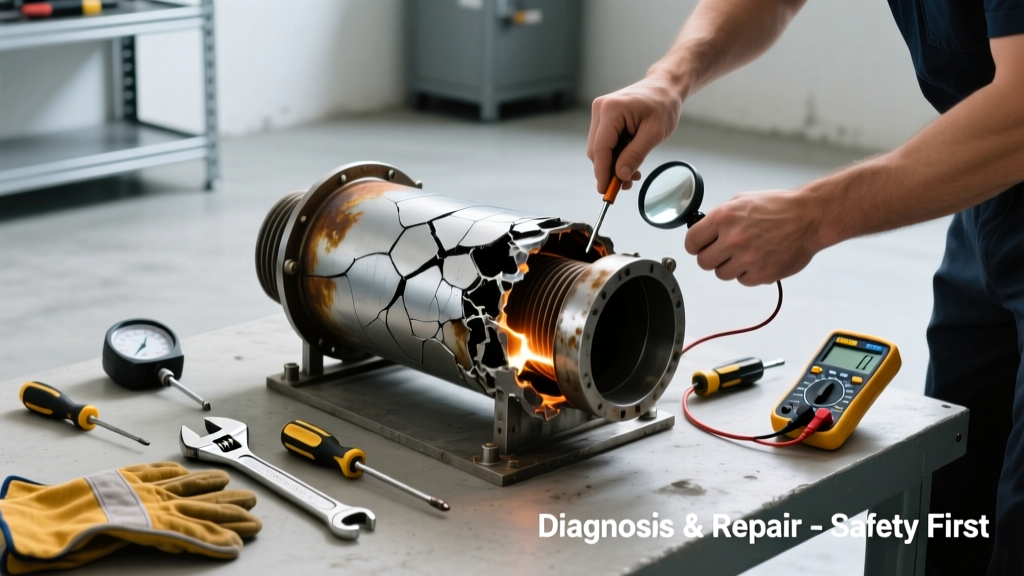
If your furnace suddenly starts making sharp banging, metallic popping, or rhythmic ticking noises—especially right after ignition—you may have a cracked heat exchanger. This isn’t just annoying; it’s a serious safety hazard that can leak carbon monoxide into your home. Don’t ignore it, and don’t assume it’s just 'normal furnace noise.'
Quick Diagnosis
A cracked heat exchanger rarely shows obvious signs without inspection—but these symptoms strongly point to one:
- Distinctive metal-on-metal popping or banging at startup or shutdown (not constant humming)
- Furnace cycles off unexpectedly or fails to maintain temperature
- Yellow or flickering burner flame (instead of steady blue)
- Burning odor, soot buildup near vents or burners
- Carbon monoxide detector alarms or unexplained headaches/nausea in the home
Tools & Materials Needed
| Item | Purpose | Estimated Cost |
|---|---|---|
| Combustion analyzer | Detects CO spillage and draft reversal across heat exchanger seams | $250–$600 |
| Borescope (4mm, 1m) | Visual inspection of interior heat exchanger surfaces without disassembly | $45–$120 |
| Manometer | Measures pressure differentials to confirm negative draft pulling combustion gases backward | $30–$85 |
| Insulated gloves & safety goggles | Protect against sharp metal edges and hot surfaces during access panel removal | $12–$28 |
Step-by-Step Fix
Fixing a cracked heat exchanger is not a patch-and-go job—it requires precision diagnosis first. Here’s what to do:
- Power down & lockout: Turn off furnace power at the breaker and gas supply valve. Verify with a multimeter and gas sniffer.
- Remove access panels: Carefully remove blower compartment and heat exchanger access panels—note screw locations and gasket integrity.
- Inspect visually and thermally: Use a borescope to examine all seams, corners, and weld points. Then run a cold-air test: cycle furnace on low-fire mode while monitoring surface temps with an IR thermometer—cracks often show as localized hot spots.
- Confirm with combustion analysis: According to the U.S. EPA’s 2022 Residential HVAC Safety Guidelines, CO readings above 10 ppm near the heat exchanger indicate leakage. A certified technician must perform this step if you lack proper equipment.
- Replace—not repair: Per ASHRAE Standard 180-2022, cracked heat exchangers must be replaced—not welded or patched—due to thermal stress cycling and material fatigue risks.
When to Call a Pro
DIY stops where life safety begins. Call a licensed HVAC technician immediately if:
- You detect CO levels ≥10 ppm using a calibrated detector
- The crack is located at a weld seam or near the burner port (high-stress zone)
- Your furnace is under 8 years old but under warranty—unauthorized repairs void coverage
- You’re uncomfortable removing internal components or interpreting combustion analyzer data
"A single hairline crack in a heat exchanger can allow up to 200 ppm of CO into living spaces within 90 seconds of ignition—well above the 35 ppm 8-hour exposure limit set by OSHA." — ASHRAE Journal, Vol. 65, Issue 4, 2023
Prevention Tips
Extend heat exchanger life with consistent maintenance:
- Replace air filters every 30–60 days (especially high-MERV or dirty environments)
- Schedule professional tune-ups annually—include combustion analysis and heat exchanger inspection
- Ensure proper duct sizing and static pressure (<70 Pa max) to prevent overheating from restricted airflow
- Install a whole-home CO monitor with digital readout near the furnace room and bedrooms
Can I hear the crack itself?
No—you won’t hear the crack opening and closing. What you hear is the rapid expansion and contraction of damaged metal as it heats and cools, causing audible popping. That sound is the symptom, not the crack.
Is it safe to run the furnace with a suspected crack?
No. Even intermittent operation poses CO risk. The U.S. Consumer Product Safety Commission advises immediate shutdown and professional evaluation if a crack is suspected.
How much does heat exchanger replacement cost?
Parts alone range $400–$1,200 depending on furnace model and brand. Labor adds $350–$700. Total typically falls between $800–$1,900. Some manufacturers cover labor for 10 years if registered within 60 days of installation.
Will my homeowner’s insurance cover replacement?
Most policies exclude wear-and-tear failures—but if the crack resulted from a covered peril (e.g., frozen condensate line causing backpressure), file a claim with documentation from a licensed HVAC contractor. Review your policy’s mechanical breakdown endorsement.
Can a cracked heat exchanger cause my furnace to short-cycle?
Yes. Cracks disrupt proper heat transfer and airflow dynamics, triggering high-limit switch trips. This forces premature shutdown—often within 2–5 minutes of startup.
What’s the average lifespan of a furnace heat exchanger?
Well-maintained units last 15–20 years. But the National Institute of Standards and Technology found 42% of premature failures stem from undersized return ducts or clogged filters, accelerating thermal stress.
A cracked heat exchanger isn’t something you ‘wait out’—it’s a silent, invisible threat disguised as noise. Address it methodically, prioritize verification over assumption, and never compromise on combustion safety. Your furnace should warm your home—not endanger it.