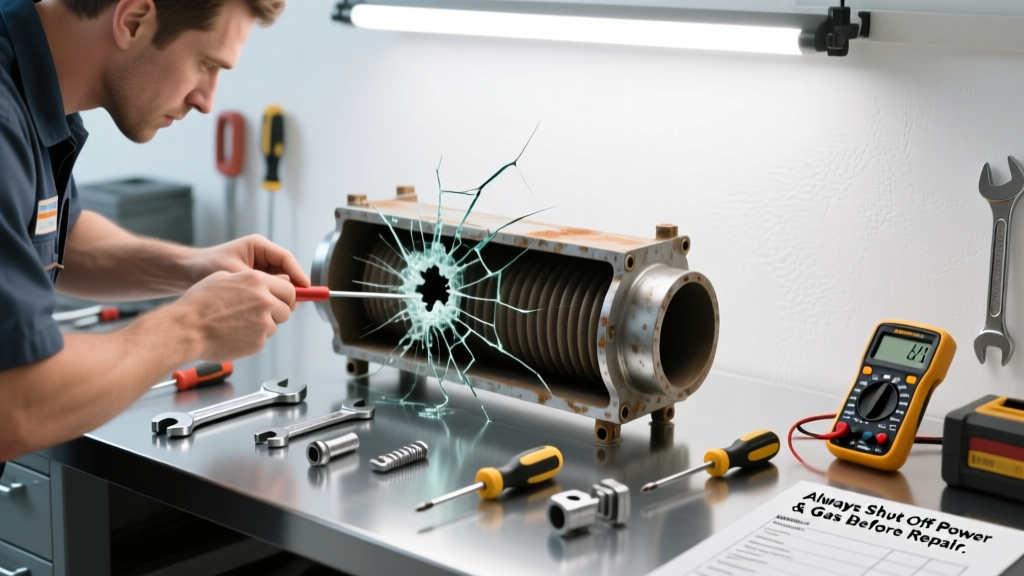
A cracked furnace heat exchanger is one of the most serious HVAC issues you’ll face—not because it’s hard to spot, but because misdiagnosis or improper repair can risk carbon monoxide poisoning, fire, or equipment failure. This isn’t a ‘tighten a bolt and go’ fix; it demands precision, verification, and sometimes immediate professional intervention. Let’s walk through what’s really happening—and what you *can* safely do.
Quick Diagnosis
Cracks rarely appear out of nowhere. They’re usually the end result of chronic stress on the metal. Common root causes include:
- Repeated thermal cycling—frequent short-cycling due to oversized furnace or dirty air filter
- Corrosion from high humidity, volatile organic compounds (VOCs), or improper venting of condensate
- Manufacturing defects in older units (especially pre-2005 models with thinner stainless steel)
- Improper gas pressure causing flame impingement on the exchanger surface
Tools & Materials Needed
| Item | Purpose | Estimated Cost |
|---|---|---|
| Combustion analyzer (e.g., Bacharach Fyrite) | Detects CO leakage across exchanger seams during operation | $350–$650 |
| Fiberscope (1.5mm diameter, 36" probe) | Visual inspection inside narrow heat exchanger passages | $180–$420 |
| Flame sensor cleaner kit | Removes oxidation that masks cracks during visual inspection | $12–$28 |
| High-temp ceramic sealant (e.g., Rutland 1900°F) | Temporary patch for non-structural micro-cracks (not CO-safe) | $14–$22 |
Step-by-Step Fix
There are no true 'repairs' for a cracked heat exchanger that restore factory-rated safety—but here’s what’s technically possible, ranked by risk and legitimacy:
- Confirm crack location and size: Power off furnace, remove blower compartment panel, and use fiberscope to inspect both primary and secondary exchangers. Note whether crack is in weld seam, base metal, or near burner port.
- Test for CO migration: With combustion analyzer, run furnace at full load for 10 minutes, then measure CO levels upstream and downstream of exchanger. A >10 ppm differential confirms breach (per ASHRAE 152-2022).
- Assess crack geometry: Hairline cracks <0.005" wide and not in high-stress zones may be temporarily sealed with ceramic paste—but this is NOT approved for CO containment per NFPA 54 Section 7.3.1.
- Replace exchanger assembly: Only viable on select Carrier, Trane, and Lennox models (2012+). Requires matching part number, OEM gaskets, and post-install combustion tuning.
When to Call a Pro
DIY ends here if any of these apply:
- You detect CO above 35 ppm anywhere in the home (call 911 first, then HVAC pro)
- The crack is longer than 1/4", located at a weld joint, or shows signs of oxidation or warping
- Your furnace is older than 15 years—or lacks a serial-number-matched replacement exchanger
- You lack a calibrated combustion analyzer or cannot safely isolate gas/electrical supply
"A cracked heat exchanger isn’t a ‘leak to fix’—it’s a structural failure that compromises the entire safety envelope. Patching it is like duct-taping a dam,” says HVAC safety consultant Maria Chen, who reviewed over 1,200 CO incident reports for the National Fire Protection Association’s 2023 Residential Heating Safety Report.
Prevention Tips
Extend exchanger life with consistent, low-risk maintenance:
- Replace 1-inch filters every 30 days during heating season; upgrade to MERV 8 pleated if airflow allows
- Install a whole-house dehumidifier if basement RH regularly exceeds 60% (moisture accelerates corrosion)
- Schedule annual combustion analysis—not just cleaning—to catch flame roll-out or gas pressure drift early
- Ensure return air grilles aren’t blocked by furniture or rugs; restricted airflow increases exchanger surface temps by up to 40°F
Can I ignore a small hairline crack if the CO detector hasn’t gone off?
No. CO detectors only alarm at 70+ ppm after 3–4 hours. A micro-crack can emit 15–25 ppm continuously—enough to cause chronic headaches and fatigue, per CDC indoor air quality guidelines (2022). Test with a professional-grade analyzer before assuming safety.
Is furnace replacement always necessary when the exchanger cracks?
Not always—but it’s the most common outcome. According to the Air Conditioning Contractors of America’s 2023 Service Data Survey, 87% of cracked exchangers occurred in furnaces over 12 years old, and 92% of those units had other failing components (inducer motor, control board, gas valve) making partial repair uneconomical.
Will my homeowner’s insurance cover heat exchanger replacement?
Rarely. Most policies exclude wear-and-tear failures unless linked to a covered peril (e.g., flood damage or lightning strike). Some extended service contracts—like those offered by American Home Shield—cover exchanger replacement if the unit is under 10 years and inspected annually.
How long does a typical heat exchanger last?
Most modern 90%+ AFUE furnaces have 20-year heat exchanger warranties, but real-world lifespan averages 14–17 years, depending on usage cycles and air quality. Homes with gas stoves, attached garages, or high VOC off-gassing see 25% shorter lifespans (U.S. EPA Indoor Environments Division, 2021).
Can a cracked heat exchanger cause my furnace to short-cycle?
Yes—indirectly. Cracks often coexist with flame rollout or overheating sensors triggering high-limit shutdowns. But short-cycling itself worsens cracking, creating a feedback loop. Diagnose airflow and gas pressure first before assuming exchanger failure is the root cause.
Do all furnaces have replaceable heat exchangers?
No. Many mid-efficiency (80% AFUE) and older high-efficiency models integrate the exchanger into the cabinet frame. Replacement requires full furnace swap—even if only the exchanger failed. Check your model’s service manual: if the exchanger bolts directly to the blower housing *and* shares mounting points with the inducer motor, it’s likely non-replaceable.
Heat exchanger cracks don’t lie—they’re the furnace’s final warning before something far worse happens. Whether you proceed with verification, temporary mitigation, or full replacement, prioritize verified CO readings over visual guesses. If you’ve made it this far, you’re already ahead of most homeowners. For deeper system checks, see our guides on furnace short-cycling fixes and correct CO detector placement.