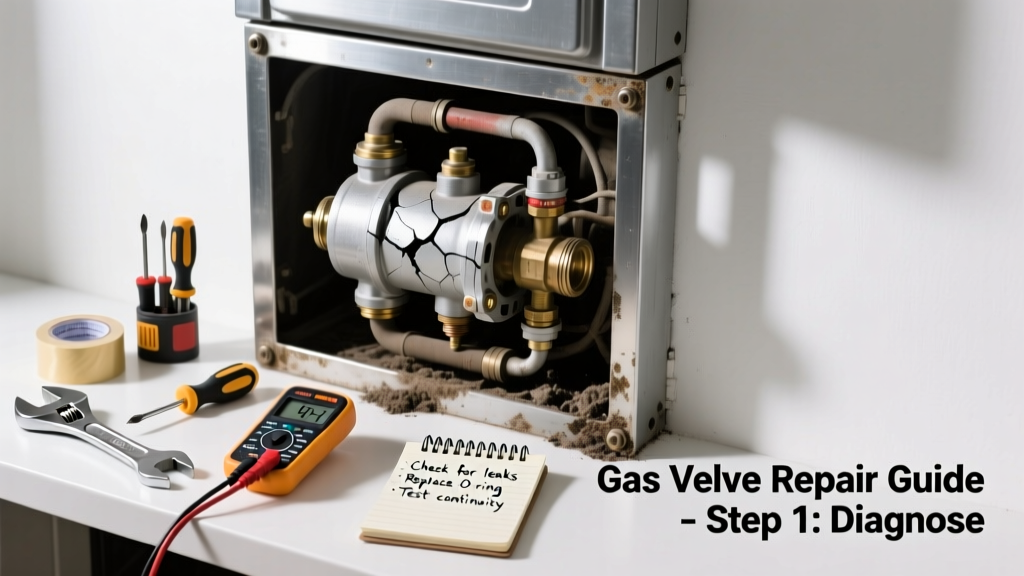
If your furnace won’t ignite—or fires up briefly then shuts off—the gas valve is a prime suspect. A failed or malfunctioning gas valve cuts fuel supply before combustion can stabilize, leaving you cold and possibly triggering safety lockouts. This isn’t just inconvenient; it’s a potential fire and carbon monoxide hazard if misdiagnosed.
Quick Diagnosis
Before grabbing tools, rule out simpler causes first. Gas valves rarely fail without warning—most issues stem from related components or environmental factors:
- Tripped circuit breaker or blown fuse supplying the furnace control board
- Clogged or corroded thermocouple (on older standing-pilot units)
- Faulty pressure switch preventing safe ignition sequence
- Low gas pressure due to utility supply issues or regulator problems
- Dirty or magnetically obstructed solenoid coil inside the valve assembly
Tools & Materials Needed
| Item | Purpose | Estimated Cost |
|---|---|---|
| Multimeter (digital, with continuity mode) | Test coil resistance and verify 24V AC signal at valve terminals | $25–$65 |
| Gas leak detector solution (soapy water mix) | Check for leaks at valve inlet/outlet fittings after reassembly | $5–$12 |
| Phillips and flat-head screwdrivers | Remove access panels and secure wiring connections | $8–$15 |
| Replacement gas valve (model-matched) | Required if coil measures open-circuit (>2000 Ω) or valve fails functional test | $120–$320 |
Step-by-Step Fix
Never bypass safety controls or force gas flow. These steps assume your furnace has an electronic ignition system (most post-1990 units). If yours uses a standing pilot, skip to the thermocouple section below.
- Power down and isolate gas: Turn off furnace power at the breaker AND shut off the main gas supply valve near the meter. Wait 5 minutes for residual gas to dissipate.
- Test voltage at valve terminals: Set multimeter to AC voltage. With power restored and furnace in call-for-heat mode, measure across the two low-voltage wires (typically red/white). You should read 24V AC for 3–5 seconds during ignition attempt. No voltage? Problem lies upstream—in the control board or pressure switch.
- Test coil resistance: Disconnect wires and set multimeter to ohms. Place probes on valve terminals. A healthy coil reads 50–120 Ω. Open circuit (OL) or >2000 Ω means coil failure—replace valve.
- Verify gas pressure (if equipped): Use a manometer tapped into the valve’s test port. Natural gas should read 3.5 ± 0.2 inches WC; propane requires 11 ± 0.5 inches WC. Low pressure prevents proper valve lift—even with good coil.
When to Call a Pro
Gas work carries life-threatening risk. Stop immediately and call a licensed HVAC technician if you observe any of these:
- Gas odor (rotten egg smell) before, during, or after testing
- Carbon monoxide alarm activation or symptoms like headache, nausea, or dizziness
- Valve body shows visible corrosion, cracks, or melted plastic housing
- Your furnace is under warranty—DIY replacement voids coverage on most brands (e.g., Carrier, Trane, Lennox)
- You lack experience interpreting electrical schematics or using a manometer
According to the U.S. Consumer Product Safety Commission’s 2022 report, improper gas appliance repairs contributed to 27% of residential CO poisoning incidents involving heating equipment.
"Never assume a 'click' means the valve opened—many failing valves energize but don’t lift the internal diaphragm. Always verify downstream gas flow with a combustible gas detector or pressure test." — HVAC Excellence Certified Technician Training Manual, 2023
Prevention Tips
Extend gas valve life with routine maintenance—not just annual cleaning:
- Replace air filters every 1–3 months to prevent overheating and erratic cycling
- Inspect gas line flex connectors annually for kinks, cracks, or corrosion
- Have a technician check manifold pressure and valve calibration during biennial tune-ups
- Install a whole-house surge protector—voltage spikes damage control boards and valve coils
Can I clean a stuck gas valve solenoid with compressed air?
No. Compressed air may blow debris deeper into the valve’s precision orifice or damage internal seals. Solenoids aren’t serviceable—cleaning attempts often worsen failure. If resistance tests normal but no gas flows, replace the entire valve assembly. For more on safe cleaning methods, see our furnace blower motor noise guide.
Why does my furnace click but not ignite?
The click is the solenoid energizing—but if gas doesn’t follow, either the valve isn’t opening (failed coil, low pressure, or internal blockage) or the igniter isn’t hot enough to light the stream. Test voltage and resistance first. If those pass, check for spider webs in the burner orifice—a common cause of delayed ignition on high-efficiency units.
Is it safe to replace the gas valve myself?
Only if you’re certified to handle gas appliances and own calibrated test equipment. The National Fuel Gas Code (NFPA 54, 2023 edition) requires leak testing with manometer and soap solution after any gas connection is disturbed—and documentation must be filed with local authorities in 22 states. Most homeowners lack both certification and tools.
How long do furnace gas valves last?
Typical lifespan is 15–20 years, but harsh environments shorten it. Homes in coastal areas (salt air) or high-humidity basements see failures as early as year 8. According to the American Society of Heating, Refrigerating and Air-Conditioning Engineers’ 2021 field study, gas valve replacement rates jump 40% in units older than 14 years.
What’s the difference between a gas valve and a gas regulator?
The regulator sits upstream—usually on the gas meter or appliance shutoff—and reduces street pressure (2–5 psi) to appliance-level pressure (3.5" WC). The gas valve is downstream, controlled by the furnace board, and acts as an on/off gate. A faulty regulator causes low pressure *before* the valve; a faulty valve fails to open *despite* correct inlet pressure.
Can a dirty flame sensor cause gas valve failure symptoms?
No—but it mimics them. A soiled flame sensor tricks the control board into shutting off gas after 3–5 seconds, making it seem like the valve closed prematurely. Clean the sensor with fine steel wool and isopropyl alcohol first—it resolves ~60% of ‘valve failure’ calls according to ServiceTitan’s 2023 HVAC technician survey. See our furnace flame sensor cleaning guide for full instructions.
A working gas valve is non-negotiable for safe, reliable heat. While some diagnostics are within reach of careful homeowners, valve replacement belongs in trained hands—especially when gas lines, pressure tests, or certification requirements are involved. When in doubt, prioritize safety over savings: a $250 service call beats a $25,000 insurance claim for fire damage—or worse, a tragedy. Keep your furnace manual handy, label all wires before disconnecting, and always double-check for leaks before restoring gas and power.