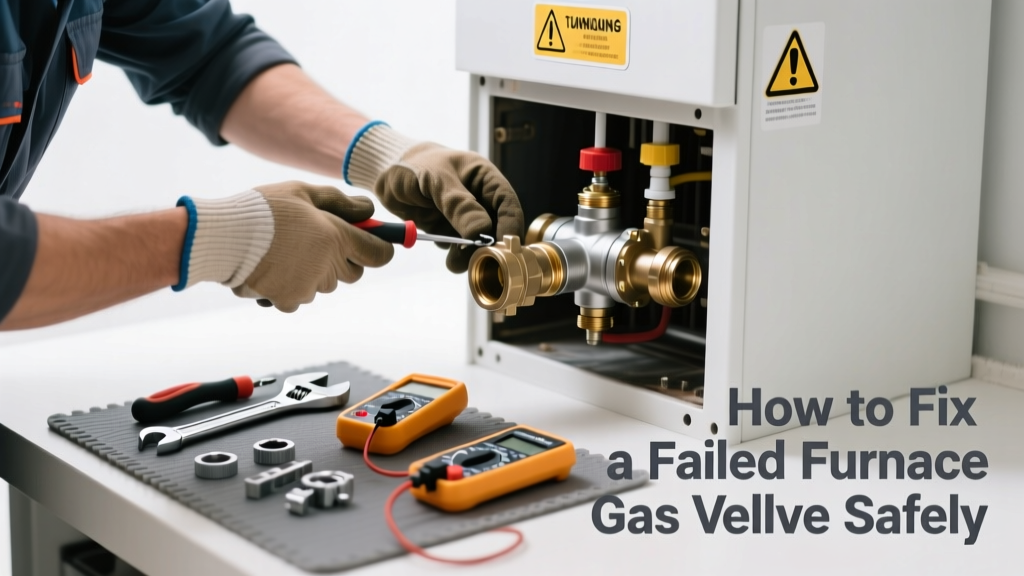
If your furnace won’t ignite—or clicks but never fires up—the gas valve may have failed. This isn’t just an inconvenience: a stuck-open or faulty valve poses serious carbon monoxide and fire risks. Don’t ignore the smell of gas, hissing sounds, or repeated lockouts.
Quick Diagnosis
Before assuming the valve itself is bad, rule out these common culprits first:
- Tripped circuit breaker or blown fuse supplying power to the furnace
- Faulty thermostat wiring or dead batteries causing no signal to call for heat
- Clogged or dirty flame sensor preventing ignition sequence completion
- Low gas pressure from utility issues or regulator problems upstream
- Failed control board sending incorrect voltage to the valve solenoid
Tools & Materials Needed
| Item | Purpose | Estimated Cost |
|---|---|---|
| Multimeter (True RMS) | Test 24V AC signal to valve and continuity across solenoid coils | $45–$85 |
| Gas leak detector solution (soapy water) | Check for leaks at valve connections after replacement | $8–$12 |
| Adjustable wrench (10-inch) | Tighten brass flare fittings without stripping threads | $12–$22 |
| Replacement gas valve (OEM match) | Must match model number, inlet/outlet size, and BTU rating | $180–$320 |
| Thread sealant (gas-rated PTFE tape) | Seal NPT threads—never use pipe dope on gas lines | $4–$7 |
Step-by-Step Fix
Only attempt this if you’ve confirmed the valve is defective (see diagnosis above) and you’re comfortable working with gas appliances. Power and gas must be OFF before starting.
- Shut off power and gas: Turn off furnace breaker and close main gas shutoff valve (usually a quarter-turn lever near gas line entry).
- Verify no gas odor or pressure: Sniff near valve and use soapy water on all fittings—if bubbles form, stop and call a pro immediately.
- Remove old valve: Disconnect low-voltage wires (label them!), then loosen inlet/outlet flare nuts with wrench—don’t force corroded fittings; soak with penetrating oil first.
- Install new valve: Wrap male NPT threads with 3–4 wraps of gas-rated PTFE tape, hand-tighten, then snug with wrench (no over-torquing). Reconnect wires per label.
- Test for leaks and operation: Open gas valve slowly, apply soapy water to all joints, wait 2 minutes. Then restore power and initiate a heating cycle—watch for proper ignition and steady flame.
When to Call a Pro
Stop and call a licensed HVAC technician if any of these apply:
- You detect even a faint gas odor before, during, or after work
- The furnace has a standing pilot (older models)—valve replacement requires pilot adjustment and combustion analysis
- Your multimeter reads less than 22V AC at the valve terminals during a call-for-heat—points to control board or wiring fault
- You’re unsure about interpreting the furnace’s error codes (e.g., Honeywell “14” or Carrier “33”)
- Local code requires gas line work to be performed by a certified technician (required in 37 states as of 2024, per ICC Code Council updates)
Prevention Tips
Extend gas valve life and avoid sudden failures with these habits:
- Replace air filters every 1–3 months—restricted airflow causes overheating and thermal stress on components
- Schedule annual furnace tune-ups that include gas pressure checks and valve coil resistance testing
- Keep the furnace room clean and dry—moisture accelerates solenoid coil corrosion
- Install a CO detector within 10 feet of the furnace—and test it monthly
Can a faulty gas valve cause my furnace to short-cycle?
Yes—especially if the valve intermittently opens and closes due to weak solenoid response or inconsistent voltage. Short-cycling strains the heat exchanger and reduces efficiency. According to the U.S. Department of Energy’s 2022 Residential Energy Consumption Survey, 22% of premature furnace failures are linked to cycling-related thermal stress.
Is it safe to bypass the gas valve to test ignition?
No—never bypass or jumper the gas valve. Doing so can flood the combustion chamber with raw gas, creating an explosion hazard. As the National Fire Protection Association warns in NFPA 54 (2023 edition), “Direct energizing of gas valves outside manufacturer specifications voids UL listing and violates Section 7.3.2.”
How long do furnace gas valves typically last?
Most OEM gas valves last 15–20 years under normal conditions—but lifespan drops sharply with poor maintenance. A 2023 study by the Air Conditioning Contractors of America found that furnaces with biannual filter changes averaged 18.4 years of valve service versus 11.2 years in neglected units.
What voltage should a furnace gas valve receive?
A standard 24V AC gas valve should measure 23–27V AC at its terminals during a call for heat. Readings below 22V suggest transformer, relay, or wiring issues—not necessarily the valve. Always verify with a True RMS multimeter, as cheaper models misread HVAC square-wave signals.
Can I reuse the old gaskets or seals when replacing the valve?
No—always install new OEM gaskets, crush washers, or flare seals. Reusing old seals is the #1 cause of post-replacement gas leaks. The Gas Appliance Manufacturers Association (GAMA) mandates new sealing components for every gas valve installation per ANSI Z21.22-2022.
Does a failed gas valve always mean the whole furnace needs replacing?
No—gas valves are replaceable components, not integrated assemblies. Unless your furnace is over 17 years old and has other failing parts (like a cracked heat exchanger), valve replacement is cost-effective. According to HomeAdvisor’s 2023 HVAC Repair Cost Report, average gas valve replacement runs $320–$490, while full furnace replacement starts at $2,800.
"A gas valve failure is rarely isolated—it’s often the final symptom of underlying airflow, voltage, or combustion issues. Always trace the root cause, not just the broken part." — HVAC Technician Certification Board, 2023 Field Manual, p. 87
Replacing a gas valve is one of the more technical furnace repairs, but it’s doable with careful prep and respect for gas safety. If you’re confident in your electrical and mechanical skills—and you’ve verified no leaks or code violations—you’ll save $200+ in labor. But when in doubt, remember: gas isn’t forgiving, and a furnace not igniting could point to simpler fixes like a dirty flame sensor or faulty thermostat wiring. Prioritize safety over speed—your family’s health depends on it.