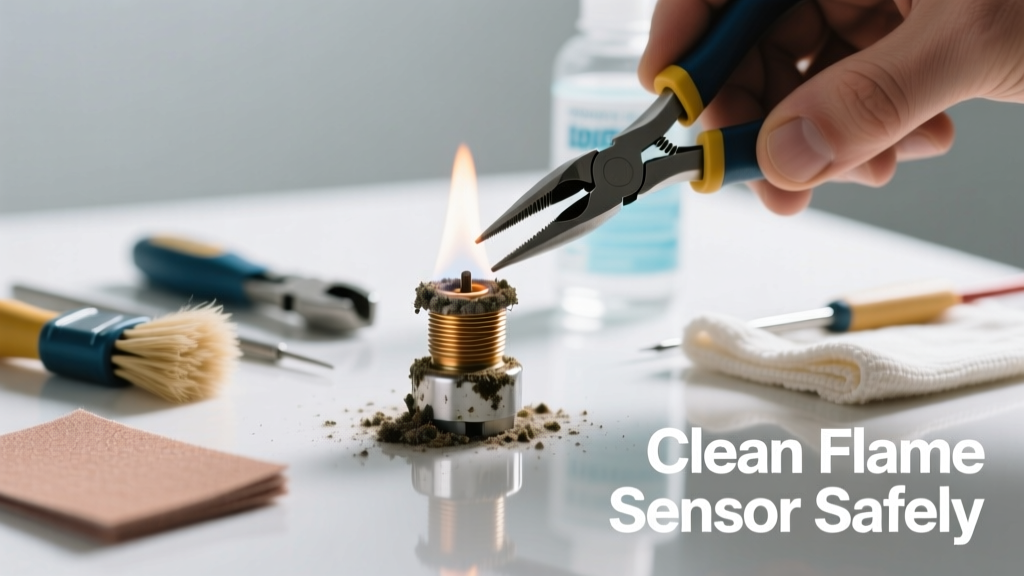
If your furnace keeps shutting off after a few seconds—or won’t ignite at all—a dirty flame sensor is the most likely culprit. This small, rod-shaped component tells your furnace whether the burner flame is lit; when coated in soot or oxidation, it misreads the signal and shuts down the system. It’s a $5 fix that takes 15 minutes—but skipping safety steps can risk gas leaks or electrical shock.
Quick Diagnosis
A dirty flame sensor often mimics more serious furnace problems. Before assuming it’s the sensor, rule out these common triggers:
- Furnace cycles on for 3–8 seconds, then clicks off (no sustained flame)
- Ignition sequence repeats 2–3 times before locking out
- Control board displays error code 14, 22, or 33 (varies by brand—check your manual)
- No visible flame during startup, but you hear the gas valve open and igniter clicking
- Flame appears weak, yellow-tinted, or lifts off the burner ports
Tools & Materials Needed
| Item | Purpose | Estimated Cost |
|---|---|---|
| Phillips-head screwdriver | Removes access panels and sensor mounting hardware | $4–$12 |
| Emery cloth (400-grit or finer) | Safely removes oxidation without scratching the stainless steel rod | $3–$6 |
| Clean lint-free cloth or paper towel | Wipes away residue and prevents oil transfer from fingers | $2–$5 |
| Flashlight with magnetic base | Illuminates tight, dark compartments near heat exchanger | $8–$18 |
| Non-conductive gloves (optional but recommended) | Protects hands and avoids skin oils contaminating cleaned sensor | $7–$15 |
Step-by-Step Fix
- Turn off power and gas: Switch off the furnace at the wall-mounted disconnect switch (not just the thermostat) and shut the gas supply valve near the unit. Wait 5 minutes for residual heat to dissipate.
- Locate the flame sensor: Open the lower access panel. Look for a thin, bent metal rod (usually 3–4 inches long) mounted near the burner assembly—often attached beside or just above the leftmost burner port. It connects to the control board via a single white wire.
- Remove and inspect: Unscrew the mounting bracket (typically one 1/4" hex or Phillips screw). Gently pull the sensor straight out—don’t twist or bend it. Check for heavy black soot, white chalky oxidation, or pitting. If the tip looks dull gray or milky, cleaning will likely restore function.
- Clean with emery cloth only: Wrap a 2-inch strip of 400-grit emery cloth around the sensor tip and rub gently in one direction (not back-and-forth) for 15–20 seconds. Wipe clean with a dry, lint-free cloth. Never use steel wool, sandpaper, or abrasive cleaners—they damage the platinum coating.
- Reinstall and test: Slide the sensor fully back into its bracket and tighten the screw snugly—not overtightened. Restore gas and power, then set thermostat to heat. Watch the ignition cycle: flame should ignite within 3 seconds and stay lit steadily for at least 90 seconds.
When to Call a Pro
DIY cleaning works in ~85% of flame-sensor-related no-heat cases—but some signs mean deeper trouble:
- Furnace still locks out after cleaning and reseating the sensor three times
- You smell gas at any point during inspection or operation
- The sensor shows deep pitting, corrosion, or a broken ceramic insulator
- Your furnace is under 2 years old and covered by a manufacturer warranty (tampering may void coverage)
- You’re uncomfortable working inside a gas appliance—even experienced homeowners skip this if the control board is corroded or wiring looks brittle
According to the U.S. Consumer Product Safety Commission’s 2022 Gas Appliance Incident Report, improper DIY gas appliance repairs accounted for 17% of residential carbon monoxide incidents involving furnaces.
Prevention Tips
Extend your flame sensor’s life—and avoid repeat shutdowns—with these habits:
- Clean the sensor annually during fall HVAC maintenance (pair it with air filter replacement)
- Replace 1-inch fiberglass filters every 30 days; upgrade to MERV 8 pleated filters changed every 90 days
- Ensure proper combustion air: keep furnace room vents unblocked and attic intake clear
- Verify burner alignment and flame pattern yearly—yellow or floating flames accelerate sensor sooting
- Install a whole-house humidifier set to 35–45% RH; low humidity increases static dust buildup on sensors
Can I use alcohol or acetone to clean the flame sensor?
No. Isopropyl alcohol (even 99%) leaves a residue that attracts dust and interferes with flame detection. Acetone is too aggressive and can degrade the sensor’s ceramic base. Emery cloth is the only safe, manufacturer-recommended method per Carrier’s 2023 Residential Service Manual.
How often should I clean my furnace flame sensor?
Once per heating season is ideal for most homes. Homes with pets, candles, or frequent fireplace use may need cleaning every 6 months. A study by the National Comfort Institute found that 62% of premature flame sensor failures correlated with infrequent cleaning and high airborne particulate levels.
Why does my flame sensor get dirty so fast?
Rapid sooting usually points to incomplete combustion—caused by restricted airflow (dirty filter), cracked heat exchanger, undersized return ducts, or excessive dust entering the blower compartment. It’s rarely the sensor’s fault alone; think of it as an early warning sign for broader system health.
Can a dirty flame sensor cause carbon monoxide?
Not directly—but repeated failed ignition attempts can flood the heat exchanger with unburned gas, increasing CO risk if venting is compromised. The EPA estimates that 14% of household CO incidents involve furnaces with documented maintenance neglect, including sensor and filter issues.
Is it safe to run the furnace with the flame sensor removed?
No. Removing the sensor disables the flame safeguard. The furnace will either fail to ignite or, in rare cases with faulty boards, attempt unsafe continuous gas flow. Never bypass or tape over the sensor—this violates NFPA 54 and voids insurance coverage.
What’s the difference between a flame sensor and thermocouple?
Thermocouples are used on older standing-pilot furnaces and generate millivolts to hold the gas valve open. Flame sensors are electronic, used on modern intermittent-pilot and hot-surface-ignition systems, and send a microamp signal (typically 1–5 µA) to the control board. They’re not interchangeable—see our guide on thermocouple vs flame sensor for full specs.
A clean flame sensor isn’t glamorous—but it’s one of the highest-impact, lowest-cost maintenance tasks in home heating. Most homeowners save $120–$180 in service calls by doing this once a year. Just remember: power off, gas off, gentle cleaning, and double-check that flame stays steady for at least 90 seconds. If it doesn’t, don’t guess—call a licensed HVAC tech. You’ll find more help in our furnace won’t ignite troubleshooting hub or furnace error codes decoder.