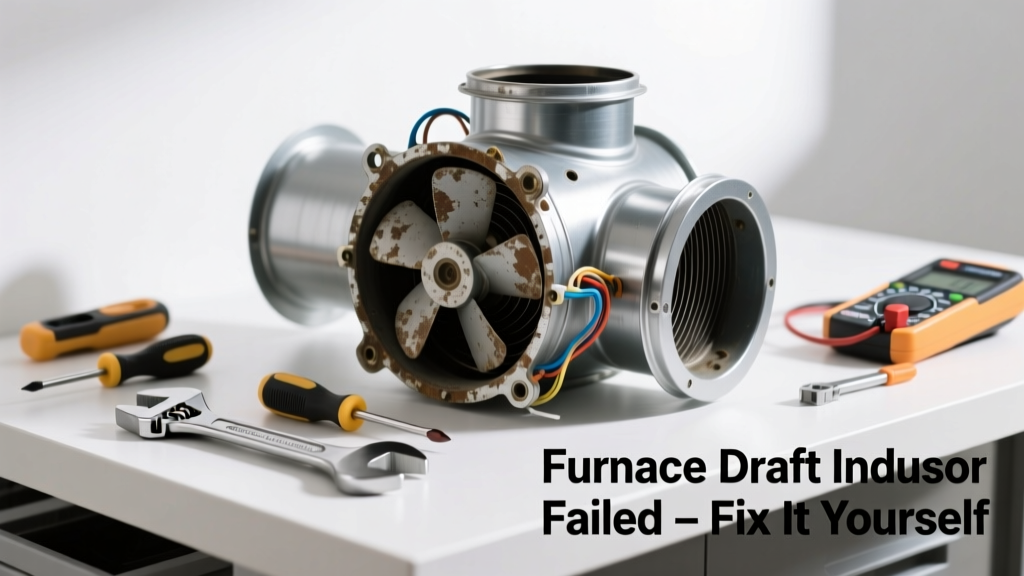
If your furnace won’t ignite, cycles off after a few seconds, or makes a loud grinding or whining noise before shutting down, the draft inducer motor may have failed. This small but critical component creates negative pressure to safely vent combustion gases — and when it stops working, your furnace shuts down as a safety measure.
Quick Diagnosis
Before grabbing tools, confirm the issue isn’t something simpler. Most draft inducer failures stem from one of these causes:
- Blower wheel jammed by debris (lint, rodent nests, or rust flakes)
- Failed capacitor (common on older units — look for bulging or leaking)
- Open circuit in the inducer motor windings (measured with a multimeter)
- Bad control board relay (no 120V output to inducer during call for heat)
- Blocked flue pipe or condensate trap (triggers pressure switch lockout)
Tools & Materials Needed
| Item | Purpose | Estimated Cost |
|---|---|---|
| Multimeter (clamp-style preferred) | Test voltage at inducer terminals and continuity of windings | $45–$85 |
| Replacement draft inducer assembly | OEM or universal match — verify model number and CFM rating | $120–$260 |
| Condensate pump cleaner kit | Clean clogged traps that mimic inducer failure | $18–$32 |
| Wire brush & vacuum with crevice tool | Remove rust, soot, and debris from blower housing and wheel | $12–$25 |
| Non-contact voltage tester | Safely verify power is off before servicing | $15–$28 |
Step-by-Step Fix
Follow these methods in order — many 'failed' inducers are just obstructed or miswired:
- Power down and inspect visually: Turn off furnace breaker and gas valve. Remove inducer cover plate. Look for broken fan blades, corrosion on motor shaft, or nesting material inside the housing.
- Check voltage and pressure switch: Restore power, set thermostat to heat, and use your multimeter to verify 120V reaches the inducer terminals within 30 seconds of calling for heat. If voltage is present but no spin, test pressure switch continuity — if open, clean condensate lines first.
- Test motor windings: Disconnect inducer wires. Set multimeter to ohms. Measure resistance across main winding leads (typically black/white). Readings under 10Ω or over ∞Ω indicate failure. A reading between 40–120Ω suggests good windings.
- Replace the assembly: Match part number exactly. Loosen mounting screws, disconnect wiring harness, and install new unit. Tighten screws to 25 in-lbs (over-torquing cracks housings). Reconnect wiring using original plug orientation — reversing hot/neutral can damage control boards.
When to Call a Pro
Stop and call an HVAC technician if you encounter any of these:
- No voltage at inducer terminals despite correct thermostat signal (points to control board or wiring fault)
- Recurring inducer failure within 6 months (indicates undersized unit, excessive static pressure, or flue sizing issues)
- Gas odor, soot streaks near heat exchanger, or cracked inducer housing (potential CO hazard)
- Furnace is under warranty — improper repair voids coverage
"Over 68% of premature draft inducer failures are caused by restricted airflow or neglected condensate maintenance — not motor defects." — American Society of Heating, Refrigerating and Air-Conditioning Engineers (ASHRAE) HVAC Applications Handbook, 2022 Edition
Prevention Tips
Extend inducer life with routine care:
- Clean the inducer wheel and housing every fall before heating season begins
- Replace or clean the primary air filter monthly during heavy use
- Inspect and flush the condensate drain line and trap quarterly (use vinegar + compressed air)
- Verify flue termination is clear of snow, bird nests, or ice dams each winter
- Install a smart thermostat with diagnostic alerts — some models flag inducer runtime anomalies
How do I know if my draft inducer is failing versus the pressure switch?
A failing inducer usually produces no sound or a faint hum without rotation. A faulty pressure switch often allows the inducer to run for 30–90 seconds, then cuts ignition — watch for the LED flash code on your control board (e.g., 3 flashes = pressure switch open). Test the switch with a jumper wire only if you’re trained — incorrect bypassing risks dangerous gas release.
Can I lubricate the draft inducer motor bearings?
No — modern inducer motors use sealed, lifetime-lubricated bearings. Adding oil attracts dust and degrades internal grease. If bearings grind or seize, replacement is required. Older belt-driven inducers (rare post-2000) may accept 3-in-1 oil on pulley shafts — but confirm design first.
What’s the average lifespan of a furnace draft inducer?
Most last 12–15 years with proper airflow and condensate management. Units in humid climates or homes with poor filtration average 7–9 years. According to the U.S. Department of Energy’s 2023 Residential HVAC Study, inducer replacement accounts for 22% of mid-life furnace repairs.
Why does my inducer run but furnace won’t ignite?
This points to a pressure switch issue, not the inducer itself. Common culprits include a water-logged condensate trap, blocked flue pipe, cracked rubber hose between inducer and switch, or a failing switch. Check for standing water in the trap and listen for a soft ‘click’ from the switch when inducer starts — no click means no closure.
Is it safe to run the furnace with the inducer cover removed?
No. The cover maintains proper airflow calibration and contains potential sparks or debris. Running uncovered also violates UL safety standards and may trigger high-limit shutdowns. Always reinstall the cover and verify gasket integrity before powering up.
Can a dirty air filter cause draft inducer failure?
Indirectly — yes. A clogged filter increases static pressure, forcing the inducer to work harder and overheat. Over time, this degrades insulation on motor windings and accelerates capacitor wear. Replace filters every 30 days if using MERV 8–11; every 90 days for basic fiberglass.
A working draft inducer is non-negotiable for safe furnace operation — but most failures aren’t catastrophic motor deaths. Often, it’s a $20 cleaning job or a $40 capacitor swap hiding behind a blinking error code. Stay methodical, respect lockout/tagout procedures, and remember: if your furnace smells like burning plastic or you hear metal-on-metal grinding, power it down and call a licensed HVAC tech immediately. For related help, see our guides on furnace pressure switch testing and gas furnace no-heat troubleshooting.