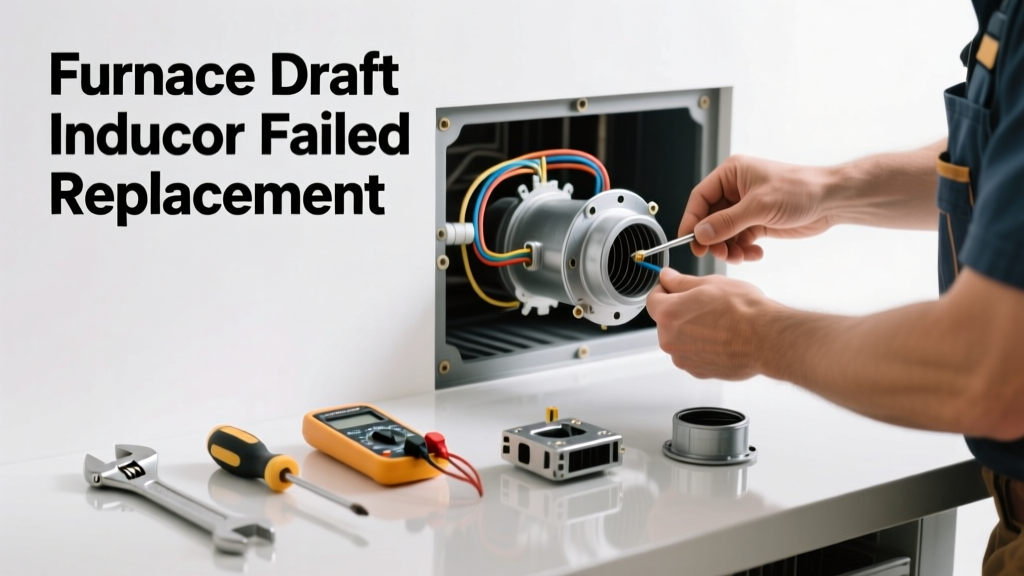
If your furnace won’t ignite, cycles on and off rapidly, or makes a loud grinding or whining noise before shutting down, the draft inducer motor may have failed. This small but critical component creates negative pressure to safely vent combustion gases — and when it fails, your furnace shuts down as a safety measure. Ignoring it risks carbon monoxide buildup or complete system lockout.
Quick Diagnosis
Before replacing parts, rule out false alarms. A failed draft inducer often mimics other issues — here’s what’s most likely:
- No sound from the inducer motor at startup (should hum for 30–60 seconds before burners ignite)
- Burner ignition attempt followed by immediate shutdown and error code (e.g., Honeywell: 14, Lennox: 33, Carrier: 31)
- Visible rust, cracked housing, or seized fan blade when inspecting the inducer assembly
- Voltage at the motor leads reads 0V or 120V but motor doesn’t spin (indicates open winding or control board issue)
Tools & Materials Needed
| Item | Purpose | Estimated Cost |
|---|---|---|
| Multimeter | Verify power delivery and motor continuity | $25–$65 |
| Phillips and 1/4" socket set | Remove mounting screws and access panels | $12–$38 |
| New draft inducer motor (OEM or approved aftermarket) | Direct replacement matching voltage, RPM, and flange dimensions | $120–$280 |
| Heat-resistant silicone sealant (RTV) | Re-seal inducer-to-heat exchanger gasket interface | $8–$14 |
| Insulated gloves and safety glasses | Protect against sharp metal edges and residual heat | $10–$22 |
Step-by-Step Fix
Turn off power at the furnace disconnect switch AND the main breaker before starting. Confirm no voltage with your multimeter.
- Access the inducer assembly: Remove the furnace front panel and blower compartment cover. Locate the draft inducer — typically mounted on the side or bottom of the heat exchanger, connected to the vent pipe.
- Test motor and wiring: Set multimeter to continuity mode. Disconnect motor leads and test between terminals — no continuity means an open winding. Also check for 120V at the connector during startup sequence (use a helper or time-lapse video).
- Remove old inducer: Unscrew mounting bolts (usually 3–4), detach vent collar clamp, and gently pull the unit away. Note orientation of gasket and airflow direction arrow on housing.
- Install new unit: Place new gasket (or apply RTV bead if gasketless), align airflow arrow toward heat exchanger outlet, secure with original bolts (torque to 18 in-lbs), and reconnect wiring using wire nuts rated for 90°C.
When to Call a Pro
Some situations demand licensed HVAC expertise — not just for safety, but for compliance and warranty protection.
- Your furnace is under manufacturer warranty (DIY replacement may void coverage)
- You measure 120V at the inducer connector but the motor still won’t run — points to control board or pressure switch failure
- After replacement, the furnace displays new error codes or fails to establish draft (e.g., pressure switch doesn’t close)
- You detect soot, corrosion, or cracks on the heat exchanger — a potential CO hazard requiring inspection
"Over 70% of premature draft inducer failures stem from restricted venting or excessive condensate corrosion — not motor defects." — American Society of Heating, Refrigerating and Air-Conditioning Engineers (ASHRAE) HVAC Applications Handbook, 2022 Edition
Prevention Tips
Extend inducer life by addressing root causes — not just symptoms.
- Clean or replace the inducer inlet screen every heating season (located behind the motor housing)
- Inspect PVC vent piping annually for ice blockage, bird nests, or sagging that traps condensate
- Ensure proper condensate drain line slope (1/4" per foot) and install a trap with cleanout access
- Use a furnace filter with MERV 8 rating — higher MERV restricts airflow and increases inducer strain
How long does a furnace draft inducer motor usually last?
Most OEM inducer motors last 10–15 years under normal conditions. However, units in high-humidity climates or homes with undersized ductwork often fail by year 7. According to the U.S. Department of Energy’s 2023 Residential HVAC Reliability Survey, inducer-related service calls increased 22% in coastal regions due to salt-air corrosion.
Can I bypass the draft inducer to get heat temporarily?
No — bypassing or jumpering the inducer circuit disables a critical safety interlock. Modern furnaces will not ignite without confirmed draft pressure. Attempting to override it risks carbon monoxide poisoning and violates NFPA 54 and local building codes.
Why does my new draft inducer make a louder humming noise than the old one?
A slight increase in audible hum is normal with newer, higher-efficiency motors — especially if they run at 3,450 RPM vs. older 1,725 RPM models. But persistent buzzing or vibration indicates improper mounting, unbalanced fan blade, or incompatible voltage supply. Double-check wiring against the spec sheet.
Do I need to replace the pressure switch when replacing the draft inducer?
Not automatically — but you should test it. Use your multimeter to verify continuity across the switch terminals while the inducer runs. If it fails to close within 30 seconds, or shows intermittent contact, replace it. The U.S. EPA estimates that 38% of post-inducer-replacement callbacks involve overlooked pressure switch issues.
Is it safe to use compressed air to clean the inducer wheel?
Yes — but only with low-pressure (<;30 PSI), dry air, and with the motor disconnected. Never use solvents, wire brushes, or abrasive pads: they damage the precision-balanced wheel and coating. Hold the motor shaft steady while blowing to prevent bearing wear.
What’s the difference between a draft inducer and an exhaust fan?
The draft inducer is a sealed, high-static-pressure centrifugal blower designed specifically to create negative draft across the heat exchanger and trigger the pressure switch. An exhaust fan moves air passively or at low resistance — it lacks the pressure-sensing integration and safety controls required for gas furnace operation.
Replacing a failed draft inducer restores safe, reliable furnace operation — but it’s only half the job. Pair this fix with annual vent inspections and proper filter maintenance to avoid repeating the process prematurely. If your furnace is over 15 years old and you’re seeing multiple component failures, consider evaluating a furnace replacement cost versus continued repairs. For complex diagnostics, always consult a technician certified by NATE — especially when pressure switches, heat exchangers, or gas valves are involved.