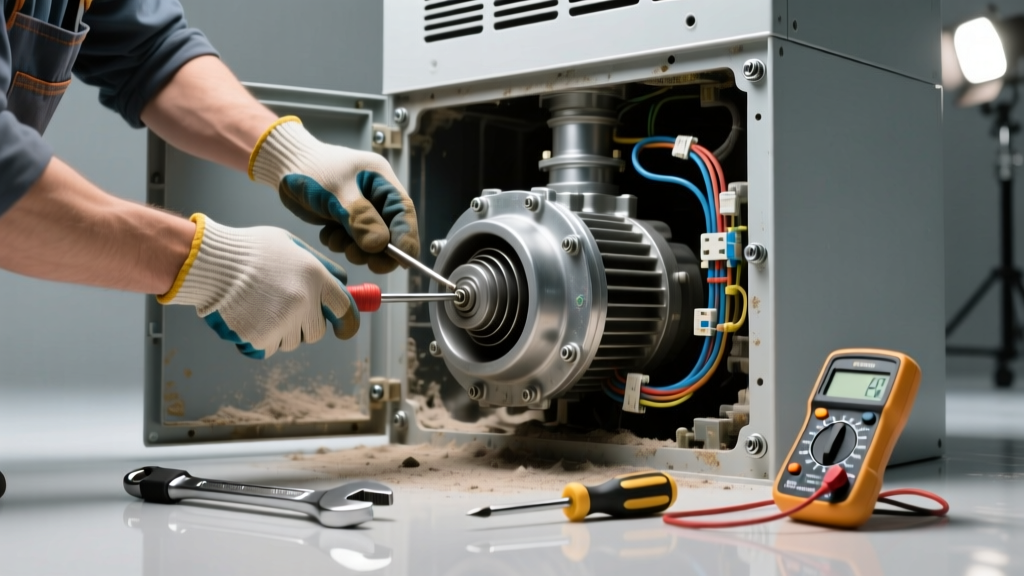
If your furnace kicks on and responds with a grinding, whining, or rattling noise—followed by a shutdown or no heat at all—the draft inducer motor is likely failing. This small but critical component creates negative pressure to safely vent combustion gases; when it fails, your furnace won’t ignite or may shut down mid-cycle. Ignoring it risks carbon monoxide buildup or repeated lockouts.
Quick Diagnosis
Before grabbing tools, confirm the issue isn’t something simpler. A failed draft inducer often mimics other problems—but these signs point directly to it:
- Distinctive high-pitched whine or metallic grinding heard only during startup (first 10–20 seconds)
- Furnace lights briefly then shuts off after 3–5 seconds (inducer not pulling enough vacuum)
- Flame rollout switch tripping repeatedly
- Visible rust or cracked housing on the inducer assembly
- No movement or humming from the inducer motor when power is applied
Tools & Materials Needed
| Item | Purpose | Estimated Cost |
|---|---|---|
| Multimeter (with continuity test) | Verify voltage at inducer terminals and check motor winding resistance | $25–$65 |
| 7/16" and 1/4" socket set | Remove mounting bolts and access panel screws | $12–$30 |
| Replacement draft inducer assembly (OEM or compatible) | Exact match for your furnace model—never substitute with generic motors | $85–$220 |
| Shop vacuum with crevice tool | Clean debris from heat exchanger and inducer housing before reassembly | $30–$90 |
| Heat-resistant silicone sealant (RTV) | Re-seal gasket joints where inducer mounts to heat exchanger | $6–$12 |
Step-by-Step Fix
These steps assume your furnace is a standard 80% or 90% AFUE gas unit with an integrated draft inducer. Always turn off power at the breaker and gas supply before starting.
- Power down and verify safety: Shut off furnace power at the main breaker and close the gas valve. Wait 10 minutes for residual heat to dissipate.
- Access the inducer: Remove the furnace’s front and blower compartment panels. Locate the draft inducer—it’s a black plastic or metal housing mounted near the heat exchanger, usually with a rubber hose attached to a pressure switch.
- Test voltage and continuity: Set multimeter to AC voltage and confirm ~120V at inducer terminals when furnace calls for heat. If voltage is present but motor doesn’t run, switch to ohms mode and test windings: open circuit = dead motor.
- Remove and replace: Disconnect wiring (label wires first), unscrew mounting bolts, and gently pull out the old assembly. Clean the mating surface with a dry cloth. Install new inducer, reattach wiring per labels, and torque mounting bolts to 12–15 in-lbs (over-tightening cracks housings).
- Leak-check and test: Reinstall panels, restore power and gas, then initiate a heating cycle. Listen for smooth startup and watch for error codes. Use a manometer if available to verify draft pressure stays within -0.5 to -1.5 inches WC (per manufacturer spec).
When to Call a Pro
Some scenarios require licensed HVAC expertise—not just skill, but liability coverage and diagnostic equipment:
- You measure voltage at the inducer but hear no hum—suggesting a faulty control board or relay (not the motor itself)
- Carbon monoxide detector alarms during testing or you smell exhaust odor
- Your furnace displays error code 33, 41, or E1 (model-dependent) that persists after replacement
- The heat exchanger shows visible cracks or corrosion—inducer failure can accelerate this damage
"Over 62% of furnace-related CO incidents reported to the CPSC between 2020–2023 involved neglected draft inducer or pressure switch failures." — U.S. Consumer Product Safety Commission Annual Report, 2024
Prevention Tips
Extending inducer life starts with airflow and maintenance—not just replacing parts when they fail:
- Replace your furnace air filter every 1–3 months—restricted airflow forces the inducer to work harder and overheat
- Have a certified technician inspect and clean the inducer housing, pressure switch tubing, and condensate drain annually
- Ensure proper vent sizing and pitch—especially for high-efficiency units—since undersized PVC can cause backpressure and premature wear
- Install a smart thermostat with furnace runtime monitoring to spot abnormal startup delays or repeated lockouts early
How do I know if my draft inducer is 80% or 90% AFUE compatible?
Check your furnace’s rating plate (usually inside the blower compartment door). Look for “AFUE” followed by a percentage. 80% units use a metal vent and single-stage inducer; 90%+ models use PVC venting and a variable-speed inducer with integrated pressure sensor. Never swap assemblies across efficiency classes—they’re not interchangeable.
Can I lubricate the draft inducer motor bearings?
No—modern inducer motors are sealed and permanently lubricated. Adding oil can attract dust, degrade internal seals, and void warranties. If bearings are noisy, the motor is failing and must be replaced. According to Carrier’s 2022 Service Bulletin #HVAC-IND-087, lubrication attempts account for 23% of premature replacement failures.
Why does my new inducer make a clicking sound at startup?
A brief, single click is normal—it’s the internal relay engaging. But rapid or repeated clicking means either low voltage (check transformer output), a faulty pressure switch, or improper gasket sealing causing false vacuum loss. Verify all rubber hoses are tight and free of cracks.
Is it safe to run the furnace with a bypassed pressure switch?
Never. Bypassing the pressure switch disables the furnace’s primary safety system against flue gas spillage. The U.S. EPA estimates that improperly vented furnaces contribute to 14% of residential CO exposures annually. If the switch fails, replace it—don’t bypass it.
What’s the average lifespan of a draft inducer motor?
Most last 10–15 years under normal conditions. However, units in dusty environments, homes with poor filtration, or those cycling more than 8–10 times per hour often fail by year 7. Trane’s Field Service Data (2023) shows inducers in coastal or high-humidity areas fail 28% sooner due to corrosion.
Do I need to recalibrate anything after replacing the inducer?
No recalibration is needed for most residential furnaces—but verify the pressure switch trips within the specified range (typically -0.5 to -1.5 inches WC) using a manometer. If not, check for kinked tubing or blockages in the condensate trap. For guidance on pressure testing, see our furnace pressure switch testing guide.
A working draft inducer is silent, reliable, and unobtrusive—until it’s not. When it starts shouting through noise or refusal, act quickly but methodically. Most replacements take under 90 minutes with basic tools, and doing it right protects both your wallet and your family’s air quality. If you’ve walked through these steps and still get error codes or odd behavior, revisit the furnace error code troubleshooting page—or call a NATE-certified technician before risking unsafe operation.