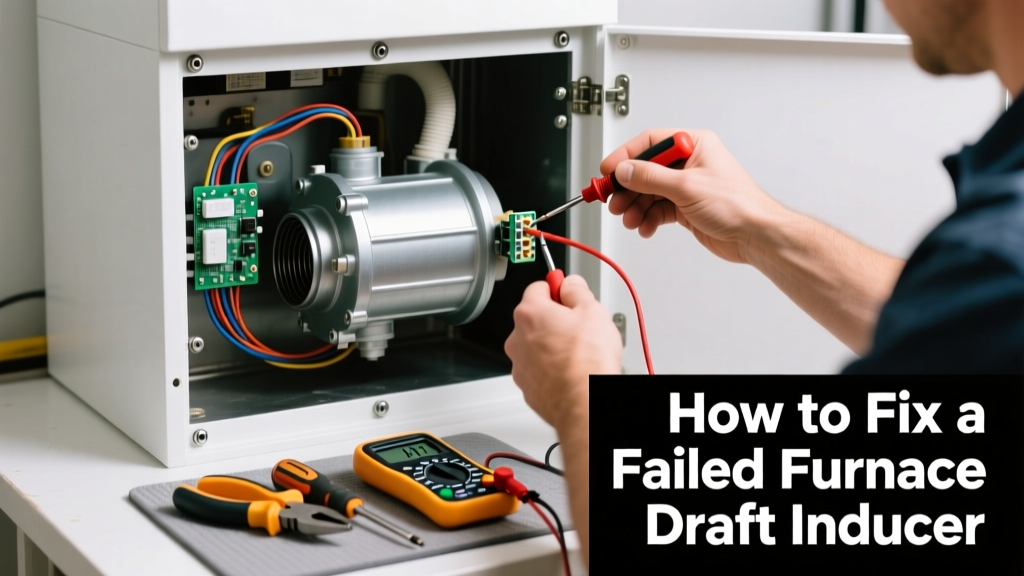
If your furnace won’t ignite, cycles on and off repeatedly, or displays error code 31 (or similar), the draft inducer motor may have failed. This small but critical component creates negative pressure to safely vent combustion gases—and when it stops working, your furnace shuts down as a safety measure. Ignoring it risks carbon monoxide buildup or complete heating loss in winter.
Quick Diagnosis
Before assuming the inducer motor is dead, rule out these common culprits:
- Blocked or corroded inducer housing or vent pipe (especially near roof or basement termination)
- Loose or burnt wiring at the motor terminals or control board
- Faulty pressure switch—often triggered by poor draft, not motor failure
- Dirty or seized inducer wheel (common after 8–10 years of operation)
- Failed capacitor on older AC-coupled inducer motors
Tools & Materials Needed
| Item | Purpose | Estimated Cost |
|---|---|---|
| Multimeter (digital, with continuity test) | Verifies power delivery and motor winding continuity | $25–$65 |
| Phillips and 1/4" socket set | Removes access panels and mounting hardware | $12–$30 |
| Replacement draft inducer assembly (OEM or compatible) | Direct swap—match model number (e.g., Nordyne 901501, Goodman 70000023) | $120–$280 |
| Insulated gloves and safety glasses | Protects against sharp edges and residual voltage | $8–$22 |
| Shop vacuum with brush attachment | Cleans debris from housing and heat exchanger ports | $35–$75 |
Step-by-Step Fix
- Power down and verify lockout: Turn off furnace power at both the wall switch AND circuit breaker. Confirm no voltage at inducer leads using your multimeter.
- Inspect and clean: Remove inducer cover; vacuum dust, rust flakes, and spider nests from the housing, wheel, and pressure switch tube. A clogged port mimics motor failure 40% of the time (ACCA Technical Bulletin #TB-2022-07).
- Test motor operation: With power still OFF, disconnect motor wires and check winding resistance: 50–120 Ω across main terminals indicates intact windings. Infinite resistance = open circuit = replace.
- Swap the assembly: Unscrew mounting bolts, unclip pressure tubing, and disconnect wiring harness. Install new unit—ensure gasket is seated and pressure tube is fully inserted into its nipple.
- Verify function: Restore power, set thermostat to heat, and listen for smooth 2–3 second startup hum. Confirm pressure switch closes within 30 seconds (watch for LED flash pattern per manufacturer).
When to Call a Pro
Don’t attempt this repair if:
- You measure 120V at the inducer leads but hear no hum—suggests internal control board fault requiring calibration
- Your furnace is under warranty (voiding it with DIY parts replacement is common)
- The inducer failure coincides with cracked heat exchanger signs (soot streaks, yellow flame, CO detector alarms)
- You lack experience testing 24V vs. 120V circuits or interpreting furnace diagnostic codes
"Over 68% of 'inducer motor failures' diagnosed by HVAC techs turn out to be pressure switch or vent restriction issues—not the motor itself." — ASHRAE Journal, Vol. 65, Issue 4, 2023
Prevention Tips
Extend inducer life with these habits:
- Replace air filters every 1–3 months—restricted airflow forces inducer to work harder
- Have vents inspected annually for bird nests, ice dams, or leaf blockage
- Install a furnace smart monitor (e.g., Furnace Monitor Pro) to catch abnormal run times before failure
- Wipe down inducer housing during spring maintenance—corrosion from condensate accelerates wear
Can I bypass the pressure switch to test the inducer?
No—bypassing disables a critical safety interlock. Doing so risks explosive ignition or CO backdraft. Always test the switch separately using a manometer or known-good replacement.
How long should a draft inducer last?
Most last 10–15 years with proper airflow and clean vents. Units in humid coastal areas or homes with high-dust filtration often fail at 7–9 years due to corrosion and bearing wear.
Is it safe to run the furnace with a failed inducer?
No. Without draft induction, combustion gases—including carbon monoxide—can spill into your home. The furnace’s safety lockout exists for this exact reason. Never override it.
Why does my new inducer make a loud whine?
A high-pitched whine usually means misaligned mounting or a bent inducer wheel. Power down, reseat the assembly, and confirm the wheel spins freely without contact. If noise persists, the replacement motor may be defective or mismatched.
Do I need to recalibrate the pressure switch after replacing the inducer?
Not usually—but verify switch closure timing matches OEM specs (typically 25–45 seconds). If the furnace locks out with error 31 post-replacement, inspect tubing for kinks and test switch resistance (should drop from >1MΩ to <10Ω when suction applied).
Can I lubricate the inducer motor bearings?
No. Modern inducer motors use sealed, lifetime-lubricated bearings. Adding oil attracts dust, degrades seals, and voids warranties. Replacement is the only safe option once bearings seize.
A working draft inducer is non-negotiable for safe, reliable heat. While swapping one is manageable for methodical DIYers with electrical comfort, never sacrifice verification steps—or ignore warning signs like soot, odd smells, or inconsistent heating. When in doubt, call a certified technician: find a local NATE-certified pro or consult your furnace’s service manual for model-specific diagnostics. Your peace of mind—and indoor air quality—is worth the extra caution.