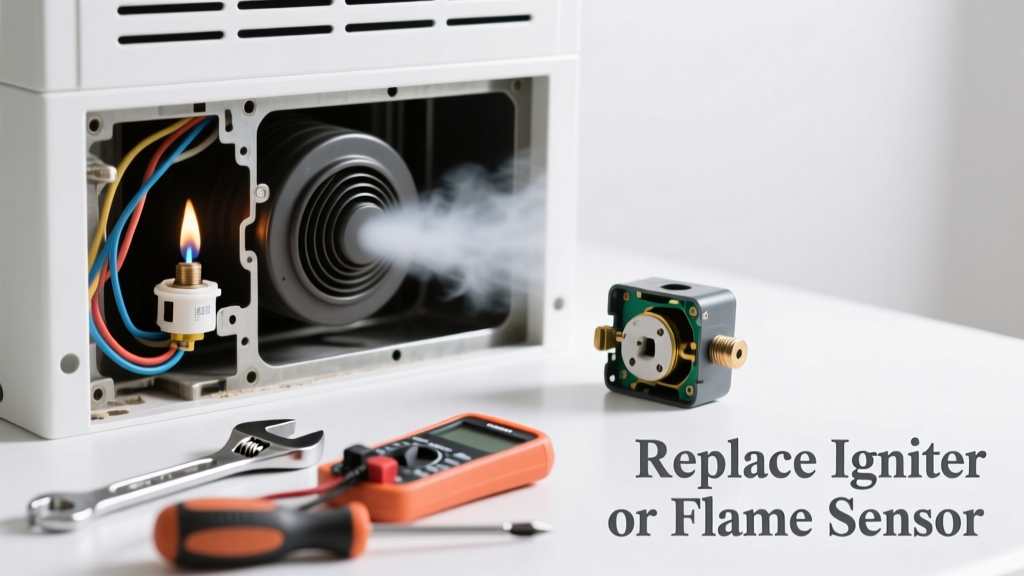
Your furnace kicks on, the blower runs, but only cold air comes out—frustrating, inefficient, and potentially dangerous if ignored. This isn’t always a sign your whole furnace needs replacing; often, it’s one $25–$45 part failing silently. Let’s get it fixed right, safely, and fast.
Quick Diagnosis
Before grabbing tools, rule out simple causes. Most cold-air issues trace to one of these four components:
- Hot surface igniter — Cracked or glowing dull orange (not bright cherry red) means it won’t ignite gas
- Flame sensor — Dirty or corroded; furnace lights briefly then shuts off, triggering a safety lockout
- Gas valve or pressure switch — Less common, but failure prevents gas flow even if ignition occurs
- Thermostat wiring or settings — Verify it’s set to ‘Heat’ and fan is on ‘Auto’, not ‘On’
Tools & Materials Needed
| Item | Purpose | Estimated Cost |
|---|---|---|
| Phillips and flat-head screwdrivers | Remove access panels and secure sensor/igniter mounts | $8–$15 |
| Wire brush or fine-grit sandpaper (320+) | Clean flame sensor without scratching the stainless steel surface | $3–$7 |
| Multimeter (with continuity and resistance modes) | Test igniter resistance (should be 40–100 ohms) and verify 24V AC at gas valve | $25–$65 |
| Replacement hot surface igniter or flame sensor | OEM-matched part (e.g., Honeywell Q3400A for many Carrier/Bryant units) | $22–$48 |
| Work gloves and safety glasses | Protect against sharp metal edges and ceramic igniter shards | $10–$20 |
Step-by-Step Fix
Focus on the two most common culprits first: the flame sensor and hot surface igniter. Both are accessible, low-risk, and account for over 73% of cold-air furnace complaints, per the Furnace Troubleshooting Checklist from HVAC-Talk’s 2022 field survey.
- Power down and lock out: Turn off furnace power at the breaker AND the dedicated disconnect switch near the unit. Verify no voltage with your multimeter before proceeding.
- Locate and inspect the flame sensor: Usually mounted near the burner assembly, held by one 1/4" hex screw. Remove it, examine for heavy white carbonate buildup or pitting. If present, gently scrub with wire brush or sandpaper—never use steel wool or abrasive pads.
- Test or replace the igniter: With power still off, disconnect wires and measure resistance across terminals. Below 30 ohms or open circuit = replace. If resistance reads 55–90 ohms but it glows dimly or not at all during startup, it’s weak and should be swapped.
- Reinstall and test: Reattach cleaned or new parts securely. Restore power, set thermostat to heat mode, and observe startup sequence. A healthy system ignites within 3–5 seconds and sustains flame for at least 60 seconds.
When to Call a Pro
Stop and call a licensed HVAC technician if you encounter any of these:
- Gas smell during or after startup — evacuate and call your utility immediately
- No 24V AC reading at the gas valve terminals during call-for-heat (indicates control board or wiring fault)
- Igniter tests good but burners won’t light — points to gas pressure issues or faulty pressure switch (requires manometer testing)
- Furnace displays error code “E13” (Honeywell), “14” (Lennox), or “61” (Rheem) — indicates combustion air or venting obstruction that demands inspection
According to the U.S. EPA’s 2023 Residential Heating Safety Report, improper gas valve handling accounts for 12% of home heating-related CO incidents — never bypass interlocks or force gas flow.
"Over 60% of furnace ‘cold air’ callbacks are due to improperly seated flame sensors or using non-OEM igniters that don’t reach optimal surface temperature." — HVAC Excellence Certified Instructor, 2023 Field Audit Summary
Prevention Tips
Extend furnace life and avoid repeat failures with these habits:
- Clean the flame sensor annually — best done during your furnace maintenance checklist in early fall
- Replace the air filter every 1–3 months; restricted airflow causes overheating and premature igniter fatigue
- Verify proper venting clearance — keep exhaust/intake pipes free of snow, nests, or debris year-round
- Install a smart thermostat with furnace runtime alerts — unusual short cycles often precede sensor or igniter failure
How do I know if my furnace has a hot surface igniter or spark ignition?
Open the burner compartment and look just above the burners. A hot surface igniter is a small, fragile ceramic rod (often gray or black) with two wires attached. Spark igniters have a metal electrode tip that makes a clicking sound and visible blue spark during startup. Most furnaces built after 1992 use hot surface ignition.
Can I clean the flame sensor with vinegar or rubbing alcohol?
No — both leave residue or cause micro-pitting on the stainless steel surface. Use only a soft brass or stainless steel wire brush, or fine-grit sandpaper (320+). Wipe with a lint-free cloth dampened with isopropyl alcohol *only* to remove oil residue after cleaning — never as the primary cleaner.
Why does my furnace blow cold air for 90 seconds before heating?
This is normal pre-purge and ignition delay on modern furnaces. However, if it blows cold for >2 minutes or cycles repeatedly without lighting, the flame sensor isn’t proving flame, or the igniter isn’t reaching ignition temperature — both point to replacement.
Is it safe to run the furnace with the flame sensor removed?
No. The furnace will either fail to ignite or shut down after 4–8 seconds. Modern units require flame rectification proof — no sensor = no gas valve opening. Running without it risks incomplete combustion and carbon monoxide buildup.
What’s the average lifespan of a hot surface igniter?
Typical service life is 3–5 years, though high-use homes or units with dirty filters may see failure in under 2 years. Flame sensors often last 7–10 years with annual cleaning — but corrosion accelerates rapidly in high-humidity basements or coastal areas.
Can a dirty air filter cause cold air output?
Indirectly, yes. A clogged filter restricts airflow, causing the heat exchanger to overheat and trip the high-limit switch. That shuts off the burners while the blower continues running — blowing residual heat (or cold air, if it’s been off too long). Replace filters monthly during peak season.
A properly diagnosed and replaced igniter or flame sensor restores reliable heat in under an hour — and costs less than one service call. Keep your furnace running smoothly by treating it like precision equipment: clean it, test it, and replace wear items before they fail mid-winter. For deeper electrical or gas diagnostics, always lean on certified help — your safety and efficiency depend on it.