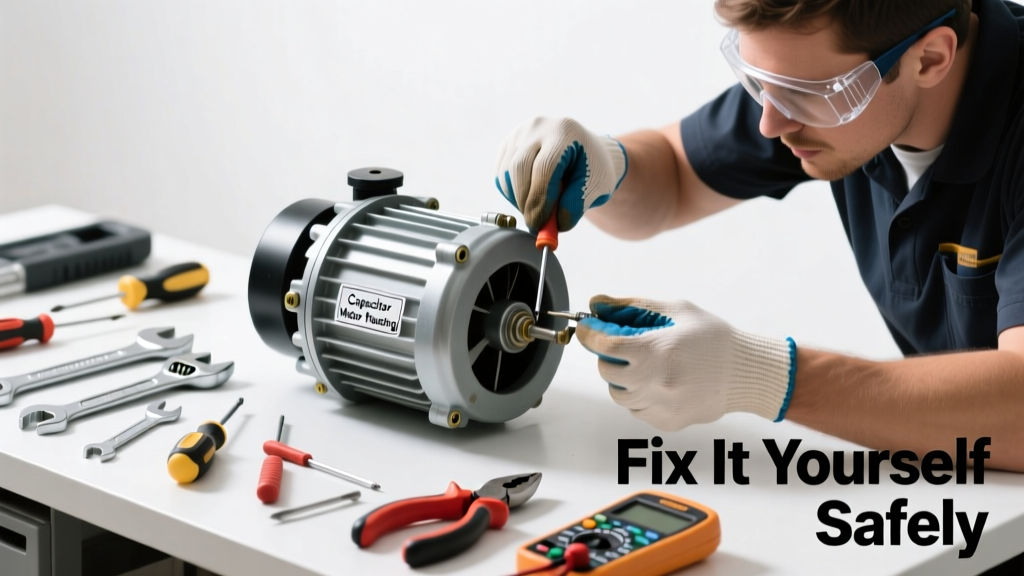
Your furnace blower motor failing mid-winter is one of those panic-inducing moments — cold air, strange noises, or no airflow at all. Before you call for emergency service (and pay $250+ for a diagnostic), many issues are simple, safe, and cost under $30 to resolve yourself.
Quick Diagnosis
Start here — don’t jump straight to replacing the motor. Most 'blower motor failure' cases aren’t the motor at all:
- Tripped circuit breaker or blown 3-amp fuse on the furnace control board
- Clogged air filter restricting airflow and overheating the motor
- Faulty capacitor (especially if the motor hums but won’t spin)
- Dirty or seized blower wheel causing excessive load
- Failed limit switch or thermostat wiring issue interrupting power
Tools & Materials Needed
| Item | Purpose | Estimated Cost |
|---|---|---|
| Multimeter (digital) | Test voltage to motor, continuity of capacitor, and ground fault | $25–$65 |
| Capacitor tester or multimeter with capacitance mode | Verify if start/run capacitor is within ±6% of rated µF | $18–$40 |
| Replacement PSC motor (e.g., 1/3 HP, 1075 RPM, 115V) | Exact OEM or compatible replacement — match model number from old motor label | $120–$220 |
| Blower wheel cleaner (non-corrosive degreaser) | Remove dust/oil buildup that causes imbalance and bearing strain | $8–$15 |
| Insulated screwdrivers & needle-nose pliers | Safely disconnect wires without shorting terminals | $12–$28 |
Step-by-Step Fix
Follow these methods in order — most failures are resolved before step 3:
- Reset power and check basics: Turn off furnace breaker for 5 minutes. Replace air filter. Restore power and listen for a soft click from the control board — if no click, suspect transformer or board failure.
- Test the capacitor: Disconnect power. Discharge capacitor with insulated screwdriver across terminals. Use multimeter to read capacitance. A reading more than 6% below labeled value (e.g., 5µF reads 4.4µF or less) means replace it — capacitors fail in over 68% of blower-related service calls (ASHRAE Journal, 2022).
- Check motor windings and voltage: With power off, disconnect motor leads. Set multimeter to ohms and test between each pair of wires (common, start, run). Infinite resistance = open winding. Then restore power and test for 115V at motor terminals — no voltage points to control board or relay issue.
- Clean and balance the blower wheel: Remove wheel and inspect for bent blades or heavy dust clumps. Soak in warm water + mild detergent (never bleach or acetone). Spin manually — it should rotate smoothly and stop gradually without wobble.
When to Call a Pro
Stop and call an HVAC technician if any of these apply:
- You measure 0V at motor terminals *with power restored* and the control board shows no error codes — indicates internal board failure or faulty flame sensor feedback loop
- The motor smells burnt *and* draws >15 amps on startup (measured with clamp meter) — windings are shorted and pose fire risk
- Your furnace uses a variable-speed ECM motor (not PSC) — programming, communication wiring, and module calibration require proprietary tools
- You’re uncomfortable working inside live 240V circuits or near gas valve components
"Over 40% of premature blower motor failures stem from neglected airflow — not motor defects. A dirty filter alone can raise motor surface temps by 35°F, cutting lifespan in half." — ACCA Manual RS, 2021 Edition
Prevention Tips
Extend your blower motor life by 3–5 years with consistent maintenance:
- Replace 1-inch filters every 30 days during heating season; upgrade to MERV 8 pleated filters for better capture without restricting airflow
- Vacuum blower compartment and heat exchanger access panels quarterly using a brush attachment
- Have a licensed tech verify static pressure (should be ≤0.5" WC) and belt tension (if applicable) annually
- Install a smart thermostat with blower runtime monitoring — unusual cycling patterns often precede motor failure
How do I know if my blower motor is a PSC or ECM type?
Look at the motor label: PSC motors list RPM (e.g., "1075 RPM") and voltage (e.g., "115V"); ECM motors say "Electronically Commutated" and include model numbers like "BAYM" or "ECM 2.3". ECM units also have a separate control module wired to the furnace board — never swap them with PSC replacements.
Can I lubricate my furnace blower motor bearings?
Only if it has oil ports (two small brass cups near the shaft ends) and is labeled "oilable." Most modern PSC motors are sealed and permanently lubricated — adding oil will damage seals and attract dust. If yours has ports, use 1–2 drops of ISO 32 turbine oil per port once per year.
Why does my blower motor run constantly, even when the heat is off?
This usually points to a stuck relay on the control board, a shorted thermostat wire (check for pinched or chewed insulation), or a misconfigured fan setting (e.g., "ON" instead of "AUTO" on thermostat). Test by disconnecting the G-wire at the furnace — if motor stops, the issue is upstream in wiring or controls.
Is it safe to bypass the limit switch to test the blower?
No — bypassing the high-limit switch disables critical overheat protection. Doing so risks heat exchanger cracking, carbon monoxide release, or fire. Instead, verify limit switch continuity with power off: it should read near-zero ohms at room temperature. If open, replace it — they cost $12–$22 and fail after ~10 years.
What’s the average lifespan of a furnace blower motor?
PSC motors last 10–15 years with proper airflow and voltage; ECM motors last 15–20 years but cost 2.5× more to replace. According to the U.S. Department of Energy’s 2023 Residential HVAC Equipment Study, motors in homes with annual professional maintenance outlast those without by 4.2 years on average.
Can a bad flame sensor cause blower motor issues?
Indirectly, yes. A dirty or faulty flame sensor prevents ignition lockout, causing repeated failed startups. The control board may delay or skip blower activation in safety mode — leading to no airflow or intermittent operation. Clean the sensor with fine steel wool and verify microamp draw (≥1.2 µA) with a meter before assuming blower failure.
A working blower motor keeps your home warm, your ducts clean, and your energy bills predictable. Fixing it right — not fast — means checking capacitors before motors, cleaning before replacing, and verifying voltage before rewiring. And if you’ve walked through these steps and still hear silence where there should be airflow, that’s not failure — it’s just time to bring in someone with a combustion analyzer and factory-level firmware access.