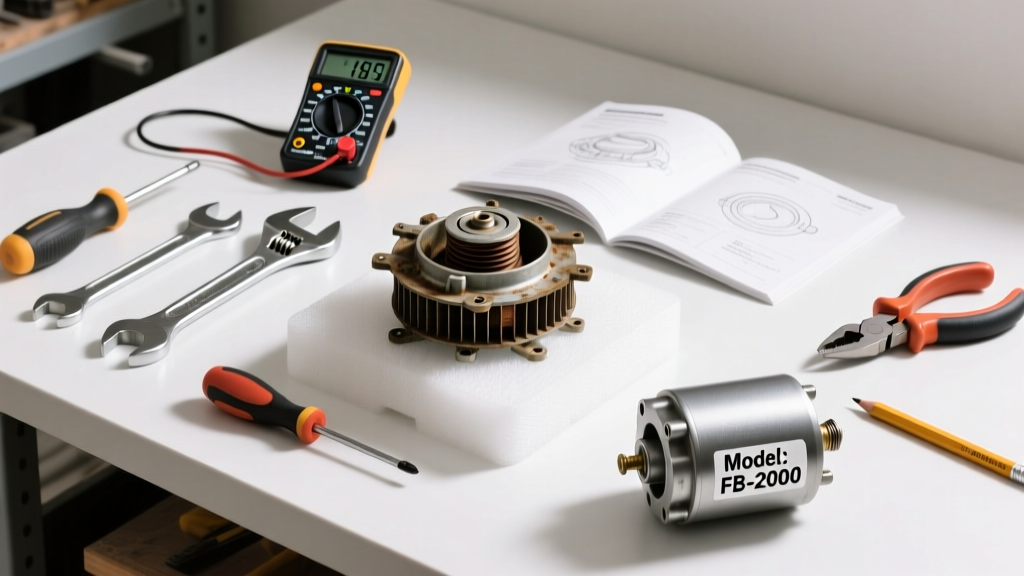
If your furnace runs but no warm air blows through the vents—or you hear a loud grinding, whining, or complete silence when the blower should engage—you’re likely facing a failed blower motor assembly. This isn’t just an inconvenience; it’s a critical system failure that can lead to overheating, heat exchanger stress, or even carbon monoxide risk if ignored.
Quick Diagnosis
Before assuming the motor itself is dead, rule out these common culprits:
- A tripped blower motor reset switch (often red, located on or near the motor housing)
- Clogged air filter restricting airflow and triggering thermal overload
- Failed capacitor—look for bulging, leaking, or burnt smell on the cylindrical component wired to the motor
- Loose or corroded wiring at the motor terminals or control board
- Seized blower wheel due to dust buildup or bearing wear (spin it manually—it should rotate smoothly)
Tools & Materials Needed
| Item | Purpose | Estimated Cost |
|---|---|---|
| Non-contact voltage tester | Verifies power is off before touching wiring—critical safety step | $15–$30 |
| Socket set (¼" and ⅜" drive) | Removes mounting bolts and blower wheel retaining nut | $25–$65 |
| Replacement blower motor (OEM or matched RPM/HP/voltage) | Must match original specs—check furnace label or manual | $120–$320 |
| Wire nut assortment (red and yellow) | Securely reconnects motor leads without exposed copper | $5–$12 |
| Shop vacuum with brush attachment | Cleans dust from blower compartment before reassembly | $40–$85 |
Step-by-Step Fix
- Power down and verify: Turn off furnace power at both the thermostat (set to OFF) and the main circuit breaker (typically 240V double-pole). Use a non-contact voltage tester on motor wires and control board terminals to confirm zero voltage.
- Access the blower assembly: Remove the furnace front panel and blower compartment door. Most units require removing the heat exchanger access panel first—consult your furnace model lookup guide for exact steps.
- Disconnect and remove: Label motor wires with tape (e.g., "Black = L1", "Red = Common") before disconnecting. Unscrew mounting brackets, then carefully slide the motor and wheel assembly forward and out. Note wheel orientation—some have keyed hubs or directional arrows.
- Install new motor: Slide in the replacement, aligning shaft and bracket holes. Tighten mounting bolts snugly—not overtightened. Reconnect wires using matching labels and UL-listed wire nuts. Double-check capacitor connections if replaced separately.
- Test operation: Restore power, set thermostat to HEAT and fan to AUTO. Listen for smooth startup (no grinding or buzzing). Confirm airflow at registers within 90 seconds. If motor shuts off after 2–3 minutes, check for airflow restriction or incorrect capacitor rating.
When to Call a Pro
Stop and call a licensed HVAC technician if any of these apply:
- You measure continuity across the motor windings but still get no rotation—this suggests internal winding damage requiring specialized testing
- Your furnace uses a variable-speed ECM motor with integrated control board communication (common in 90%+ AFUE models)
- You detect burning insulation odor or visible charring on wiring or the control board
- The blower wheel wobbles more than 1/16" side-to-side—indicating bent shaft or compromised heat exchanger support
Prevention Tips
Extend blower motor life with consistent maintenance:
- Replace or clean air filters every 30–90 days—according to MERV rating and household conditions (pets, allergies, construction)
- Vacuum blower wheel and housing annually using a soft brush attachment—dust buildup causes imbalance and bearing strain
- Check capacitor health every heating season with a multimeter; replace if capacitance drops >10% from rated µF
- Ensure return air grilles aren’t blocked by furniture or rugs—static pressure above 0.5" WC stresses motors
"Over 68% of premature blower motor failures stem from restricted airflow—not motor defects." — ASHRAE HVAC Applications Handbook, 2022 Edition, Section 47.3
Can I reuse the old blower wheel with a new motor?
Yes—if the wheel spins freely, shows no cracks or warping, and its hub isn’t stripped or scored. However, always inspect the wheel’s balance: spin it by hand and watch for wobble. A misaligned wheel accelerates bearing wear on the new motor. If in doubt, replace both—many OEM kits include wheel and motor as a matched set.
What happens if I install a motor with higher RPM than the original?
You’ll increase static pressure beyond design limits, potentially damaging ductwork seams, collapsing flexible ducts, and overloading the heat exchanger. It also voids UL listing and may violate local mechanical code. Always match the nameplate RPM, voltage, phase, and horsepower exactly—or consult the furnace wiring diagram guide.
How long does a furnace blower motor typically last?
Most PSC (permanent split capacitor) motors last 10–15 years with proper airflow and maintenance. ECM (electronically commutated) motors often exceed 20 years—but their control boards fail earlier. According to the U.S. Department of Energy’s 2023 Residential HVAC Reliability Study, blower motor replacement accounts for 22% of all furnace service calls after year 12.
Is it safe to bypass the blower motor’s thermal overload switch?
No—never bypass or tape down the reset switch. It exists to prevent fire hazard from locked-rotor current and coil overheating. Bypassing it risks melting insulation, igniting nearby combustibles, or releasing toxic fumes from overheated windings. If the switch trips repeatedly, diagnose root cause—capacitor, voltage drop, or binding wheel—before proceeding.
Do I need to lubricate the new blower motor bearings?
Almost never. Modern PSC and ECM motors use sealed, lifetime-lubricated ball bearings. Adding oil can wash out factory grease or attract dust, accelerating wear. Only older belt-driven or sleeve-bearing motors (pre-1990s) require periodic oiling—and even then, only with manufacturer-specified non-detergent oil applied via designated ports.
Why does my new motor hum but not spin?
This usually points to a failed start capacitor—even on a new motor. Test capacitance with a multimeter: a 5–45 µF capacitor reading below 90% of labeled value needs replacement. Also verify line voltage at motor terminals is within ±5% of nameplate rating (e.g., 230V ±11.5V). Low voltage causes insufficient torque.
A working blower motor is the unsung hero of your heating system—quiet, reliable, and easy to overlook until it fails. Replacing it yourself saves $300–$600 in labor, but only if you respect the electrical hazards and match specs precisely. Keep your filter fresh, your ducts clear, and your motor cool—and you’ll likely avoid this repair for another decade.