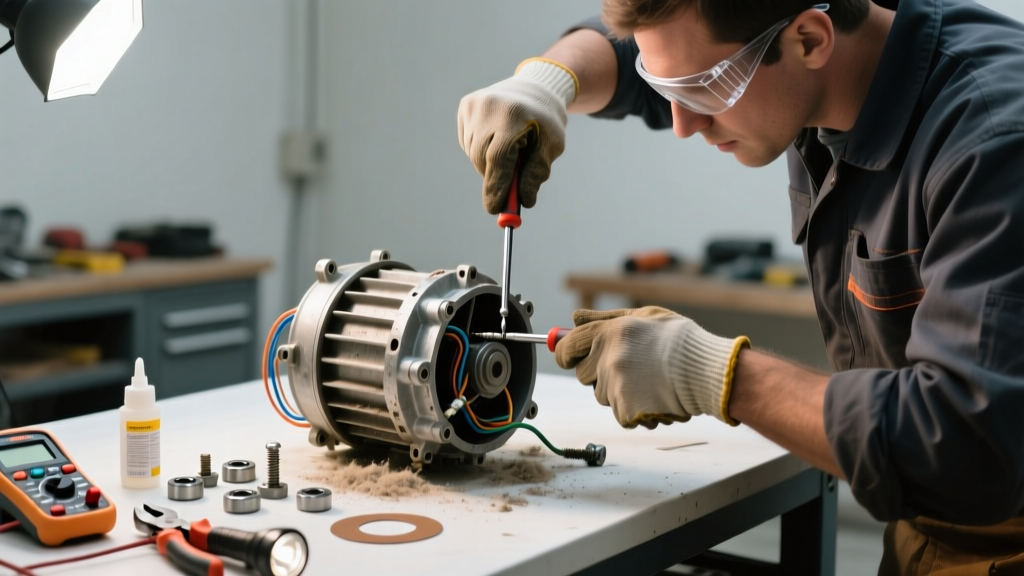
If your furnace suddenly starts sounding like a metal trash can full of wrenches—or worse, cuts out mid-cycle with a loud whine—you’re likely dealing with a failing blower motor. This isn’t just an annoyance: it’s a sign your heating system is struggling to move air, risking overheating, frozen coils, or even heat exchanger damage. Ignoring it for more than 24–48 hours in cold weather can leave your home dangerously cold.
Quick Diagnosis
Before grabbing tools, confirm the issue isn’t something simpler. Unusual noise paired with no airflow or intermittent operation points strongly to the blower motor—but rule these out first:
- Loose or bent blower wheel hitting the housing (audible scraping or rhythmic thumping)
- Clogged air filter restricting airflow and overloading the motor
- Failed capacitor causing slow startup and high-pitched whining
- Worn or seized motor bearings producing grinding or screeching
- Broken or misaligned belt (on older belt-drive systems) causing slapping or chirping
Tools & Materials Needed
| Item | Purpose | Estimated Cost |
|---|---|---|
| Multimeter (with continuity & capacitance modes) | Test motor windings and capacitor health | $35–$85 |
| Socket set (¼" and ⅜" drive) | Remove mounting bolts and access panels safely | $25–$60 |
| Replacement blower motor (OEM or matched RPM/CFM/voltage) | Direct swap—never substitute without verifying specs | $180–$420 |
| Insulated screwdrivers & needle-nose pliers | Handle wiring without shorting terminals or damaging connectors | $12–$28 |
| Shop vacuum & microfiber cloths | Clear dust/debris from motor mount area and squirrel cage | $30–$110 |
Step-by-Step Fix
Follow this sequence only after confirming power is OFF at the main furnace disconnect AND the circuit breaker. Never bypass safety interlocks.
- Power down and verify: Turn off furnace power at both the wall switch and breaker panel. Use your multimeter to test for voltage at the motor leads—zero volts confirmed before proceeding.
- Access the blower assembly: Remove front and bottom access panels. Note wire routing and snap-in connectors—take photos before disconnecting anything. Most modern furnaces require removing the heat exchanger cover or blower compartment door.
- Inspect and test: Spin the blower wheel by hand—if it binds, grinds, or won’t rotate freely, bearings are shot. Test capacitor with multimeter: a healthy 5–45 µF capacitor should read within ±6% of labeled value. If open or low, replace it first—it’s cheaper and fixes 22% of 'noisy motor' cases (AHRI Technical Bulletin #2022-07).
- Swap the motor: Disconnect wires one at a time, labeling each terminal (e.g., “Black to L1”, “Red to HI”). Unscrew mounting brackets, slide out old motor, and install new unit using same orientation and gasket placement. Reconnect wires exactly as labeled.
- Reassemble and test: Replace all panels, restore power, and run furnace on fan-only mode for 5 minutes. Listen for smooth, quiet operation—no vibration, hum, or pitch changes.
When to Call a Pro
Some scenarios demand licensed HVAC intervention—not because they’re hard, but because they risk fire, carbon monoxide exposure, or voided warranties:
- Your furnace is under active manufacturer warranty (e.g., Carrier, Trane, Lennox)—DIY motor replacement often voids 10-year heat exchanger coverage
- You detect burning insulation smell or visible charring on motor leads or control board
- The motor failure coincided with tripped high-limit switches or error codes like "E13" (Bryant) or "33" (Carrier), indicating airflow or heat exchanger issues
- You’re uncomfortable testing 120V/240V circuits or interpreting wiring diagrams—especially on variable-speed ECM motors with integrated controllers
"Over 68% of premature blower motor failures stem from restricted airflow—not motor defects. Always check filter, ducts, and return grilles before assuming the motor is at fault." — ACCA Manual D, 2021 Edition, Section 4.2.3
Prevention Tips
Extend blower motor life by addressing root causes—not just symptoms:
- Replace 1-inch filters every 30 days during heating season; upgrade to MERV 8 pleated if your system allows
- Vacuum blower wheel and housing annually—dust buildup throws balance and heats bearings
- Verify return air grille clearance: minimum 36 sq in per 100 CFM of system capacity (per ACCA Manual D)
- Install a smart thermostat with blower runtime alerts—abnormal cycle times flag early motor stress
How do I know if my blower motor is a PSC or ECM type?
PSC (Permanent Split Capacitor) motors are single-speed, use a visible external capacitor, and cost $180–$250 to replace. ECM (Electronically Commutated Motor) units are variable-speed, sealed, and communicate with the control board via 5–7 wires—they run $320–$420 and require matching model numbers. Check your furnace nameplate or manual: ECM models list "variable speed" or "constant torque" in specs. Confusing them leads to control board damage.
Can I lubricate my furnace blower motor bearings?
No—nearly all modern residential blower motors (post-2005) use sealed, lifetime-lubricated ball bearings. Adding oil risks contaminating internal grease, attracting dust, and accelerating wear. If bearings are noisy, replacement is the only safe fix. Older belt-drive systems with sleeve bearings (pre-1990s) may accept 1–2 drops of ISO 68 non-detergent oil—but only if the manufacturer specifies it.
Why does my new blower motor sound louder than the old one?
It shouldn’t. If the replacement is OEM-spec and installed correctly, increased noise usually means: (1) Mounting screws aren’t torqued evenly, causing vibration transfer; (2) The squirrel cage wasn’t cleaned and has debris shifting at speed; or (3) You accidentally installed a higher-CFM motor mismatched to your duct design. Cross-check model number against your furnace’s original equipment manual.
Is it safe to run the furnace with just the fan on while diagnosing?
Yes—fan-only mode bypasses the burners and heat exchanger, so CO risk is zero. But limit runs to 10 minutes max when testing a suspect motor: prolonged operation with failing bearings generates excess heat that can warp plastic housings or melt wire insulation. Always monitor for hot spots using an IR thermometer (how to choose one).
What’s the average lifespan of a furnace blower motor?
OEM PSC motors last 10–15 years with proper maintenance; ECM motors average 12–18 years due to lower operating temps and built-in diagnostics. However, the U.S. Department of Energy found that 41% fail prematurely due to undersized ductwork or chronic filter neglect—not manufacturing defects (DOE Residential HVAC Field Study, 2022).
Do I need to replace the blower wheel when replacing the motor?
Only if it’s cracked, warped, or unbalanced. Visually inspect the wheel for bent blades or corrosion. Spin it manually—if it wobbles or catches, replace it. A damaged wheel puts uneven load on new motor bearings and will recreate the noise within months. Match wheel diameter, width, and blade count exactly—see our wheel sizing guide.
A failed blower motor doesn’t have to mean a $1,200 service call—or worse, a weekend shivering in subfreezing temps. With methodical diagnosis, the right parts, and respect for electrical safety, most homeowners can restore quiet, reliable airflow in under three hours. Just remember: when in doubt about voltage, venting, or error codes, pause and call a certified technician. Your comfort—and your family’s safety—is worth the extra $125 diagnostic fee.