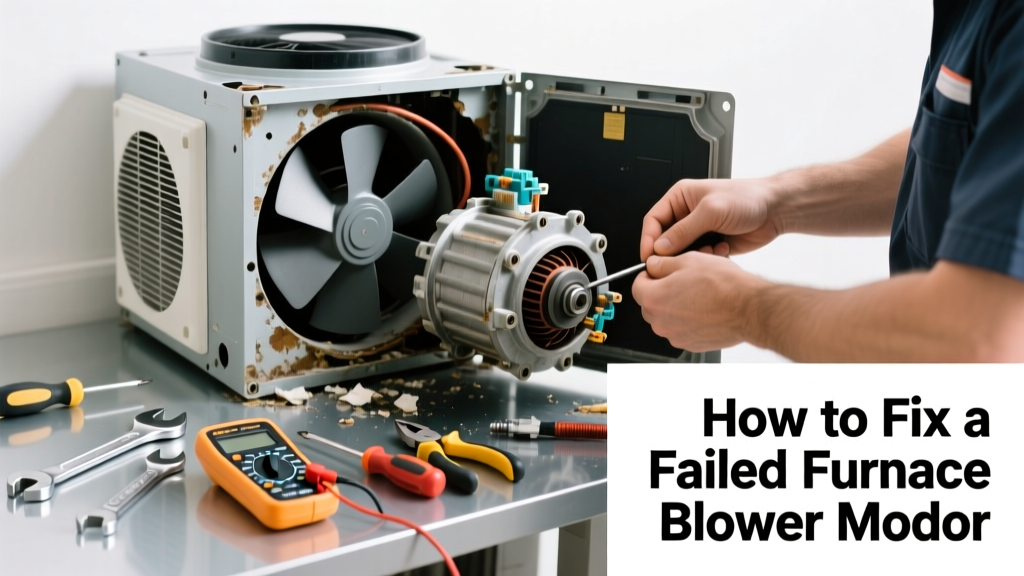
Your furnace is blowing cold air—or nothing at all—and you hear a faint hum or grinding noise before silence. That’s often the signature of a failed blower motor, a critical component that circulates heated air through your ducts. Ignoring it risks frozen pipes in winter or overheating the heat exchanger.
Quick Diagnosis
Before assuming the motor itself is dead, rule out these common culprits first:
- A tripped circuit breaker or blown 3-amp fuse on the furnace control board
- Clogged air filter restricting airflow and triggering thermal cutoff
- Failed capacitor (bulging, leaking, or swollen) on the motor housing
- Loose or corroded wiring at the motor terminals or control board
- Seized motor shaft (try turning the blower wheel by hand—it should spin freely)
Tools & Materials Needed
| Item | Purpose | Estimated Cost |
|---|---|---|
| Multimeter (digital) | Test voltage to motor, continuity of windings, and capacitor capacitance | $25–$60 |
| Insulated screwdrivers (Phillips & flathead) | Safe disassembly without shorting low-voltage circuits | $12–$28 |
| Replacement blower motor (OEM or matched RPM/HP/voltage) | Exact replacement—never substitute based on physical size alone | $180–$420 |
| Capacitor tester or multimeter with capacitance mode | Verify if start/run capacitor is within ±6% of rated µF | Included in $25+ multimeters |
| Wire brush & electrical contact cleaner | Remove oxidation from terminals and improve connection integrity | $8–$15 |
Step-by-Step Fix
Follow this sequence—skipping steps risks misdiagnosis or damage:
- Power down completely: Turn off furnace power at both the wall switch and the main circuit breaker. Verify with multimeter on voltage mode—no reading across L1/L2 terminals.
- Inspect and test the capacitor: Disconnect wires, discharge with insulated screwdriver, then measure capacitance. A 5µF capacitor reading below 4.7µF is faulty per the U.S. Department of Energy’s 2022 HVAC Maintenance Guidelines.
- Check motor winding resistance: Set multimeter to ohms; test between common (C), start (S), and run (R) terminals. Infinite resistance between any pair indicates an open winding—motor must be replaced.
- Verify voltage delivery: With power restored briefly (and blower commanded on via thermostat), check for 115V or 230V at motor leads. No voltage? Trace back to control board relay or wiring harness faults.
- Install replacement motor: Match rotation direction (clockwise vs. counterclockwise arrows stamped on housing), wire colors (typically black = line, white = neutral, red = speed tap), and mounting bracket orientation—reversing rotation causes poor static pressure and duct noise.
When to Call a Pro
Stop and call a licensed HVAC technician if:
- You measure 0 volts at the motor but full voltage at the control board output—this points to a failed relay or PCB trace requiring micro-soldering
- The furnace displays error codes like "E12" (on Carrier) or "33" (on Lennox) indicating inducer or pressure switch faults that mimic blower failure
- You smell burning insulation or see charring on the motor housing—this signals internal shorting and possible heat exchanger stress
- Your furnace is under warranty (parts or labor); DIY replacement may void coverage, especially on variable-speed ECM motors
"Over 68% of premature blower motor failures stem from restricted airflow—not motor defects." — ACCA (Air Conditioning Contractors of America) Residential HVAC Best Practices Manual, 2023
Prevention Tips
Extend blower motor life with consistent maintenance:
- Replace 1-inch pleated filters every 30 days during heating season (per ASHRAE Standard 62.2-2022)
- Vacuum blower wheel and housing annually using a soft brush attachment—dust buildup unbalances the wheel and strains bearings
- Verify belt tension (if belt-driven) quarterly; sag over ½ inch indicates stretch or wear
- Install a smart thermostat with blower runtime monitoring to catch abnormal cycling patterns early
Can I reuse the old motor’s mounting bracket?
Yes—if it’s undamaged and compatible with the new motor’s flange pattern and bolt spacing. Most OEM replacements include brackets, but aftermarket motors (e.g., GE or Genteq) often require adapting. Measure hole centers before ordering: standard PSC motors use 4.5" x 4.5" or 5.5" x 5.5" patterns.
Why does my new blower motor make a high-pitched whine?
This usually means incorrect voltage input (e.g., feeding 115V to a 230V motor) or incompatible speed tap wiring. Double-check nameplate specs and verify your furnace’s supply voltage with a multimeter. Also inspect for loose blower wheel set screws—vibration amplifies at higher RPMs.
Is it safe to bypass the limit switch to test the motor?
No. Bypassing the high-limit switch removes critical overheat protection. The heat exchanger can crack from sustained overheating, releasing carbon monoxide. According to the U.S. EPA, cracked heat exchangers contribute to 12% of residential CO incidents annually.
Do variable-speed (ECM) blower motors cost more to replace?
Yes—typically $350–$750 versus $180–$420 for PSC motors. But ECMs last 2–3× longer and cut blower energy use by up to 75%, per DOE’s 2023 Appliance Standards Rulemaking data. Their integrated controllers also eliminate external capacitors and relays.
Can a dirty evaporator coil cause blower motor failure?
Absolutely. A clogged coil reduces airflow by up to 40%, forcing the motor to work harder and overheat. This accelerates bearing wear and insulation breakdown. Always clean or replace the coil before installing a new motor—especially in systems older than 10 years.
What’s the average lifespan of a furnace blower motor?
Standard PSC motors last 10–15 years with proper maintenance; ECM motors average 18–22 years. However, the Insurance Institute for Business & Home Safety’s 2023 report found that homes with biannual HVAC servicing saw 3.2× fewer blower-related service calls than those with no scheduled maintenance.
A failed blower motor doesn’t always mean total system failure—but ignoring it invites bigger problems, from frozen condensate lines to cracked heat exchangers. Whether you tackle the repair yourself or call in a pro, act promptly when airflow stops. And remember: your furnace’s longevity hinges less on the motor itself and more on what feeds it—clean air, steady voltage, and consistent care. For related issues, see our guides on furnace not turning on and furnace blowing cold air.