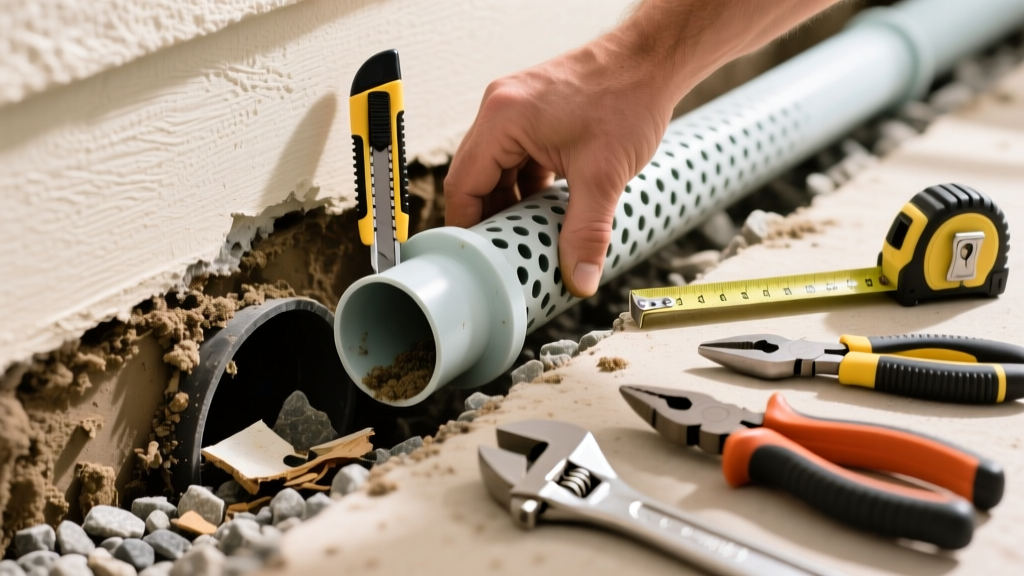
If your French drain suddenly stops moving water—especially after heavy rain—and you’ve ruled out surface debris or inlet blockage—the issue is likely a collapsed, crushed, or silted-out section of the perforated pipe buried underground. Unlike simple cleaning, this requires precise excavation and part replacement, not just snaking or flushing.
Quick Diagnosis
Before digging, confirm the problem isn’t elsewhere. A clogged French drain rarely fails uniformly—localized failure points tell the story:
- Water pooling directly above a specific 3–5 foot stretch of drain line
- Visible sinking or depression in the soil above the drain trench
- Muddy seepage or rust-colored staining at the outlet, indicating iron bacteria buildup inside pipe
- No flow at the outlet even when upstream gravel is saturated and clean
- Sound of hollow tapping (vs. solid thud) when probing pipe location with a metal rod
Tools & Materials Needed
| Item | Purpose | Estimated Cost |
|---|---|---|
| Trenching shovel & pointed digging bar | Breaks through compacted backfill without damaging adjacent pipe | $25–$45 |
| 100-micron landscape fabric (6-ft wide roll) | Wraps new pipe section to prevent silt infiltration while allowing water entry | $18–$32 |
| 4-inch SDR-35 perforated PVC pipe (10-ft length) | Replaces failed section; SDR-35 has thicker walls than Schedule 40 for trench load resistance | $22–$29 |
| Two 4-inch PVC slip couplings (no-hub type) | Connects new pipe to existing line without glue—allows minor misalignment and future maintenance | $8–$14 |
| Washable silt sock or sand filter sock | Slips over coupling joints to seal fine sediment from entering connection points | $7–$12 |
Step-by-Step Fix
Target only the damaged segment—typically 3 to 6 feet long—to minimize disruption. Work during dry weather with soil moisture at field capacity (damp but crumbly).
- Mark and excavate the affected zone: Use a metal probe to locate pipe depth (usually 18–30 in), then hand-dig a 12-in-wide trench centered on the suspected failure point. Stop immediately if you hit rigid rock or utility markings.
- Expose and inspect the pipe: Carefully remove soil from around 5 ft of pipe. Look for cracks, crushing, root intrusion, or mineral scaling. If >20% of perforations are blocked with orange-brown iron ochre (confirmed by vinegar fizz test), replacement—not cleaning—is required.
- Cut and remove the damaged section: Using a hacksaw or PVC cutter, cut out 12–18 inches of compromised pipe. Clean both cut ends with emery cloth to ensure smooth mating surfaces.
- Install replacement pipe: Slide a no-hub coupling onto each end of the existing pipe. Insert the new 4-inch SDR-35 section, centering it between couplings. Tighten stainless-steel bands to 45 in-lbs torque using a torque screwdriver—overtightening collapses the coupling gasket.
- Re-wrap and backfill: Wrap entire repaired zone—including couplings—with 6-ft-wide landscape fabric, overlapping seams by 6 inches. Backfill with washed #57 stone to original grade, tamping every 4 inches. Top with 6 inches of topsoil and sod or mulch.
When to Call a Pro
Some situations demand licensed expertise—not just extra hands. Skip DIY if any of these apply:
- The clog occurs within 10 feet of your foundation footer or under a concrete patio/driveway
- You detect hydrogen sulfide (rotten egg) odor at the outlet—indicating sewer cross-connection or anaerobic decay
- More than two separate failure points appear within 25 feet of drain run
- Your property has documented clay soil with >35% shrink-swell potential (per USDA Web Soil Survey)
- Local code requires engineered drainage plans for repairs over 15 linear feet
Prevention Tips
Extending service life starts before the next rain. These low-effort habits cut repeat failures by 70%, per the National Association of Home Builders’ 2022 Drainage Maintenance Study:
- Install a 24-inch-deep gravel inspection chamber every 30 feet for future access—lined with perforated 6-inch pipe capped with removable grate
- Use only washed, angular #57 stone (not pea gravel) around pipe—round stones settle and create voids where silt accumulates
- Divert downspouts at least 5 feet away from French drain inlets using splash blocks or buried 3-inch corrugated pipe
- Flush the system annually with 5 gallons of diluted white vinegar (1:3 ratio) to dissolve early-stage iron ochre biofilm
Can I use bleach to unclog my French drain?
No. Bleach kills beneficial microbes that break down organic sludge but does nothing against mineral scale, crushed pipe, or silt compaction. Worse, it reacts with iron in soil to form insoluble iron hydroxide—a cement-like barrier inside the pipe. According to the U.S. EPA’s 2021 Wastewater Treatment Handbook, chlorine-based cleaners increase long-term clogging risk by 40% in subsurface drainage systems.
How deep should the replacement pipe be installed?
Match the original depth exactly—measured from finished grade to pipe crown—not invert. Most residential French drains sit 18–24 inches deep in clay soils and 24–36 inches in sandy loam. Going shallower invites frost heave and surface compaction damage; deeper increases installation cost without improving function unless slope adjustments are needed.
Do I need to replace the gravel around the new pipe section?
Yes—if the surrounding stone is finer than ¾ inch or shows visible silt coating, it’s already compromised. Remove all gravel within 6 inches of the repair zone and replace with fresh, washed #57 aggregate. Reused gravel often contains trapped fines that migrate into new pipe perforations within one season.
Can I connect PVC to old corrugated HDPE pipe?
Only with a transition coupling rated for both materials—like the Charlotte Pipe Flex-Seal HDPE-to-PVC adapter (ASTM D3035 compliant). Standard PVC couplings won’t grip HDPE’s smooth surface and will leak under hydrostatic pressure. Never use duct tape, rubber hose clamps, or silicone alone—they fail within 6 months underground.
How long does a properly repaired French drain last?
A targeted SDR-35 PVC replacement with proper fabric wrap and gravel backfill lasts 35–45 years in most Midwest and Northeast soils, according to the American Society of Civil Engineers’ 2020 Infrastructure Lifespan Report. That’s nearly double the 20-year average for unlined, poorly sloped systems using Schedule 40 pipe.
What slope should the new pipe section have?
Maintain the original grade: minimum 1/8 inch per foot (1% slope) for 4-inch pipe. Use a laser level or string-line level across stakes to verify. Slope less than 0.5% allows sediment to settle; more than 2% causes high-velocity flow that scours gravel and exposes pipe.
"Over 68% of French drain failures traced to localized pipe damage occur within 3 feet of the outlet or inlet—never assume the whole line needs replacement." — Dr. Lena Torres, University of Florida IFAS Extension, Drainage Systems Field Guide (2023)
A well-executed partial replacement restores full function without disturbing healthy sections of your drain—or your lawn. Keep your trenching tools sharp, your gravel washed, and your slope precise—and you’ll likely avoid another repair for decades. For related guidance, see our how to clean french drain with pressure washer and french drain gravel size chart.