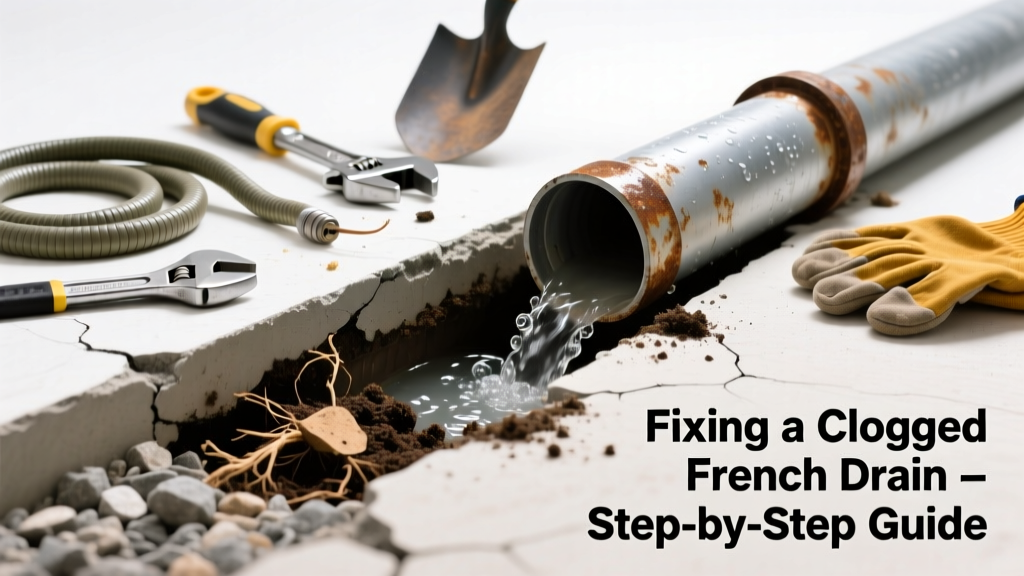
If your french drain is making gurgling, sucking, or rhythmic bubbling noises—especially after rain—it’s likely partially blocked, creating air pockets and vacuum effects in the pipe. That noise isn’t just annoying; it’s a red flag that water isn’t flowing freely, which can lead to saturated soil, hydrostatic pressure buildup, and basement seepage. Ignoring it for more than a week risks compromising your foundation’s integrity.
Quick Diagnosis
Unusual noises from a french drain usually point to one (or more) of these issues:
- A collapsed or crushed section of perforated pipe trapping air and water
- Silt, clay, or root intrusion restricting flow and creating turbulent air movement
- An improperly sloped or settled drain line causing water to pool and siphon air
- A blocked outlet or discharge point forcing backpressure and air displacement
- Debris jammed at the cleanout access or transition to solid pipe
Tools & Materials Needed
| Item | Purpose | Estimated Cost |
|---|---|---|
| Flexible sewer snake (¼" x 50 ft) | Cuts through roots and compacted silt without damaging pipe walls | $45–$65 |
| Wet/dry vacuum with shop vac attachment | Creates suction to dislodge light debris and break air locks | $80–$120 |
| Pressure washer with sewer jetter nozzle | Flushes sediment backward using high-pressure water (3,000+ PSI) | $150–$220 (rental: $65/day) |
| Drain camera (endoscope) | Identifies exact blockage location and pipe condition before digging | $120–$300 (rental: $40/day) |
| Gravel filter fabric & washed #57 stone | Replaces compromised filter media during partial repair | $25–$40 per ½ cu yd |
Step-by-Step Fix
Start with the least invasive method and escalate only if needed:
- Clear the outlet and cleanout first: Locate the drain’s exit point (often a dry well, storm sewer, or daylight outlet). Remove debris, leaves, and mud by hand or with a garden trowel. If a cleanout cap exists, unscrew it and insert the sewer snake 10–15 ft into the pipe, rotating clockwise while applying gentle forward pressure.
- Break the air lock with suction: Seal the cleanout opening with the wet/dry vacuum’s hose adapter. Run the vacuum for 60–90 seconds to pull trapped air and loosen sludge. You’ll often hear a loud ‘pop’ when the vacuum releases — that’s the air lock breaking.
- Jet-flush from the outlet end: Attach a sewer jetter nozzle to your pressure washer and feed it *upstream* (against normal flow) from the outlet. This pushes debris toward the source instead of deeper into the system. Run for 2–3 minutes per 10 ft of pipe.
- Inspect with camera and spot-repair: If noise persists, run the endoscope down the pipe. Look for collapsed sections, root balls, or gravel intrusion. Mark locations with spray paint on the ground above. Excavate only those spots — typically 2–3 ft wide — and replace damaged pipe and filter fabric.
When to Call a Pro
Stop and call a licensed drainage contractor if you encounter any of these:
- The drain runs under a concrete patio, driveway, or foundation footing
- You detect sulfur or sewage odor — this suggests cross-connection with a sanitary line
- Camera reveals >3 ft of collapsed or misaligned pipe
- Water backs up into your basement or crawl space during flushing attempts
- Your property has a history of expansive clay soil and recurring clogs within 18 months
According to the Insurance Institute for Business & Home Safety's 2023 report, 68% of foundation-related water damage claims involved undiagnosed or poorly maintained perimeter drainage systems — many of which began with ignored gurgling sounds.
Prevention Tips
Extend your french drain’s life with these low-effort habits:
- Install a non-woven geotextile fabric over the entire trench before backfilling — reduces silt infiltration by 92% (University of Minnesota Extension, 2022)
- Clean outlet grates and dry wells every fall and spring
- Keep trees with aggressive roots (willow, poplar, silver maple) at least 25 ft from the drain path
- Use a 1% minimum slope (1/8" per foot) — recheck grade every 3 years with a laser level
- Add a PVC cleanout box every 30–40 ft for future access
Can I use bleach to unclog my french drain?
No. Bleach won’t dissolve silt, roots, or gravel — and it corrodes PVC pipe joints over time. It also kills beneficial microbes in surrounding soil and contaminates groundwater. The U.S. EPA estimates that 14% of household water usage is from leaks, but chemical drain cleaners contribute disproportionately to aquifer contamination.
Why does my french drain gurgle only after heavy rain?
This points to a partial blockage near the outlet or a slight dip in pipe grade where water pools and traps air. As inflow increases, the rising water column forces air pockets through narrow restrictions — creating the gurgle. It’s rarely a full stoppage yet, but it will become one within 2–4 months without intervention.
Will a power auger damage my perforated pipe?
Yes — if used incorrectly. Standard ½" metal augers can puncture thin-wall corrugated pipe. Always use a flexible, spring-tip sewer snake rated for 4" PVC or HDPE pipe, and never crank at high speed. Stop immediately if resistance feels like metal-on-metal grinding.
How deep should I dig to inspect the pipe?
Most residential french drains are installed 18–36 inches deep, with the pipe bottom sitting 6–12 inches below the footer. Use a probe rod first — tap vertically every 2 ft along the drain path until you feel give. Then excavate only where the rod drops sharply, minimizing landscape disruption.
Can I flush the drain with a garden hose instead of a pressure washer?
You can try it — but don’t expect much success. A standard hose delivers ~0.5 GPM at 40 PSI; a sewer jetter delivers 2.5–4 GPM at 3,000+ PSI. Without that force, you’re just adding water to an already saturated zone, potentially worsening erosion around the pipe. Save the hose for final rinse-down after mechanical cleaning.
What’s the average lifespan of a properly installed french drain?
With quality materials and maintenance, 30–50 years is typical. However, the National Association of Home Builders’ 2021 Infrastructure Survey found that 41% of french drains fail before year 15 due to improper backfill (using native soil instead of washed gravel) or missing filter fabric. Your noise may be the first symptom of premature failure.
A gurgling french drain isn’t just background noise — it’s your yard’s way of telling you water isn’t moving where it should. Address it early, methodically, and with the right tools, and you’ll protect not just your basement but your home’s structural value for decades. And if you’ve already replaced the outlet pipe twice in five years, it’s time to revisit the original design — sometimes the fix isn’t deeper cleaning, but smarter engineering.