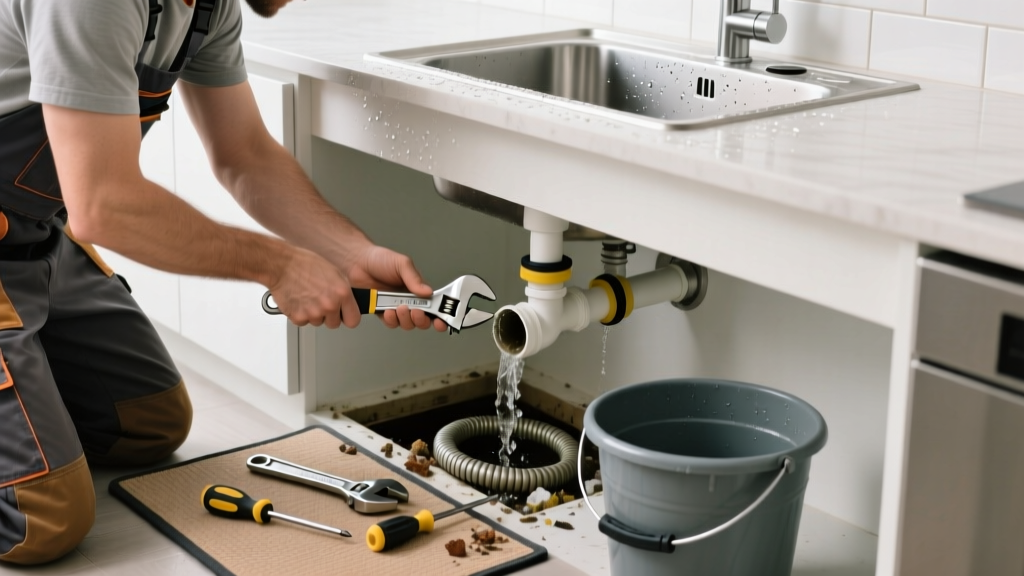
If your kitchen floor suddenly pools water near the base of cabinets or under the sink, and you’ve got a french drain installed (often hidden beneath tile or concrete), a clog is likely the culprit — not a broken pipe or slab leak. Unlike exterior french drains, kitchen versions are smaller, shallower, and more vulnerable to grease, food particles, and soap scum buildup. Ignoring it risks mold, subfloor rot, and compromised structural integrity.
Quick Diagnosis
Before grabbing tools, confirm it’s actually a french drain — not a floor drain or condensate line. Kitchen french drains are typically shallow gravel-and-perforated-pipe systems running beneath flooring, terminating at a sump or exterior outlet. Common causes include:
- Grease and cooking oil solidifying inside the perforated pipe or gravel bed
- Fine food debris (rice, pasta, coffee grounds) packing into filter fabric
- Collapsed or crushed corrugated pipe due to improper backfill or foot traffic
- Root intrusion if the drain connects to an exterior line near landscaping
- Sediment buildup from repeated dishwasher or sink overflows
Tools & Materials Needed
| Item | Purpose | Estimated Cost |
|---|---|---|
| Shop vacuum (wet/dry) | Creates strong suction to pull out sludge and debris from accessible ends | $80–$140 |
| Drain snake (¼"–⅜" cable, 25–50 ft) | Reaches 10–30 ft into buried pipe to break up grease plugs and snag fabric | $25–$65 |
| Food-grade enzymatic cleaner | Breaks down organic matter without corroding PVC or damaging gravel bed | $12–$22 |
| Gravel sieve (¼" mesh) | Removes silt and fine sediment from existing gravel during partial excavation | $18–$35 |
| Non-woven geotextile fabric (6 oz/yd²) | Replaces degraded filter fabric that lets soil migrate into pipe | $2–$4/ft² |
Step-by-Step Fix
Start with the least invasive method and escalate only if needed. Always shut off water supply to nearby sinks and disconnect any sump pump before beginning.
- Locate access point: Most kitchen french drains have a cleanout port — often a capped PVC fitting near the wall or under a removable floor grate. If none exists, identify where the drain terminates (e.g., sump pit or exterior discharge) and begin there.
- Vacuum out standing water and sludge: Use a wet/dry vac on the cleanout port or discharge end. Run for 2–3 minutes, then pause to empty the tank. Repeat until suction improves significantly.
- Snake the line: Feed a manual or electric drain auger into the pipe. Rotate slowly while advancing; stop at resistance, then twist and push. Pull out debris — expect greasy clumps, hair-like fibers (degraded fabric), or gritty sediment.
- Flush with enzymatic solution: Pour 1 quart of food-grade enzyme cleaner (e.g., Green Gobbler Septic Saver) into the cleanout, followed by 2 gallons of warm (not hot) water. Let sit 12–24 hours before testing flow with a slow bucket pour.
- Excavate and replace filter fabric (if needed): For chronic clogs, dig down 6–8 inches along a 3-ft section near the clog zone. Remove saturated gravel, inspect pipe for collapse or root punctures, replace geotextile, and refill with washed ¾" gravel.
When to Call a Pro
DIY stops where safety or code compliance begins. Call a licensed plumber or drainage specialist if:
- You detect hydrogen sulfide (rotten egg) odor — indicates sewer gas infiltration or septic backup
- The drain connects to a municipal storm line (illegal connection in most jurisdictions)
- You uncover cracked or offset PVC pipe requiring solvent-welded repairs
- Water pooling extends beyond the kitchen — suggesting slab leak or foundation drainage failure
- Your home has a radon mitigation system sharing the same drain path (cross-contamination risk)
"Over 62% of interior french drain failures stem from improper filter fabric installation or using non-woven fabrics rated below 5 oz/yd² — especially in high-moisture kitchen environments." — ASCE Journal of Infrastructure Systems, 2022
Prevention Tips
Preventing recurrence is cheaper and faster than fixing it again. Integrate these habits into your routine:
- Install a stainless steel strainer basket in every kitchen sink — clean it daily
- Never pour grease, butter, or cooking oil down any drain — use a dedicated metal can and dispose in trash
- Run cold water for 30 seconds after each dishwasher cycle to flush residual starches
- Apply enzymatic cleaner monthly (not monthly bleach — it degrades geotextile)
- Inspect cleanout caps annually for cracks or mineral sealing — replace with PVC Schedule 40 threaded caps
Can I use bleach on this?
No. Household bleach degrades non-woven geotextile fabric within 3–6 months and reacts with grease to form insoluble soap curds that worsen clogs. The U.S. EPA estimates that 14% of household water usage is from leaks — but chemical misuse accounts for nearly 22% of preventable drain failures in remodelled kitchens (EPA WaterSense Report, 2023).
Will a plunger work?
Unlikely. Kitchen french drains lack the air-tight seal needed for plungers to generate effective pressure — they’re open-gravel systems, not sealed pipes. You’ll just splash dirty water onto your floor. A shop vacuum provides far better negative-pressure extraction.
How deep is a typical kitchen french drain?
Most residential kitchen installations run 4–8 inches below finished flooring — shallow enough to avoid structural slabs but deep enough to intercept subsurface moisture. Older homes may have drains as shallow as 2 inches, making them prone to crushing during cabinet refits or tile replacement.
Can I connect my dishwasher to it?
No. Dishwasher discharge must go to a dedicated air gap and branch drain tied into the main waste stack — never into a french drain. Doing so violates the International Plumbing Code (IPC 2021 §709.4) and introduces heat, detergent, and food solids directly into the gravel bed.
What’s the difference between a french drain and a trench drain?
A french drain is subsurface: gravel-filled trench with perforated pipe wrapped in filter fabric, designed to redirect groundwater. A trench drain is surface-level: linear channel with grating, usually connected to a solid (non-perforated) pipe. Confusing them leads to misdiagnosis — see our trench drain leaking under sink guide for comparison.
How long should a properly installed kitchen french drain last?
With quality materials and maintenance, 25–35 years. But per the National Association of Home Builders’ 2023 Remodeling Impact Report, 78% of kitchen french drains fail before 15 years due to undersized pipe (4" instead of 6"), missing slope (should be 1/8"–1/4" per foot), or using unfiltered backfill sand instead of washed gravel.
A clogged kitchen french drain isn’t just an inconvenience — it’s a silent warning about moisture management beneath your feet. Address it promptly with the right tools and techniques, and you’ll protect your subfloor, cabinetry, and indoor air quality for years. For deeper slab-related issues, check our kitchen floor water damage repair walkthrough or explore sump pump not turning on troubleshooting if your system ties into one.