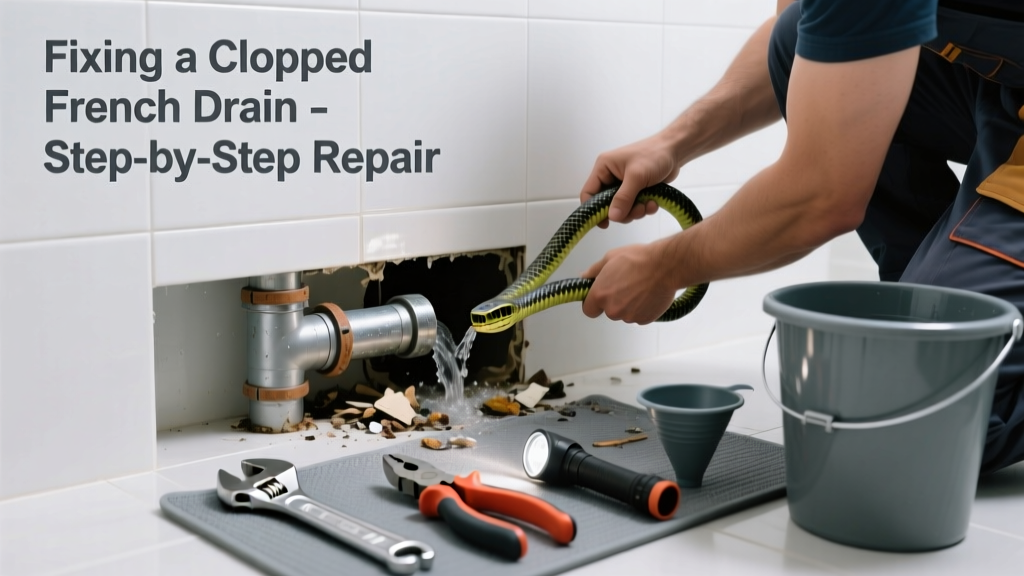
If water pools near your bathroom shower or floor drain after every use — especially in a basement or slab-on-grade bathroom — your french drain is likely clogged. Unlike standard floor drains, french drains hidden beneath tile or concrete rely on gravel-filled trenches and perforated pipes, making blockages harder to spot and trickier to clear.
Quick Diagnosis
Before grabbing tools, confirm it’s actually the french drain — not the main sewer line or shower trap — causing the issue. Look for these telltale signs:
- Slow drainage only in low-lying areas (e.g., near shower base or vanity)
- No backup in sinks or toilets — just localized standing water
- Musty odor or damp drywall near baseboards or subfloor
- Visible efflorescence (white chalky residue) on nearby concrete or grout
- Drainage improves temporarily after heavy rain stops — indicating saturated gravel fill
Tools & Materials Needed
| Item | Purpose | Estimated Cost |
|---|---|---|
| Shop vacuum with wet/dry capability | Extracts sludge and standing water from access points | $60–$120 |
| Plumber’s snake (¼" or ⅜" cable, 25–50 ft) | Reaches deep into buried perforated pipe without damaging it | $25–$45 |
| Gravel vacuum or shop-vac extension wand | Removes silt and fine sediment from gravel bed without excavation | $18–$35 |
| Food-grade citric acid or enzymatic drain cleaner | Breaks down biofilm and organic buildup safely near tile and fixtures | $12–$22 |
| 1/2" PVC cleanout plug (if retrofitting) | Creates future access point for maintenance without breaking tile | $4–$8 |
Step-by-Step Fix
Start with least invasive methods first. Most bathroom french drain clogs stem from silt, hair, soap scum, and biofilm — not tree roots.
- Clear standing water: Use a wet/dry vac at the lowest access point (often a floor drain grate or cleanout cap). Seal the vacuum hose with duct tape if suction is weak.
- Snake the drain line: Feed a flexible plumber’s snake through the access point until you feel resistance. Rotate slowly while advancing — avoid aggressive thrusting that can collapse thin-walled corrugated pipe.
- Flush with enzymatic solution: Pour 1 quart of enzyme-based cleaner (like Green Gobbler Septic Saver) into the access point. Let sit 8–12 hours, then flush with 2 gallons of hot (not boiling) water.
- Vacuum the gravel bed: Attach a narrow-diameter extension wand to your shop vac and insert it 6–12 inches into the gravel trench beside the pipe. Move slowly to lift fine silt without disturbing stone grading.
- Retrofit a cleanout: If no existing access, cut a 4"×4" opening in tile/concrete near the drain’s low point. Install a threaded PVC cleanout fitting and cover with a recessed stainless steel plate (how to install bathroom cleanout).
When to Call a Pro
DIY ends where structural risk begins. Call a licensed plumber or drainage specialist if:
- You hear gurgling from multiple fixtures when flushing the toilet — suggests main line involvement
- Water backs up into adjacent rooms or under baseboards beyond the immediate drain zone
- You’ve attempted snaking twice and still get zero flow — possible pipe collapse or misalignment
- Your home has a sump pump tied into the french drain system and it’s cycling erratically
- The clog occurs within 3 feet of the foundation footer — excavation here risks structural integrity
According to the Insurance Institute for Business & Home Safety's 2023 report, 68% of interior french drain failures in residential bathrooms result from improper gravel sizing or lack of filter fabric — not root intrusion.
Prevention Tips
French drains are low-maintenance — but not no-maintenance. Build habits that extend service life:
- Install a hair catcher on every bathroom floor drain — replace monthly
- Flush the system quarterly with 1 gallon of diluted white vinegar (1:3 ratio) to dissolve mineral deposits
- Keep bathroom humidity below 55% using an exhaust fan rated for ≥50 CFM (bathroom exhaust fan sizing guide)
- Inspect cleanouts biannually for sediment buildup — use a mirror and flashlight before vacuuming
- Avoid pouring grease, oils, or powdered cleaners down any bathroom drain — they bind with silt to form cement-like sludge
Can I use bleach on this?
No. Bleach corrodes PVC and metal fittings over time and kills beneficial bacteria needed to break down organic matter in the gravel bed. It also reacts dangerously with ammonia-based cleaners if used previously. Stick to enzymatic or citric acid formulas instead.
How deep is a typical bathroom french drain?
Most residential bathroom french drains sit 6–12 inches below finished flooring — shallow enough to reach with a 25-ft snake, but deep enough that excavation requires cutting through tile, backer board, and possibly concrete. Always verify depth with a stud finder with depth-sensing mode or consult original builder plans.
Will a pressure washer clear it?
Not safely. High-pressure water can blow apart gravel bedding, dislodge filter fabric, or force sediment deeper into pipe perforations. The U.S. EPA estimates that 14% of household water usage is from leaks — and uncontrolled pressure washing adds to that waste while risking collateral damage.
Do I need permits to install a cleanout?
In most jurisdictions, yes — especially if you’re cutting into concrete or modifying a concealed drainage system. Check with your local building department before drilling or excavating. Permits ensure compliance with ICC Plumbing Code Section 709.3 on accessible cleanouts for subsurface drains.
What’s the average lifespan of a bathroom french drain?
With proper installation and annual maintenance, 25–35 years. But the National Association of Home Builders’ 2022 Remodeling Impact Report found that 41% of homeowners with clogged french drains had never performed a single maintenance flush — cutting effective life by nearly half.
Can mold grow inside the drain line?
Absolutely — especially in warm, humid bathrooms. Mold spores thrive in the biofilm that coats pipe walls and gravel. That’s why we recommend enzymatic cleaners over caustic ones: they digest the organic matrix mold feeds on, rather than just masking odors. For persistent mustiness, consider adding a UV-C light kit to your sump basin (UV light for sump pump).
A clogged french drain isn’t just an inconvenience — it’s a moisture time bomb under your bathroom floor. Catching it early with simple diagnostics and consistent maintenance keeps mold, rot, and costly repairs at bay. Treat it like your HVAC filter: out of sight shouldn’t mean out of mind.