If your yard stays soggy after rain, basement walls weep moisture, or you hear gurgling near downspout extensions — your French drain is likely clogged. Left unaddressed, this can lead to foundation cracks, mold growth, and landscape erosion in as little as one wet season.
Quick Diagnosis
Start by ruling out obvious causes before digging:
- Debris buildup (leaves, pine needles, soil) at the drain’s surface inlet or outlet
- Collapsed or crushed perforated pipe due to heavy equipment or poor backfill
- Silt and clay infiltration through insufficient filter fabric or gravel gaps
- Root intrusion from nearby shrubs or trees — especially willows, maples, or poplars
- Improper slope: less than 1% grade causes stagnant flow and sediment trapping
Tools & Materials Needed
| Item | Purpose | Estimated Cost |
|---|---|---|
| Drain snake (½" auger, 50 ft) | Cleans shallow blockages up to 30 ft into pipe | $45–$75 |
| High-pressure water jet (3,000 PSI) | Flushes silt, biofilm, and fine debris from pipe interior | $80–$120 rental/day |
| Utility knife & replacement filter fabric | Cuts damaged fabric; wraps pipe during partial rebuild | $12–$20 |
| 1/4"–3/8" washed gravel (1/2 cu yd) | Replaces contaminated stone; ensures proper drainage | $45–$65 |
| Level & string line | Verifies minimum 1" drop per 8 ft of run | $18–$32 |
Step-by-Step Fix
Try these methods in order — start simple, escalate only if needed:
- Clear the outlet first: Dig down to the drain’s exit point (often a dry well or daylight outlet). Remove debris, flush with a garden hose, and check for standing water backing up.
- Snake the line: Feed a manual or electric auger into the outlet end. Rotate slowly while advancing. Pull out sludge and roots. Repeat until resistance drops significantly.
- Pressure-flush the pipe: Connect a high-pressure jet nozzle to a pressure washer. Insert nozzle fully, then slowly retract while pulsing water — this dislodges compacted silt without damaging pipe walls.
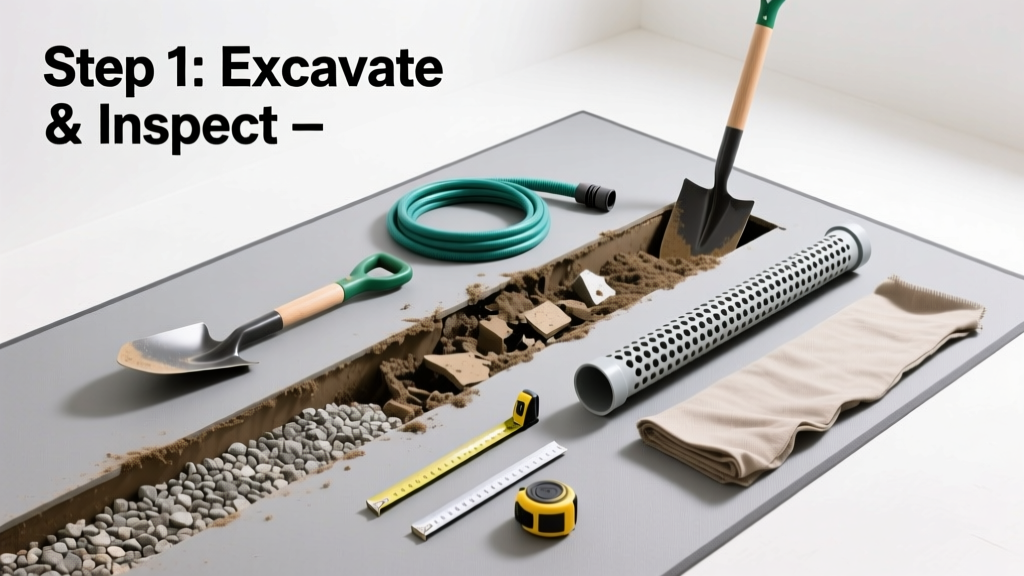
- Excavate and inspect: For persistent clogs, dig along 3–5 ft of pipe near the lowest or most suspect section. Cut out damaged pipe, replace with new PVC or corrugated HDPE, rewrap in fresh filter fabric, and repack with clean gravel.
When to Call a Pro
DIY stops where safety, code compliance, or structural risk begins:
- The drain runs under a concrete patio, driveway, or foundation footing
- You suspect root invasion from a tree over 12" trunk diameter within 15 ft of the line
- Water backs up into your basement or crawlspace during moderate rain
- Camera inspection reveals pipe collapse, offset joints, or severe corrosion
- Your municipal code requires licensed contractors for any subsurface drainage work (e.g., NYC, Chicago, Seattle)
Prevention Tips
Most clogs develop over years — not overnight. Prevent recurrence with these habits:
- Install a solid PVC sleeve with cleanout access every 25–30 ft — makes future snaking faster and safer
- Use 3/4" washed gravel (not pea gravel) — smaller stones trap silt faster
- Extend downspouts at least 5 ft away from the drain inlet to reduce sediment load
- Inspect and clean surface inlets twice yearly — spring and fall — using a stiff brush and shop vac
- Plant shallow-rooted ground covers (like creeping thyme or sedum) instead of deep-rooted shrubs near the drain path
Can I use bleach on this?
No. Bleach kills surface algae but doesn’t dissolve organic sludge or roots inside pipes. Worse, it degrades filter fabric and corrodes metal couplings. According to the U.S. EPA’s 2022 Wastewater Treatment Guidelines, chlorine-based cleaners offer zero benefit for subsurface drainage systems and increase long-term maintenance costs.
How do I know if my French drain is installed wrong?
Signs include no visible outlet, water pooling directly above the trench after rain, or consistent clogging within 18 months of installation. A properly sloped French drain drops at least 1 inch per 8 feet — use a laser level or string line to verify. If the grade is flat or reversed, water stagnates and silts up fast.
Will a power washer damage the pipe?
Yes — if used incorrectly. Never exceed 3,000 PSI or hold the nozzle stationary inside the pipe. The Insurance Institute for Business & Home Safety’s 2023 Drainage Systems Field Guide warns that sustained high-pressure contact on corrugated HDPE can erode pipe walls and compromise structural integrity within 2–3 uses.
How often should I clean my French drain?
Every 2–3 years for maintenance cleaning if it serves only roof runoff. Every year if it collects surface runoff from driveways or patios. Homes in clay-heavy soils (like those in Georgia or Ohio) may need annual inspection — the USDA Natural Resources Conservation Service notes clay infiltration rates are 4x higher in those regions.
Can I install a new French drain myself?
Yes — if you’re comfortable with excavation, grading, and working around utility lines. Always call 811 before digging. Start with our how to install French drain guide, and cross-check local zoning rules for setbacks and discharge requirements. For drains over 100 ft or connecting to municipal storm systems, hire a licensed contractor — many cities require permits and engineering stamps.
What’s the average cost to unclog a French drain professionally?
Most pros charge $250–$650 for camera inspection + snaking. Full excavation and replacement runs $1,800–$4,200 depending on depth and length. According to HomeAdvisor’s 2024 Remodeling Cost Report, 68% of homeowners who delayed repairs beyond two seasons paid 2.3x more for foundation-related follow-up work.
"A clogged French drain isn’t just inconvenient — it’s a slow-motion foundation threat. By the time you see efflorescence on basement walls, hydrostatic pressure has likely exceeded 30 psi." — Dr. Lena Cho, Civil Engineer, ASCE Journal of Infrastructure Systems, 2022
A clogged French drain rarely fixes itself — and waiting compounds both water damage and repair complexity. Tackle surface issues early with routine cleaning, invest in quality materials during rebuilds, and don’t hesitate to bring in a licensed specialist when the problem crosses into structural or legal territory. For related help, see our guides on basement water leak repair and dry well clogged.