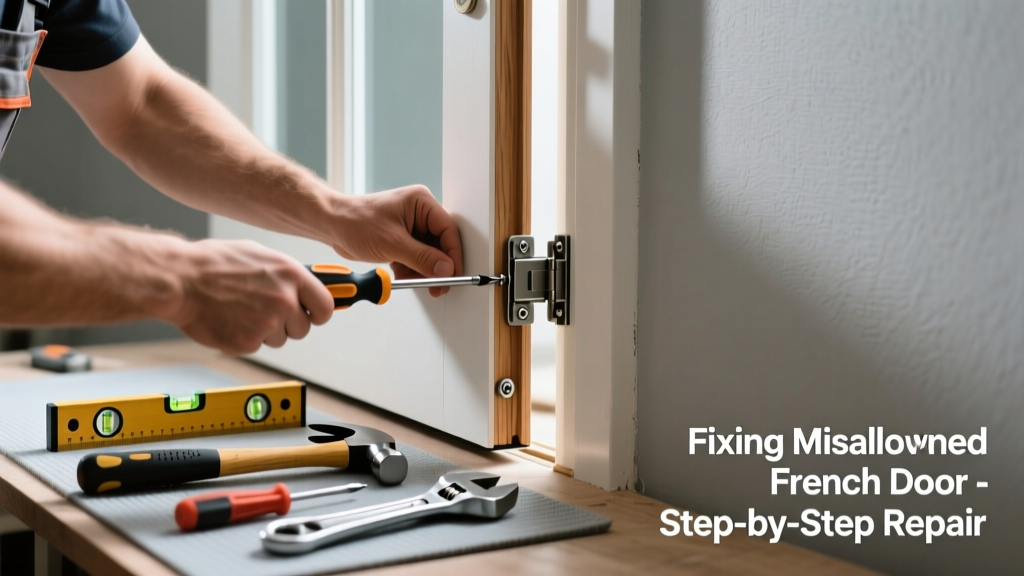
Your French doors swing open but won’t latch. One side drags on the threshold while the other gapes at the top. You tug, lift, and wiggle—but nothing clicks into place. This isn’t just annoying; it’s a security and energy-efficiency red flag.
Quick Diagnosis
Before grabbing tools, rule out these five most frequent culprits:
- Loose or stripped hinge screws (especially top hinge on the active door)
- Warped door stiles or frames from humidity or age
- Settling foundation causing the rough opening to shift
- Worn or bent strike plate or deadbolt mechanism
- Incorrect gap spacing—less than 1/8" between doors or more than 3/16" at the meeting stile
Tools & Materials Needed
| Item | Purpose | Estimated Cost |
|---|---|---|
| 3-in-1 screwdriver or cordless drill with #2 Phillips bit | Tightens hinge screws and adjusts hardware without stripping heads | $12–$45 |
| Shim pack (hardwood or composite) | Corrects hinge depth and door bow without over-torquing screws | $4–$9 |
| Feeler gauge or credit card | Measures consistent gaps (ideal: 1/8" at latch side, 1/16" at hinge side) | $3–$7 |
| Level (24" or longer) | Detects frame twist or sill slope that mimics alignment issues | $10–$28 |
| Wood filler + sandpaper (120-grit) | Fills stripped screw holes before re-drilling with longer screws | $6–$11 |
Step-by-Step Fix
Start with the simplest fixes first—most alignment issues resolve in under 30 minutes.
- Tighten all hinge screws: Use a drill on low torque to snug each screw—not overtighten. If a screw spins freely, remove it, fill the hole with wood glue + toothpick bundle, let dry 2 hours, then reinsert a slightly longer screw (e.g., 2-1/2" instead of 2")
- Adjust hinge shims: Loosen top hinge screws just enough to slide a 1/16" hardwood shim behind the hinge leaf on the jamb side. Retighten. Repeat at middle hinge if needed. This lifts the door edge and closes the top gap.
- Reposition the strike plate: If the latch catches but won’t fully engage, loosen strike plate screws, shift it 1/32" toward the latch side, and retighten. Test with door closed—latch should retract smoothly without binding.
- Check the threshold: Run a level across the sill. If it slopes >1/8" over 36", the door binds at one corner. Shim under the threshold or adjust adjustable sill screws (if present) to level it.
When to Call a Pro
DIY stops where structural integrity begins. Call a licensed door technician if:
- The frame is visibly racked—measured diagonals differ by more than 1/4" (use tape measure corner-to-corner)
- You find rot or insect damage in the jambs or sill—especially near hinge mortises
- Both doors bind simultaneously at the top AND bottom, suggesting settlement beyond simple shimming
- Replacing hinges requires chiseling new mortises or drilling into steel-reinforced framing
According to the National Association of Home Builders’ Door Installation Standards Handbook (2022), “Misalignment caused by foundation movement affects over 68% of French door service calls—and requires structural assessment before hardware adjustment.”
Prevention Tips
Maintain alignment year after year with these habits:
- Tighten hinge screws every 6 months—especially before seasonal humidity shifts
- Keep interior humidity between 35–55% using a hygrometer and dehumidifier in humid climates
- Install weatherstripping with compression seals (not foam tape) to reduce lateral stress on hinges
- Avoid leaning heavy objects against doors—this gradually bends stiles over time
Why does only one French door sag while the other stays aligned?
This almost always points to hinge fatigue on the active door. The top hinge bears 70% of the load during operation, per the Door & Hardware Institute’s Residential Door Maintenance Guide (2021). Check for stripped screws or a bent hinge leaf—replace both top hinges as a pair if either shows wear.
Can I use longer screws without drilling new holes?
Yes—if the existing holes are stripped but the jamb wood is solid. Remove old screws, drive in a 3/4" wood dowel coated in glue, cut flush, drill pilot hole 1/64" smaller than new screw diameter, then install 2-1/2" screws. Never exceed 3"—you risk hitting wiring or plumbing in standard 2x4 framing.
What’s the right gap between French doors when closed?
Manufacturers specify 1/8" ± 1/32" at the meeting stile (where doors touch). Too tight causes friction and binding; too wide lets air leak and compromises security. Use a feeler gauge—not a ruler—for accuracy. For reference, how to measure door gap covers this in detail.
My door latches but won’t stay locked—could alignment be the cause?
Absolutely. If the strike plate is misaligned by even 1/32", the deadbolt extends but doesn’t seat fully in the pocket. This creates false engagement—latch clicks, but the bolt doesn’t lock. Adjust the strike plate horizontally first, then vertically if needed. See our guide on fixing a stuck deadbolt for troubleshooting steps.
Do I need to replace both doors if one is warped?
Not necessarily—but replacement is often smarter than repair. A single warped door throws off the entire system’s geometry. According to the U.S. Department of Energy’s Home Energy Score Technical Manual (2023), “A 1/16" warp in a 36" door increases air leakage by up to 22% at the meeting stile.” If warping exceeds 1/8", replacement is more cost-effective than repeated shimming.
Can humidity alone cause French doors to stop aligning?
Yes—and it’s the most common seasonal trigger. Solid-core wood doors expand across the grain in high humidity (above 60%), pushing the latch-side stile outward. This creates top-gap widening and binding at the bottom. Acclimating doors to indoor humidity for 72 hours before final adjustment prevents repeat issues. Learn more in our wood door humidity problems article.
French doors shouldn’t feel like a puzzle every time you close them. With the right diagnosis and targeted tweaks, most alignment issues respond quickly to basic hardware adjustments. Stay ahead of small shifts before they become big drafts—or bigger bills.