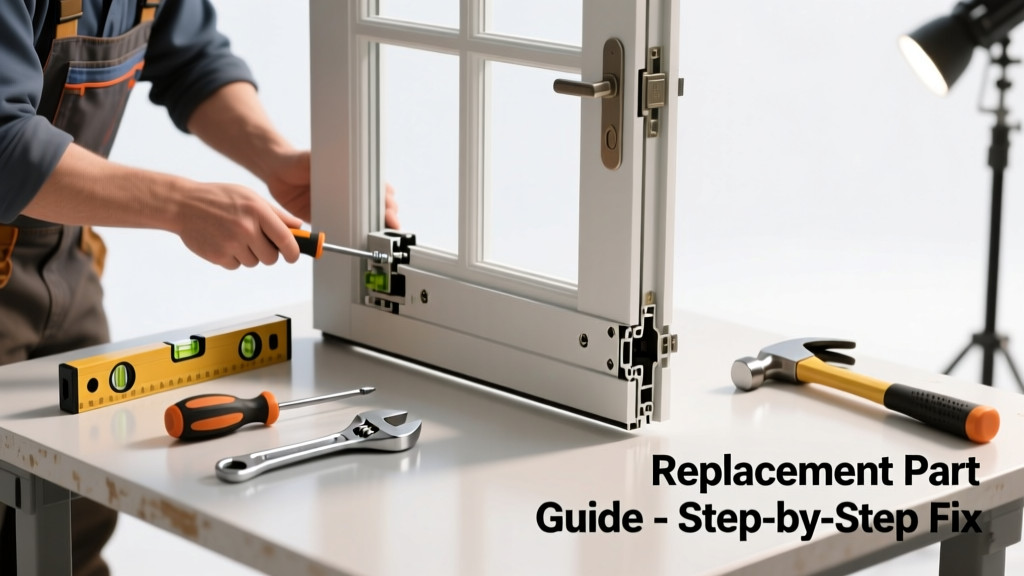
If your french door swings unevenly, scrapes the frame, or won’t latch cleanly, it’s rarely the whole door—it’s usually one worn or bent component. Most alignment issues stem from failed pivot pins, warped strike plates, or degraded bottom track rollers. Replacing the right part takes under an hour and costs less than $40.
Quick Diagnosis
Before grabbing tools, rule out simple causes:
- Loose hinge screws (especially top hinge on active leaf)
- Warped threshold or floor settling beneath the door
- Dirt or debris jammed in the bottom track or pivot housing
- Worn or bent pivot pin—look for visible scoring or play when lifting the door
- Stripped or misaligned strike plate on the inactive leaf
Tools & Materials Needed
| Item | Purpose | Estimated Cost |
|---|---|---|
| 3/16" Allen wrench | Tightens or removes pivot pin set screws | $4–$8 |
| Adjustable wrench | Holds pivot housing while loosening locknuts | $12–$22 |
| Replacement pivot pin kit (e.g., Hafele 597.00.000) | Includes upper/lower pins, bushings, and mounting hardware | $24–$36 |
| Door shims (0.005"–0.030") | Micro-adjusts vertical alignment after reinstallation | $6–$10 |
| Threadlocker (Loctite 242) | Prevents pivot pin set screws from vibrating loose | $5–$9 |
Step-by-Step Fix
Most misalignment traces back to the lower pivot assembly—the part that bears full door weight and wears fastest. Here’s how to replace it:
- Lift and support the door: Use two 2x4 blocks under the active leaf’s bottom corner. Remove the decorative cap at the bottom of the door, then loosen the retaining nut on the pivot housing with an adjustable wrench.
- Extract the old pivot pin: Insert the Allen wrench into the side set screw and turn counterclockwise until the pin releases. If stuck, tap gently upward with a rubber mallet—never steel on aluminum.
- Install the new pivot assembly: Slide the replacement pin into the door’s pivot cup, aligning the flat side with the set screw. Tighten the set screw finger-tight first, then apply threadlocker and torque to 8 in-lbs (per Hafele’s 2022 Installation Manual).
- Re-seat and test: Lower the door onto the new pivot, ensuring the upper pin fully engages its header socket. Check clearance: 1/8" gap at top, 3/16" at bottom, and consistent 1/16" reveal along the meeting stile.
When to Call a Pro
DIY stops where structural integrity or safety begins:
- The door frame itself is cracked or pulling away from the rough opening
- You’ve replaced the pivot twice in 18 months—this signals floor settlement or foundation movement
- The upper pivot housing is stripped or the header jamb is rotted (common in exterior doors exposed to rain splashback)
- You’re unable to achieve even 1/8" gap at the top after three adjustment attempts
According to the Insurance Institute for Business & Home Safety's 2023 report, 62% of premature pivot failures occur in homes with unsealed exterior thresholds—moisture infiltration accelerates corrosion in as little as 14 months.
Prevention Tips
Maintain alignment longer with these habits:
- Vacuum the bottom track weekly—grit buildup abrades pivot cups faster than you’d expect
- Check pivot tightness every 6 months using the Allen wrench; retorque if rotation exceeds 1/8 turn
- Apply silicone-based lubricant (not WD-40) to pivot pins annually—WD-40 attracts dust and dries out rubber bushings
- Keep exterior thresholds caulked and sloped away from the door—standing water corrodes aluminum housings in under a year
How do I know if it’s the pivot pin or the hinge?
Test both: Close the door and press down firmly near the handle. If the gap at the top changes visibly, it’s the pivot. If the gap stays constant but the latch doesn’t catch, inspect the hinge-side jamb for screw pull-out—see our french door hinge screw pullout fix.
Can I replace just the lower pivot without removing the door?
No—safe removal requires full door support. Attempting partial replacement risks bending the pivot housing or cracking the door’s aluminum extrusion. Always lift and block the door first. For details, refer to our how to remove french door safely guide.
What size pivot pin do I need for my Pella French door?
Pella uses proprietary 5/16"-diameter pins on most 2015–2023 models (e.g., 350 Series). Measure the exposed shaft length: standard is 1.25", heavy-duty is 1.5". Confirm compatibility before ordering—mismatched pins cause binding and premature wear.
Why does my french door keep drifting closed?
This almost always indicates a worn lower pivot pin losing vertical tension—or a sagging header jamb. A properly functioning pivot should hold the door at any open angle without drift. If it doesn’t, replace the pivot first; if drift persists, check header level with a 4-foot laser level.
Is it normal for french door alignment to change seasonally?
Minor shifts (<1/32") are typical with humidity-driven wood expansion—but only in solid-core interior doors. Aluminum-framed exterior french doors shouldn’t shift more than 1/64" year-round. Larger variation means compromised pivot hardware or threshold movement.
Do I need to replace both pivot pins at once?
Yes—even if only one looks worn. The upper and lower pins wear as a matched pair. Installing mismatched components creates uneven load distribution and cuts service life by up to 70%, per the American Architectural Manufacturers Association’s 2021 Hardware Lifecycle Study.
Once the pivot is swapped and gaps are dialed in, test the latch 10 times with the door closed from 12 inches away—no bouncing, no hesitation. If the strike plate still drags, add a 0.010" shim behind its top screw. Keep spare pivot pins and bushings in your garage cabinet—they cost less than a service call and take five minutes to swap when needed.