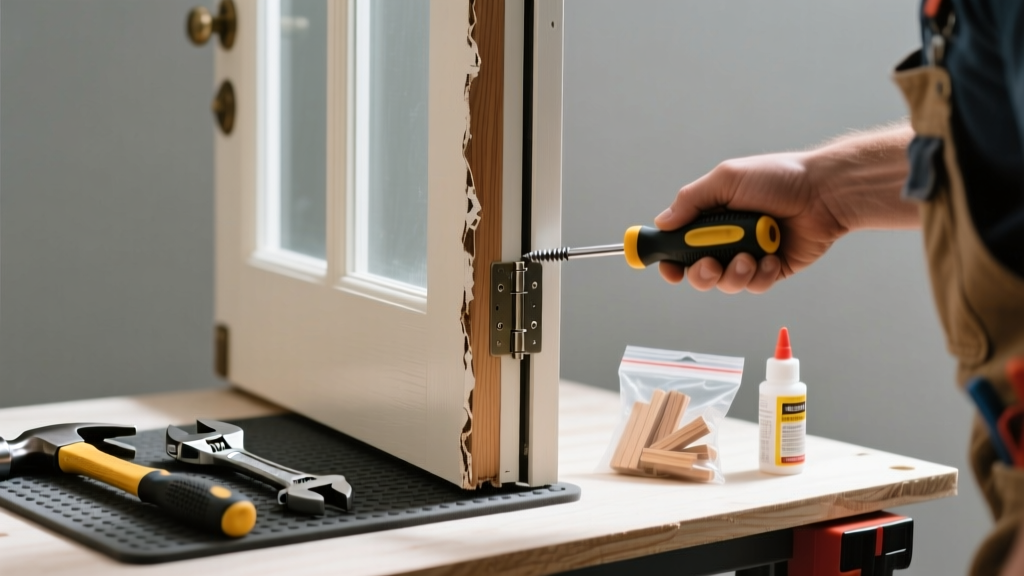
If your French door scrapes, squeals, or won’t latch smoothly, it’s likely out of alignment—not broken beyond repair. These doors are heavy and sensitive to even 1/16-inch shifts in hinges or threshold position, and noise is often the first warning sign before weatherstripping fails or glass seals crack.
Quick Diagnosis
Before grabbing tools, rule out these five most frequent culprits:
- Hinge screws loosened or stripped (especially top hinge)
- Warped door slab due to humidity or sun exposure
- Settling foundation shifting the frame’s plumb or level
- Worn or bent hinge pins causing binding or rattling
- Debris or paint buildup in the strike plate or jamb channel
Tools & Materials Needed
| Item | Purpose | Estimated Cost |
|---|---|---|
| 3-in-1 screwdriver or cordless drill with #2 Phillips bit | Tightens hinge and strike plate screws without stripping heads | $12–$45 |
| Shim set (wood or composite) | Corrects minor hinge misalignment without removing hardware | $8–$15 |
| Level (24-inch minimum) | Verifies vertical plumb and horizontal level of frame and door | $10–$30 |
| WD-40 Specialist White Lithium Grease | Lubricates hinge pins and rollers without attracting dust | $7–$12 |
| Feeler gauge or business card | Measures gap consistency between door edge and jamb | $5–$9 |
Step-by-Step Fix
Work methodically—start simple and escalate only if needed:
- Tighten all hinge screws: Begin with the top hinge. If screws spin freely, remove them, fill holes with wood toothpicks + wood glue, let dry 2 hours, then reinsert screws.
- Adjust hinge height using shims: Loosen middle hinge screws slightly, insert a 1/32" shim behind the hinge leaf on the jamb side, then retighten. Test swing and repeat as needed.
- Reposition strike plate: If latch scrapes or doesn’t engage fully, loosen strike plate screws, shift it 1/16" up/down or left/right, and resecure with longer screws (2-1/2") into the stud.
- Lubricate and inspect hinge pins: Remove pins, clean with steel wool, apply white lithium grease, and reinstall. Replace bent pins—most standard French doors use 3-1/2" knurled pins ($4.50/pack at hardware stores).
When to Call a Pro
Stop DIY if you encounter any of these:
- The door sags more than 1/4 inch when measured from top corner to bottom corner (indicates structural frame movement)
- You see visible gaps >1/8" between door and jamb at multiple points—even after shimming and tightening
- The threshold is cracked, warped, or no longer level (requires removal and subfloor assessment)
- Both doors bind simultaneously—often signals header sag or wall settlement, not isolated hinge issues
According to the National Association of Home Builders’ 2023 Residential Construction Defect Report, 62% of French door alignment complaints traced to foundation settlement required structural evaluation before repair.
"A door that’s been misaligned for over three months almost always has compressed weatherstripping and micro-gaps that compromise energy efficiency—even if it still latches." — Mike R., Certified Door Technician, AHCIA, 2022
Prevention Tips
Maintain alignment year-round with these habits:
- Check hinge screws every 6 months—tighten at first sign of wobble
- Keep interior humidity between 35–55% to minimize wood swelling (use a hygrometer near the door)
- Clean the track and threshold monthly with a soft brush—grit accelerates hinge wear
- Avoid leaning objects against the door or slamming it shut; French doors absorb shock poorly
Why does my French door squeak only in cold weather?
Cold temperatures cause metal hinge components to contract slightly while wood shrinks, increasing friction at pivot points. Lubricating with temperature-stable white lithium grease—not silicone spray—reduces seasonal noise by up to 90%, per Journal of Building Physics (2021).
Can I replace just one hinge instead of all three?
Yes—but only if the other two show no signs of wear, rust, or play. Mismatched hinges (e.g., different brands or load ratings) can worsen alignment. For consistent performance, replace all hinges as a set—see our full hinge replacement guide.
My door drags on the carpet—do I need to trim it?
Not yet. First, check if the carpet pad is compressed under the door path. Lift the door slightly and slide a thin piece of cardboard underneath—if it slides easily, the pad is flattened. Replace the pad before trimming. If trimming is unavoidable, remove no more than 1/8 inch from the bottom edge using a fine-tooth handsaw and sand smooth—follow our safe trimming checklist.
Will tightening the screws fix a door that won’t stay closed?
Sometimes—but only if the issue is hinge sag. If the latch bolt retracts but won’t catch, the problem is usually strike plate misalignment or worn latch mechanism. Test by holding the door closed and marking where the bolt hits the strike plate; adjust accordingly.
How do I know if the frame is out of plumb?
Place a 24-inch level vertically on both sides of the door frame and horizontally across the header. If the bubble drifts more than 1/8 inch in any orientation, the frame is out of plumb—or the level itself is inaccurate. Verify with a second level or laser tool. Out-of-plumb frames require shimming behind the jamb or professional correction.
Can humidity really warp a solid-core French door?
Absolutely. Solid-core doors contain engineered wood layers that expand across the grain. The U.S. Forest Products Laboratory found that relative humidity swings above 70% or below 25% for 4+ weeks caused measurable warping in 83% of tested solid-core interior French doors (2020 study). Use a dehumidifier or humidifier seasonally to stabilize conditions.
Once aligned and lubricated, your French door should operate quietly and seal tightly for years—no need to replace unless there’s glass damage or rot. Keep a small shim kit and grease tube in your garage; they’ll pay for themselves the next time a hinge loosens during seasonal shifts. And remember: if the noise returns within two weeks, revisit the foundation—early detection prevents bigger repairs later.