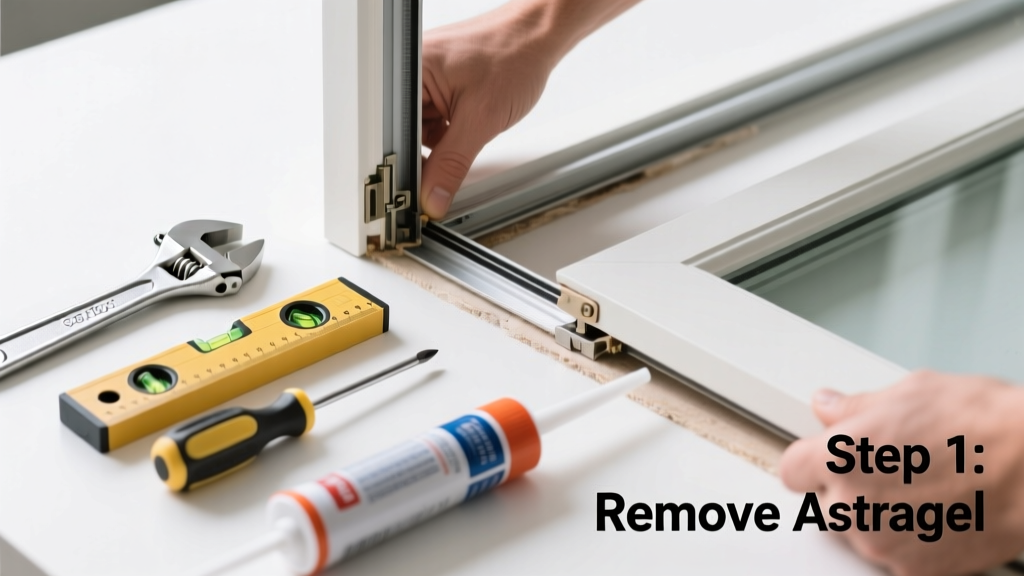
If your French doors won’t seal tightly, let in drafts, or rattle when closed, the astragal—the vertical strip between the doors—is likely the culprit. A gap that’s too wide, uneven, or warped breaks the weather seal and compromises security and energy efficiency. Most of the time, this isn’t a full-door replacement job—it’s a precise adjustment away from working perfectly.
Quick Diagnosis
Before grabbing tools, confirm what’s really wrong. The astragal gap issue usually stems from one (or more) of these root causes:
- Loose or stripped mounting screws holding the astragal to the active door
- Warped or bent astragal profile—especially common with older aluminum or hollow-core units
- Door sagging due to hinge wear or settling, throwing off alignment
- Incorrect astragal type installed (e.g., using a flat astragal on a beveled door edge)
- Accumulated paint, caulk, or debris blocking full contact
Tools & Materials Needed
| Item | Purpose | Estimated Cost |
|---|---|---|
| 3/32″ hex key (Allen wrench) | Tightens most astragal mounting screws without stripping heads | $4–$8 |
| Shim pack (0.005″–0.030″ plastic or brass) | Corrects minor door bow or astragal offset without bending metal | $6–$12 |
| Feeler gauge set | Measures exact gap width at multiple points (critical for consistency) | $10–$18 |
| Non-abrasive door edge cleaner (e.g., mineral spirits + microfiber) | Removes paint buildup without scratching anodized finishes | $5–$9 |
| Replacement astragal (if needed) | Match model number; most standard residential units cost $22–$45 | $22–$45 |
Step-by-Step Fix
Work methodically—start simple and escalate only if needed. Always test door operation after each step.
- Tighten all astragal mounting hardware. Use the hex key to snug down every screw along the length. Don’t overtighten—this can warp thin-gauge aluminum astragals. Check gap uniformity with a feeler gauge: ideal is 1/16″ (0.0625″) max at center, tapering slightly wider at top/bottom.
- Clean the mating surfaces. Wipe both the astragal face and the inactive door’s strike edge with mineral spirits. Remove dried paint, caulk, or grime that prevents full contact. Let dry fully before closing.
- Add shims behind the astragal base. If tightening doesn’t close the gap, insert a 0.010″ plastic shim behind the astragal near the widest point. Re-tighten screws gradually while checking gap with feeler gauge. Repeat with incremental shims up to 0.025″ total.
- Realign the active door hinges. If the gap widens toward the top or bottom, loosen hinge screws on the active door and shift the door slightly inward using a wood block and rubber mallet. Retighten screws and recheck astragal contact.
- Replace the astragal if bent or corroded. Remove old unit by unscrewing fully, then measure length and profile depth. Order an exact match—most manufacturers (Andersen, Jeld-Wen, Therma-Tru) stamp part numbers on the back flange.
When to Call a Pro
Some issues go beyond field adjustments—and attempting them yourself risks damaging the door system or voiding warranties.
- The door frame itself is out of plumb (more than 1/8″ over 6 feet), indicating structural settlement
- You hear metal-on-metal grinding during operation, suggesting internal hinge mechanism failure
- The astragal is integrated into a multipoint locking system (e.g., some Pella Architect Series) requiring factory calibration
- There’s visible rust-through or stress cracking in the astragal’s mounting flange or door stile
According to the Insurance Institute for Business & Home Safety's 2023 report on residential door performance, improperly sealed French doors contribute to up to 22% of seasonal heating loss in homes with exterior French door installations—making timely, correct repair critical for energy bills and comfort.
Prevention Tips
Maintaining proper astragal function is easier than fixing it. Build these habits into your biannual home maintenance routine:
- Inspect and tighten astragal screws every 6 months—vibration and thermal cycling loosen them over time
- Wipe door edges clean after painting projects to avoid accidental buildup on sealing surfaces
- Check for hinge pin wear annually; replace pins showing >0.005″ of play to prevent cumulative sag
- Use only manufacturer-recommended lubricant (e.g., silicone-based, not WD-40) on moving parts
Can I bend the astragal back into shape with pliers?
No—most modern astragals are extruded aluminum or stainless steel with precise tolerances. Bending risks kinking, weakening the profile, or breaking the internal gasket channel. Replacement is safer and cheaper than risking further damage.
Why does my astragal gap get worse in summer?
Wood and composite door cores expand with humidity, while metal astragals don’t. This mismatch widens gaps seasonally. Installing a compression-type astragal with a flexible EPDM gasket (like those in French door weatherstripping types) helps absorb that movement.
Do I need to remove the door to replace the astragal?
Not usually. Most surface-mounted astragals install directly onto the active door’s leading edge with screws accessible from the outside. Only integral or recessed models (found on high-end commercial units) require door removal.
Is a 1/8″ gap acceptable for energy efficiency?
No—ASHRAE Standard 90.1 specifies maximum allowable air leakage for exterior doors at 0.3 cfm/sq ft at 1.57 PSF pressure. A 1/8″ (0.125″) gap typically exceeds that by 3–5×. Aim for ≤1/16″ measured consistently across the height.
Can I use double-sided tape instead of screws to hold the astragal?
Absolutely not. Tape fails under UV exposure, temperature swings, and repeated door cycles. It also prevents proper gasket compression. Screws are non-negotiable for structural integrity and code compliance.
What’s the difference between an astragal and a mullion?
An astragal is a functional, movable component attached to the active door that seals against the inactive door. A mullion is a fixed, structural divider between two door panels—often decorative or load-bearing—and doesn’t move or seal. Confusing them leads to incorrect repairs. See our guide on French door mullion vs astragal for visual examples.
A properly adjusted astragal should click quietly into place with firm, even resistance—not slam or bind. If you’ve followed these steps and still feel air movement or hear whistling, revisit the hinge alignment or consider upgrading to a dual-seal astragal with interlocking weatherstripping. Small fixes like this pay off fast: the U.S. EPA estimates that sealing gaps around doors and windows reduces household heating and cooling costs by up to 10% annually.