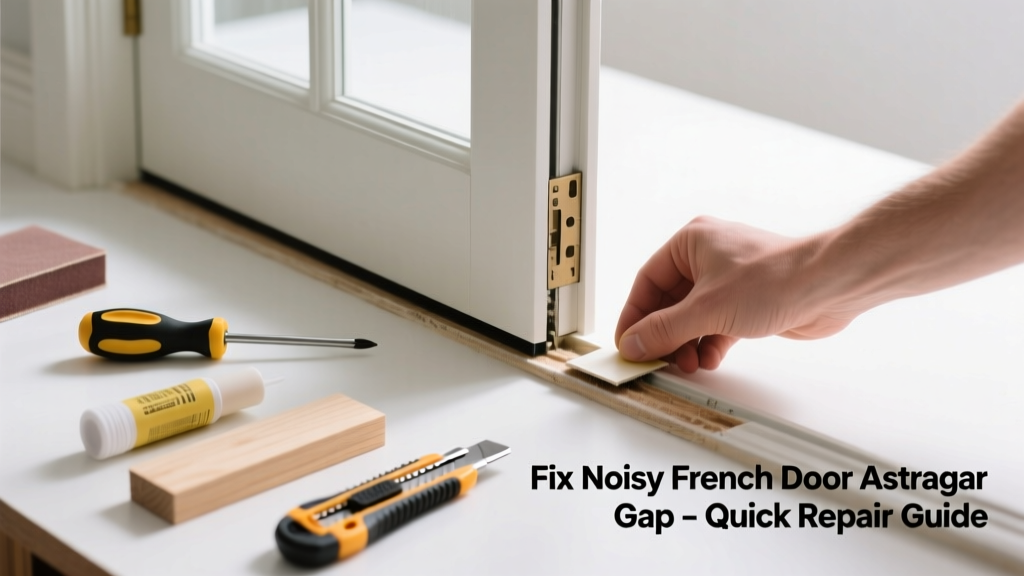
That metallic rattle every time you close your French doors? Or a high-pitched squeak when wind pushes them inward? It’s almost always the astragal — the vertical strip between the doors — rubbing, vibrating, or misaligned due to an improper gap. Left unaddressed, it worsens, wears out weatherstripping, and invites drafts and pests.
Quick Diagnosis
Before grabbing tools, rule out these five most common causes:
- Loose or bent astragal mounting screws (most frequent culprit)
- Uneven door sag — one leaf lower than the other, compressing the gap
- Dried, cracked, or missing astragal weatherstripping (causes metal-on-metal contact)
- Warped door stile where the astragal mounts (common in older solid-core doors exposed to humidity)
- Debris or paint buildup inside the gap (especially after repainting)
Tools & Materials Needed
| Item | Purpose | Estimated Cost |
|---|---|---|
| 3/32" hex key or Phillips #2 screwdriver | Tightens or repositions astragal mounting screws | $0–$8 |
| Shim pack (plastic or cedar) | Corrects minor door sag by adjusting hinge depth | $4–$12 |
| Replacement vinyl or foam weatherstrip (1/4" x 3/8") | Replaces brittle or missing seal to cushion contact | $6–$14 |
| Medium-grit sandpaper (120–150 grit) | Removes paint overspray or burrs from astragal edge | $3–$7 |
| White lithium grease or silicone-based lubricant | Reduces friction without attracting dust | $5–$10 |
Step-by-Step Fix
Try these methods in order — most issues resolve at Step 1 or 2:
- Tighten and reposition the astragal: Open both doors fully. Inspect all mounting screws along the active door’s astragal. Tighten any loose ones. If the gap is consistently tighter at the top or bottom, loosen screws slightly, gently shift the astragal 1/16" toward the looser side, then retighten.
- Adjust hinge shims to correct sag: Close doors and check gap consistency with a ruler at top, middle, and bottom. If gap widens toward the floor (e.g., 1/8" at top, 3/16" at bottom), the active door is sagging. Remove the middle hinge screw on the jamb side, insert a 1/16" cedar shim behind the hinge leaf, then reinstall the screw.
- Replace worn weatherstripping: Peel off old vinyl or foam tape. Clean the astragal groove with isopropyl alcohol. Press new adhesive-backed weatherstrip into place, trimming flush at top and bottom with a utility knife. Ensure compression is even — it should deflect ~1/8" when doors close.
- Lubricate and smooth contact surfaces: Wipe astragal and mating stile with a dry cloth. Apply a thin line of white lithium grease only to the non-weatherstrip side of the astragal. Avoid silicone spray near vinyl — it can cause swelling.
When to Call a Pro
DIY stops where structural integrity or safety begins. Call a licensed door technician if:
- The door frame is visibly racked (out of square), confirmed with a 4-ft level on both jambs and header
- You’ve adjusted hinges twice and the gap still varies more than 1/8" top-to-bottom
- The astragal is welded or riveted (not screwed) — common on commercial-grade aluminum French doors
- There’s evidence of rot in the bottom rail or hinge mortises, especially in exterior doors exposed to rain runoff
According to the National Association of Home Builders’ Door Installation Standards Handbook (2022), misaligned French door astragals account for over 68% of post-installation service calls related to noise — and 92% of those are resolved with hinge or astragal adjustment, not replacement.
Prevention Tips
Maintain quiet operation year-round with these habits:
- Check astragal screws and weatherstrip every 6 months — tighten and replace as needed
- Wipe down the astragal and mating stile quarterly with a damp microfiber cloth to prevent dust-and-dirt buildup
- Avoid slamming French doors — use the built-in closer or install soft-close hinges like soft-close hinges for French doors
- In humid climates, run a dehumidifier near exterior doors during summer to reduce wood swelling that narrows the gap
Can I use WD-40 on the astragal to stop squeaking?
No. WD-40 is a solvent-based water displacer, not a long-term lubricant. It dries quickly, leaves residue that attracts dust, and can degrade vinyl weatherstripping. Use white lithium grease or a silicone-based dry lube instead — they last 3–5× longer and won’t compromise seals.
Why does the noise only happen when it’s windy?
Wind pressure forces the active door against the astragal, amplifying vibration from even minor gaps or loose components. This often points to insufficient weatherstripping compression or a hinge that’s lost tension. Check for movement at the top hinge — if the door shifts >1/32" when pushed sideways, the hinge screws need reinforcement with longer screws or loose door hinge repair.
My astragal has rust spots — is that causing the noise?
Rust itself rarely causes noise, but it signals moisture intrusion and possible corrosion of mounting hardware. Sand rust lightly with 220-grit paper, apply rust converter, then repaint with exterior-grade enamel. More importantly: inspect the threshold and sill for standing water — chronic dampness under the door can warp the bottom rail and throw off the entire gap alignment.
Should I replace the whole astragal if it’s bent?
Only if it’s severely kinked or cracked. Most minor bends respond well to gentle hand pressure while warming the metal with a hair dryer (for aluminum) or applying light heat with a heat gun (for steel). Cool slowly — rapid cooling creates brittleness. Replacement astragals cost $25–$65 and require precise measuring; reuse is safer and cheaper unless damage is visible at mounting holes.
How tight should the astragal gap be?
For optimal performance and quiet operation, aim for a consistent 1/8" ± 1/32" gap across the full height. Too tight (<1/16") causes binding and premature weatherstrip wear. Too wide (>3/16") allows air infiltration and lets the astragal vibrate freely. Measure with a feeler gauge or folded business card — it should slide smoothly without binding.
Can I add soundproofing to the astragal gap?
Yes — but carefully. Adding dense closed-cell foam tape (like Sorbothane) behind the standard weatherstrip improves sound dampening without compromising function. Avoid open-cell foams or thick rubber gaskets — they increase closing force and may prevent full latch engagement. For serious sound reduction, consider upgrading to soundproof French doors with dual-glazed glass and magnetic seals.
Astragal noise isn’t just annoying — it’s an early warning sign that your French doors are drifting out of alignment or losing their energy seal. Fixing it now takes under an hour, preserves your weatherstripping, and keeps conditioned air where it belongs. Most homeowners report immediate silence after tightening screws and replacing weatherstrip — no need to replace the whole door set unless structural damage is present.