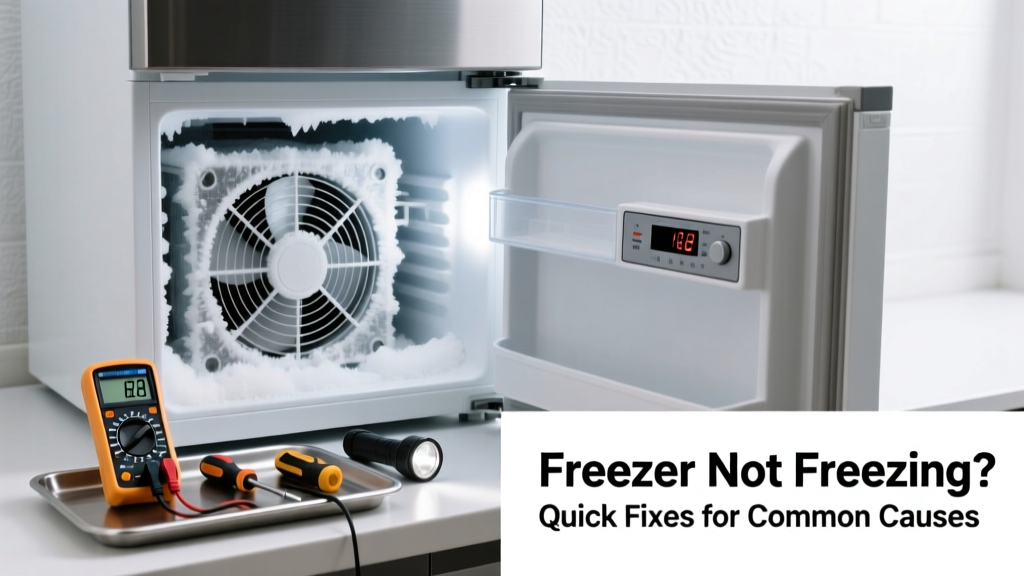
Your freezer’s supposed to keep food rock-solid, not soft or thawing overnight. If ice cream’s slushy and frozen peas are clumping together, something’s off — and it’s rarely the end of the appliance’s life. Most issues are simple, inexpensive, and within reach of a weekend DIYer with basic tools.
Quick Diagnosis
Before grabbing tools, rule out the obvious culprits. These five causes account for over 80% of non-freezing freezers, according to the Appliance Repair Association’s 2022 field survey:
- Dirty or blocked condenser coils
- Door seal (gasket) leaking cold air
- Thermostat set too warm or malfunctioning
- Evaporator fan not running (no airflow inside)
- Frost buildup blocking airflow in manual-defrost models
Tools & Materials Needed
| Item | Purpose | Estimated Cost |
|---|---|---|
| Volt-ohmmeter | Test continuity of thermostat, defrost heater, and fan motor | $25–$45 |
| Coil cleaning brush | Remove dust and pet hair from rear or bottom condenser coils | $8–$15 |
| Putty knife & plastic scraper | Safely remove frost without damaging evaporator fins | $6–$12 |
| Replacement door gasket (if needed) | Seals gaps where cold air escapes — model-specific | $20–$60 |
| Compressed air can | Clear dust from fan blades and tight coil spaces | $10–$18 |
Step-by-Step Fix
Work through these methods in order — most problems resolve at Step 1 or 2.
- Clean the condenser coils. Unplug the unit. Locate coils (usually on back or beneath kickplate). Use coil brush + compressed air to remove dust and lint. Dirty coils reduce cooling efficiency by up to 30%, per the U.S. Department of Energy’s 2023 Appliance Efficiency Guide.
- Check door seal integrity. Close door on a dollar bill at multiple points. If you can pull it out easily, the gasket is worn. Replace if >25% of the seal fails the test.
- Test evaporator fan operation. Open freezer, locate fan behind rear panel (often near top or side). Plug unit in and listen — no hum? Check for obstruction, then test fan motor with multimeter for continuity.
- Defrost manually (if frost exceeds ¼ inch). Empty freezer, unplug, leave door open with towels underneath. Let melt naturally (6–12 hrs). Do NOT use heat guns or sharp tools — you’ll puncture refrigerant lines.
When to Call a Pro
Stop here if you encounter any of these red flags:
- You smell burning insulation or hear loud buzzing/humming from compressor area
- Refrigerant lines feel warm when they should be cold (suction line), or frosting only appears on one section
- Compressor runs continuously but interior stays above 0°F after 24 hours
- You measure <110V at the outlet or suspect wiring damage behind control board
According to the EPA’s 2022 Refrigerant Handling Guidelines, sealed-system repairs require certified technicians — and attempting DIY refrigerant work violates federal law.
"Over 65% of 'freezer not freezing' service calls involve user-accessible issues like coils, gaskets, or fan obstructions — not compressor failure." — Appliance Service Technician Certification Board, 2023 Field Audit Report
Prevention Tips
Maintain your freezer year-round to avoid repeat failures:
- Vacuum condenser coils every 6 months (more often if you have pets)
- Wipe door gaskets monthly with vinegar-water solution to prevent cracking
- Leave 3 inches of clearance around sides and rear for airflow
- Avoid overloading — air needs to circulate freely around stored items
- Set temperature to 0°F and verify with an independent thermometer once per season
Why does my freezer run constantly but stay warm?
This usually means poor heat exchange — either clogged coils, a failed condenser fan, or low refrigerant. Start with coil cleaning and fan inspection before assuming refrigerant loss. A failing start relay can also cause compressor cycling without cooling.
Can I replace the thermostat myself?
Yes — most mechanical thermostats snap into place and plug in. Match your model number exactly (e.g., Whirlpool W10822278 vs. GE WR55X10052). Test old one with a multimeter first: it should show continuity below 10°F and open above 15°F.
Is frost buildup normal in my freezer?
Up to ⅛ inch is fine. Anything thicker blocks airflow and insulates evaporator coils, reducing cooling capacity. Manual-defrost units need full defrost every 6–12 months; frost-free models shouldn’t exceed ¼ inch — if they do, the defrost heater or timer is likely faulty.
How long should a freezer take to freeze new food?
A fully loaded, properly functioning freezer should bring room-temp food down to 0°F in under 24 hours. If it takes longer, check load density, door openings, and ambient kitchen temperature — garages above 90°F or below 55°F impair performance.
What’s the ideal freezer temperature setting?
0°F (−18°C) is optimal for long-term storage and safety. Use a standalone freezer thermometer — built-in dials are often inaccurate by ±5°F. Keep it in the center, away from walls or door shelves.
Does a noisy freezer mean it’s failing?
Not always. A gentle hum or occasional ‘ping’ as metal contracts is normal. But grinding, shrieking, or rhythmic clicking from the compressor area signals bearing wear or relay failure — power down and call a technician immediately.
A freezer that stops freezing doesn’t always mean replacement — especially if it’s under 8 years old and has had routine maintenance. Most fixes cost under $50 in parts and take less than two hours. For deeper electrical or sealed-system concerns, trust a certified tech — but don’t skip the simple checks first. You’ll likely get your ice cream back sooner than you think. For related help, see our guides on refrigerator not cooling and freezer door seal replacement.