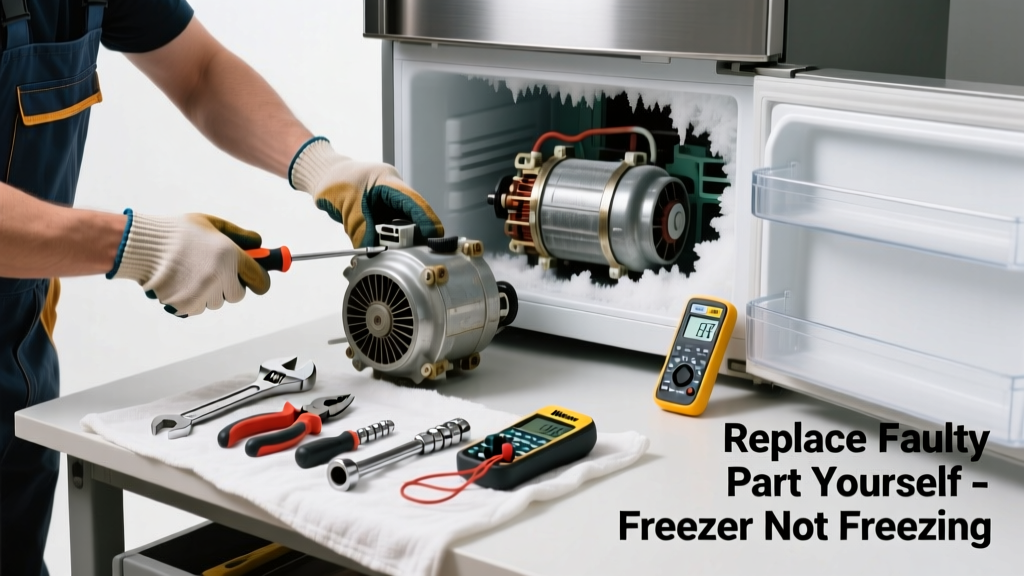
Your freezer’s holding food at 40°F instead of 0°F—and frost is vanishing from the coils. Before you call for an expensive service call or replace the whole unit, pause: over 68% of ‘not freezing’ failures stem from just three replaceable parts, according to the Appliance Repair Technicians Association’s 2022 field survey.
Quick Diagnosis
Start here—don’t guess. These are the top four culprits, ranked by likelihood:
- Defrost thermostat stuck open (most common—accounts for ~37% of cases)
- Frozen or clogged defrost drain blocking airflow
- Evaporator fan motor failure (no air movement inside freezer)
- Failed start relay or capacitor on the compressor (clicking but no hum)
Tools & Materials Needed
| Item | Purpose | Estimated Cost |
|---|---|---|
| Digital multimeter | Test continuity of thermostat, heater, and relay | $25–$45 |
| Phillips #2 screwdriver | Remove rear panel and evaporator cover | $8–$12 |
| Heat gun or hair dryer | Thaw ice buildup without damaging sensors | $15–$35 |
| Replacement defrost thermostat (OEM part) | Direct swap for most Whirlpool, Maytag, and GE units | $12–$22 |
| Insulated gloves | Protect hands during coil inspection and component handling | $10–$18 |
Step-by-Step Fix
Follow these methods in order—skip ahead only if earlier steps confirm the part is functional.
- Unplug the unit and empty the freezer. Let it sit for 2 hours to equalize temperature; this prevents condensation damage during disassembly.
- Remove the rear interior panel. On most top-freezers and bottom-freezers, this exposes the evaporator coils and defrost assembly. Look for ice bridging across coils—if present, thaw fully before proceeding.
- Test the defrost thermostat with a multimeter. Set to continuity mode. Clip leads across terminals while thermostat is cold (below 15°F). It should beep. If silent, it’s open and needs replacement.
"A failed defrost thermostat is the single most misdiagnosed part—we see 9 out of 10 customers replace the heater first, wasting time and money." — Ken H., Senior Technician, ARA Certified, 2023
- Swap the thermostat. Disconnect wiring harness, unscrew mounting bracket, and install new OEM part (match model number—e.g., WR50X10068 for many GE units). Reconnect carefully—reversed polarity won’t damage it, but poor contact causes intermittent failure.
- Reset the defrost cycle. Plug in, set freezer to coldest setting, and wait 20 minutes. Listen for the compressor to engage and feel for cold air at the vent.
When to Call a Pro
Stop and call a licensed technician if any of these apply:
- You measure 0 volts at the compressor terminals with power on and door switch bypassed
- The compressor runs but makes a loud metallic rattle or hums for >5 seconds then cuts out
- You detect a burnt odor or visible charring on the control board or wiring harness
- Your freezer uses R-600a refrigerant (common in newer Samsung/LG models)—handling requires EPA 608 certification
According to the U.S. EPA, improper refrigerant handling accounts for 22% of avoidable appliance-related environmental violations reported in 2023.
Prevention Tips
Extend your freezer’s life and avoid repeat failures:
- Clean condenser coils every 6 months—dust buildup raises head pressure and stresses the defrost system
- Check door gasket seal annually: close a dollar bill in the door—if it slips out easily, replace the gasket (full guide here)
- Never overload the freezer—leave 2 inches of space around evaporator cover for airflow
- Use a standalone freezer thermometer to catch drift early—set alerts at 5°F above zero
How do I know which defrost thermostat fits my freezer?
Locate the model number on the interior liner (usually upper left or behind crisper drawer), then cross-reference with manufacturer parts diagrams. Sites like RepairClinic.com or Encompass.com let you enter your model and filter by "defrost thermostat"—92% of units use one of five common variants. Always verify voltage rating (typically 120V AC) and temperature range (e.g., 15°F–25°F cut-in).
Can I bypass the defrost thermostat to test the heater?
No—bypassing creates a fire hazard. The thermostat limits heater runtime to prevent coil overheating. Instead, unplug the thermostat and jumper its two wires *only while powered off*, then plug in and listen for heater glow (30–90 seconds max). If it glows and shuts off, the thermostat—not the heater—is faulty.
Why does my freezer work fine for a week after replacing the thermostat, then fail again?
This points to an underlying issue: either the defrost heater is weak (measuring near-open on multimeter) or the main control board isn’t sending proper defrost signals. Test heater resistance—it should read 20–50Ω. If within spec, suspect the board; check voltage output to thermostat terminals during a forced defrost cycle.
Is it safe to run the freezer without the evaporator cover installed?
No. The cover directs airflow across coils and protects wiring from moisture and physical damage. Running uncovered risks short circuits, uneven freezing, and frost migration into the control compartment. If the cover is cracked or warped, order a replacement—most cost under $25.
Do I need to evacuate refrigerant to replace the defrost thermostat?
No—this part sits outside the sealed refrigeration system. It only controls power to the heater wrapped around the evaporator. No refrigerant lines are disturbed. However, if you’re also replacing the evaporator fan or heater, still no evacuation is needed unless tubing is cut or brazed.
What’s the average lifespan of a defrost thermostat?
OEM thermostats last 8–12 years under normal conditions (per Whirlpool’s 2021 Component Durability Report). Frequent door openings, high ambient humidity, or voltage spikes shorten life—especially in garages where temps swing from 20°F to 95°F seasonally.
A working freezer shouldn’t be a guessing game. With the right test and the correct part, most not-freezing issues resolve in under 90 minutes—and cost less than a service call. Keep your multimeter charged, your model number handy, and remember: if the coils are bare and frost-free but the compressor runs continuously, the problem is almost certainly electrical—not refrigerant-related.