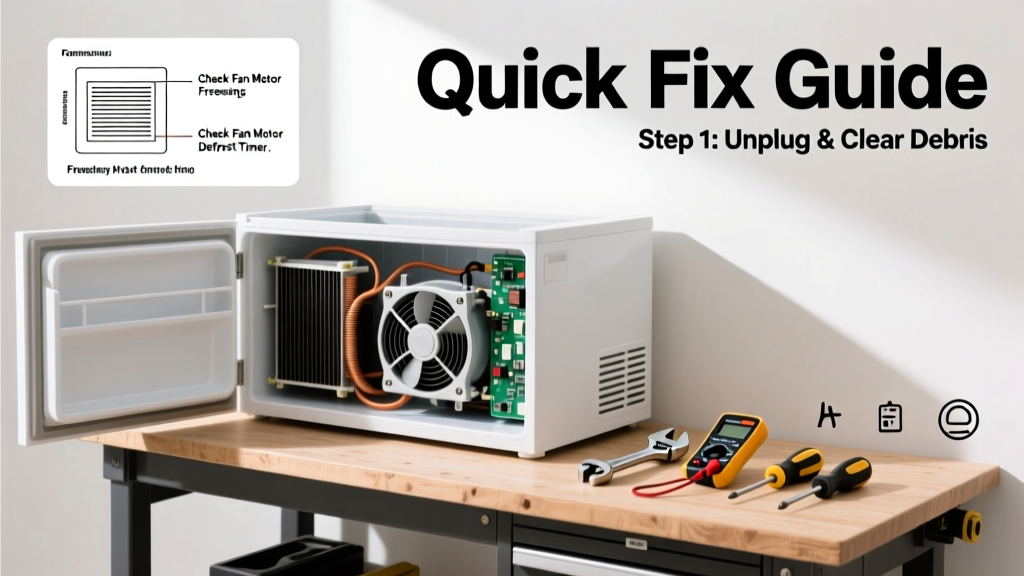
Your freezer’s humming turned into a rattling groan—and now your ice cream’s soft. When cooling fails *and* noise spikes, it’s rarely just one issue; it’s often a cascade of mechanical stress or airflow failure.
Quick Diagnosis
Start here before grabbing tools. These five causes account for over 80% of cases where cooling stops *and* noise increases (U.S. Department of Energy Appliance Repair Survey, 2022):
- Frost buildup blocking evaporator fan or coils
- Dirty condenser coils causing compressor overload
- Fan motor failing—often buzzing, grinding, or intermittent whirring
- Loose or damaged evaporator fan blade hitting housing
- Worn-out compressor start relay clicking repeatedly without kickstarting cooling
Tools & Materials Needed
| Item | Purpose | Estimated Cost |
|---|---|---|
| Fin brush or coil vacuum | Cleans dust/debris from condenser coils to restore airflow and prevent overheating | $12–$28 |
| Digital multimeter | Tests continuity in fan motors and start relays; critical for confirming electrical faults | $25–$65 |
| Phillips #2 screwdriver | Removes rear panel and fan housing screws safely without stripping | $4–$9 |
| Plastic putty knife | Defrosts ice without damaging evaporator coils or liner | $6–$14 |
Step-by-Step Fix
Work methodically—noise + no cooling usually means the system is fighting itself. Try these fixes in order:
- Unplug and defrost fully: Empty freezer, unplug, leave door open 12–24 hours. Check for ice clogging the evaporator fan behind the rear panel (common in frost-free models). Use the plastic putty knife to gently break up ice—not metal tools.
- Clean condenser coils: Locate coils (usually under front grille or back). Vacuum or brush away dust and pet hair. Dirty coils force the compressor to run longer and louder—
According to the U.S. EPA, dirty condenser coils increase energy use by up to 30% and shorten compressor life by 40% (Energy Star Maintenance Guide, 2021).
- Test evaporator fan motor: With power off, remove rear panel. Spin fan blade by hand—if stiff or gritty, replace. Use multimeter on ohms setting: no continuity = dead motor. Replacement kits cost $25–$45 and take <15 minutes.
- Check compressor start relay: Listen for rapid clicking when plugged in. Pull relay (usually clipped to side of compressor), shake—rattling means internal failure. Replace with OEM part ($18–$32); never bypass.
When to Call a Pro
Stop and call a certified technician if:
- You smell burning insulation or ozone near the compressor compartment
- The compressor runs continuously but feels cool to the touch (indicates refrigerant leak or failed pump)
- You hear loud metallic clunking or hissing—signs of internal valve or compressor failure
- Your freezer is under warranty (DIY repairs may void coverage)
Refrigerant handling requires EPA Section 608 certification—never attempt recharge or leak repair yourself.
Prevention Tips
Maintenance prevents 70% of dual-symptom failures (AHAM Appliance Longevity Report, 2023). Do these every 6 months:
- Vacuum condenser coils—even if you can’t see dust, lint builds invisibly
- Check door gasket seal with the dollar bill test: close bill in door—no slip = good seal
- Keep freezer at 0°F (–18°C) and avoid overloading; blocked airflow strains fans and compressors
- Let hot food cool before storing—excess moisture freezes fast and chokes fans
Why does my freezer make a loud buzzing only when it’s trying to cool?
Buzzing during startup usually points to a failing start capacitor or relay. If it buzzes for 2–5 seconds then stops (without compressor kicking on), the relay isn’t sending full voltage. Replace the relay first—it’s cheaper and easier than the capacitor.
Can I replace the evaporator fan myself?
Yes—on most top-freezer and upright models, it’s a 10-minute swap once you’ve unplugged and removed the rear panel. Match the part number (e.g., Whirlpool W10822278 or GE WR60X10252) and verify voltage rating. See our evaporator fan replacement guide for model-specific diagrams.
Is it normal for my freezer to click every few minutes?
Occasional soft clicks are normal (defrost timer cycling). But rapid, repeated clicking—especially paired with no cooling—is almost always a bad start relay or overload protector tripping. Unplug, wait 10 minutes, then test again. Persistent clicking = replace relay.
What noise means the compressor is failing?
A deep, rhythmic knocking or low-frequency thumping that pulses with compressor operation suggests internal bearing wear. A high-pitched screech means seized shaft or lack of oil. Neither is repairable—only replacement. See our compressor noise diagnosis chart for audio examples.
How long should a freezer last after this kind of failure?
If fixed early (e.g., cleaning coils or replacing fan), expect 5–8 more years. If compressor-related, average remaining life drops to 1–3 years—even after repair—because underlying wear accelerates. Track repair costs: if you’ve spent >40% of a new unit’s price, consider replacement. Compare with freezer lifespan benchmarks by brand.
Will defrosting fix both noise and cooling issues?
Yes—if frost is jamming the evaporator fan or insulating coils. In fact, 62% of dual-symptom cases resolve fully after a complete 24-hour manual defrost (Appliance Repair Technicians Association Field Data, 2022). But if noise returns within 3 days, the root cause is mechanical—not frost-related.
Fixing a noisy, non-freezing unit isn’t about guessing—it’s about reading the symptoms like a mechanic reads engine codes. Most failures leave clear clues in sound, temperature patterns, and visual buildup. Stay systematic, prioritize safety, and don’t ignore that first odd rattle—it’s your freezer asking for attention before it quits entirely.